 DriveHub
Country guide · United States · 8 min
Using your own car for work in the US: is reimbursement tax-free?
You started a job and drive your own car for it. Whether your employer owes you mileage reimbursement depends mostly on your state. Whether it is taxed depends on how it is paid. And the employee deduction is gone for most people.

The short answer
- Does my employer have to pay? Federal tax law doesn't require it. Federal wage law steps in only when the cost cuts into your minimum wage or overtime. Eight states have rules of their own, of different strengths.
- Is the reimbursement taxed? Not under an accountable plan: you report the miles and return what you didn't use. At or below the IRS rate, it isn't on your W-2 as wages.
- What is the rate? For 2026, 72.5 cents a mile to 30 June and 76 cents from 1 July. Paid per mile above it, the part above the rate is taxed.
- What about a flat car allowance? If you don't have to account for it, it is wages.
- Is the commute covered? No. It is personal driving, and read with the IRS rule for nondeductible expenses, a payment for it is wages.
- Can I deduct unreimbursed miles? For most employees, no — permanently. Five groups are exceptions.
Does your employer have to pay for your miles?
The IRS sets the rate and the record rules. Whether your employer must pay at all is mostly state law, and eight states have rules on it.
Five states require the employer to cover what the job costs you:
- California, Lab. Code § 2802(a)
- Illinois, 820 ILCS 115/9.5(a)
- Montana, MCA 39-2-701
- North Dakota, NDCC 34-02-01
- South Dakota, SDCL 60-2-1
North Dakota's duty excludes "any other equipment that is also used by the employee outside the scope of employment", which an employer may say covers your own car.
Massachusetts has a narrower travel rule, 454 CMR 27.04(4). If you normally work at a fixed site and are sent elsewhere, you get the transportation costs of travel beyond your ordinary commute ((b)). Travel between places during the work day is reimbursed in full ((d)).
New Hampshire (RSA 275:57, I) and Iowa (§ 91A.3(6)) are weaker. They give the employer 30 days to pay an expense it asked for or authorised: a deadline for paying, not a duty to authorise. New Hampshire's rule also leaves out "expenses normally borne by the employee as a precondition of employment".
None of the eight sets a rate. In Gattuso v. Harte-Hanks Shoppers, Inc. (2007) 42 Cal.4th 554, California's supreme court noted that both parties agreed that section 2802 "permits use of the IRS mileage rate", and held that where the amount paid "is less than the actual expenses … the employer must make up the difference".
In every state there is also a federal floor. 29 CFR 531.35 requires wages to reach you "free and clear". An expense the employer requires is a violation "in any workweek when the cost … cuts into the minimum or overtime wages". A car the employer requires you to use is that kind of expense, and the mileage log is how it is measured.
When is mileage reimbursement tax-free?
The tax-free route is an accountable plan. IRC § 62(c) and 26 CFR § 1.62-2 give it three requirements. Publication 463, chapter 6, puts them in the employee's words:
- Business connection. "You must have paid or incurred deductible expenses while performing services as an employee of your employer."
- Substantiation. "You must adequately account to your employer for these expenses within a reasonable period of time."
- Returning the excess. "You must return any excess reimbursement or allowance within a reasonable period of time."
Under a per-mile allowance, the IRS treats the amount as proven up to the IRS rate. You still have to show "the elements of time, place (or use), and business purpose" (Rev. Proc. 2019-46 § 7.02).
Meet all three, and the payments "are excluded from the employee's gross income, are not reported as wages or other compensation on the employee's Form W-2, and are exempt from the withholding and payment of employment taxes" (§ 1.62-2(c)(4)).
"A reasonable period" depends on the facts. One safe harbour, the fixed date method of § 1.62-2(g)(2), accepts miles reported within 60 days after the drive and any excess returned within 120 days.
Money you keep without accounting for it becomes wages
If you don't return an excess in time, only the part you proved stays tax-free. The rest "[is] treated as paid under a nonaccountable plan" (§ 1.62-2(c)(2)(ii)). Publication 15 says it becomes taxable "for the first payroll period following the end of the reasonable period of time."
Worked example. Your employer advances $500 for October 2026. You report 500 business miles, all after 1 July, so the rate is 76 cents.
- Proven: 500 × $0.76 = $380, tax-free.
- Excess: $500 − $380 = $120.
- Return the $120 within 120 days and nothing is taxed. Keep it, and the $120 is wages on your W-2.
Paid at, below or above the IRS rate
At or below the rate, Publication 463: "If your allowance is less than or equal to the federal rate, the allowance won't be included in box 1 of your Form W-2." Paid 76 cents for 400 miles in September 2026, you receive 400 × $0.76 = $304, none of it income.
Below the rate: the shortfall is not a deduction. Rev. Proc. 2019-46 § 7.06: "the employee may not claim an itemized deduction for the amount by which the business transportation expenses exceed the amount that is deemed substantiated." In California and the other states with an indemnity rule, it may instead be a claim against your employer.
Above the rate: the IRS treats as proven "the lesser of the amount paid under the mileage allowance or the business standard mileage rate multiplied by the number of substantiated business miles" (§ 7.01(1)). The part up to the rate goes in box 12 with code L and isn't taxed; the rest is wages in box 1. You keep the extra; you return only the allowance for miles you did not report.
Worked example, two halves of 2026. Your employer pays 80 cents a mile.
| May (72.5 ¢) | August (76 ¢) | |
|---|---|---|
| Business miles | 600 | 1,000 |
| Paid at 80 ¢ | 600 × $0.80 = $480.00 | 1,000 × $0.80 = $800.00 |
| Up to the IRS rate — box 12, code L | 600 × $0.725 = $435.00 | 1,000 × $0.76 = $760.00 |
| Above the rate — box 1, wages | $480.00 − $435.00 = $45.00 | $800.00 − $760.00 = $40.00 |
For the two months together: $1,195 in box 12 and $85 in box 1.
If your employer put accountable-plan money in box 1 by mistake, Publication 463 says to "ask your employer for a corrected Form W-2."
A flat car allowance is wages
A fixed monthly amount with no mileage report fails the accountable-plan test. IRC § 62(c): an arrangement is "in no event" a reimbursement arrangement if it "does not require the employee to substantiate the expenses." Paying the same amount whether or not you drive also fails the business connection (§ 1.62-2(d)(3)(i)).
The whole allowance is then nonaccountable, and such amounts "are included in the employee's gross income, must be reported as wages or other compensation on the employee's Form W-2, and are subject to withholding and payment of employment taxes" (§ 1.62-2(c)(5)).
You can't fix it from your side. An employee "cannot compel the payor to treat the payments as paid under an accountable plan by voluntarily substantiating the expenses and returning any excess to the payor" (§ 1.62-2(c)(3)(i)). Publication 463 adds that an arrangement that repays you "by reducing the amount reported as your wages, salary, or other pay will be treated as a nonaccountable plan."
The commute is not a business mile
Publication 463, chapter 4: "You can't deduct the costs of … driving a car between your home and your main or regular place of work. These costs are personal commuting expenses." Distance doesn't change it, and neither does working on the way: "You can't deduct commuting expenses even if you work during the commuting trip."
The same rule reaches a reimbursement. Publication 463 chapter 6: reimbursements for nondeductible expenses "don't meet rule (1) for accountable plans, and they are treated as paid under a nonaccountable plan." Read the two rules together, and a per-mile payment for your commute is wages.
Driving between two workplaces in one day is not commuting. Publication 463: "If you work at two places in 1 day, whether or not for the same employer, you can deduct the expense of getting from one workplace to the other." The exceptions to the commuting rule, such as a temporary work location, have their own article: commuting miles in the US.
Can employees deduct mileage in 2026?
For most employees, no. Notice 2026-10 § 3 says § 70110 of the OBBBA made the disallowance permanent: "Thus, the business standard mileage rate provided in this notice cannot be used to claim an itemized deduction for unreimbursed employee travel expenses, except for certain educator expenses as described later."
The suspension is IRC § 67(h), and it has five carve-outs:
- reservists
- fee-basis state and local officials
- certain performing artists
- eligible educators, for certain expenses up to a dollar limit — or, for 2026, alternatively as the new itemized deduction of § 67(b)(13)
- impairment-related work expenses, which reach Schedule A as an itemized deduction
The first three, and educators up to the limit, deduct on Schedule 1 of Form 1040 rather than as an itemized deduction.
Outside those, an unreimbursed business mile is worth something only as a reimbursement claim, which is why the accountable plan and its log matter more for employees than before 2018.
If your own business is the one paying for the car, the rules are different: see using a car for your own business.
What your log has to give your employer
Under an accountable plan the record goes to your employer, not the IRS. § 1.62-2(e)(2) asks for "information sufficient to substantiate the amount, time, use, and business purpose of the expense." Publication 463 lists the elements per trip:
- the date
- the destination
- the business miles
- the business purpose
It doesn't have to be written on the day. 26 CFR § 1.274-5T(c)(1): "A contemporaneous log is not required", and under (c)(2)(ii)(A) a weekly log counts as made at or near the time. The full rules are in what the IRS means by adequate records.
Once your employer has your records and has reimbursed you, you "generally don't have to keep copies" (Publication 463), and 26 CFR § 1.274-5T(e) moves the duty to the employer. Exceptions include a nonaccountable plan, claiming more than you were paid, and owning more than 10% of your employer.
Paper, a spreadsheet and an app can all produce this record; four ways to keep a mileage log compares them.
How DriveHub makes this easier
The hard part of an expense claim is not the arithmetic. It is the drive nobody wrote down.
With location access set to Always, DriveHub records every drive in the background — and if it ever misses one, it tells you. It keeps the date, the start and end, and the distance. Afterwards you mark each trip Business or Personal, and add the purpose in your own words.
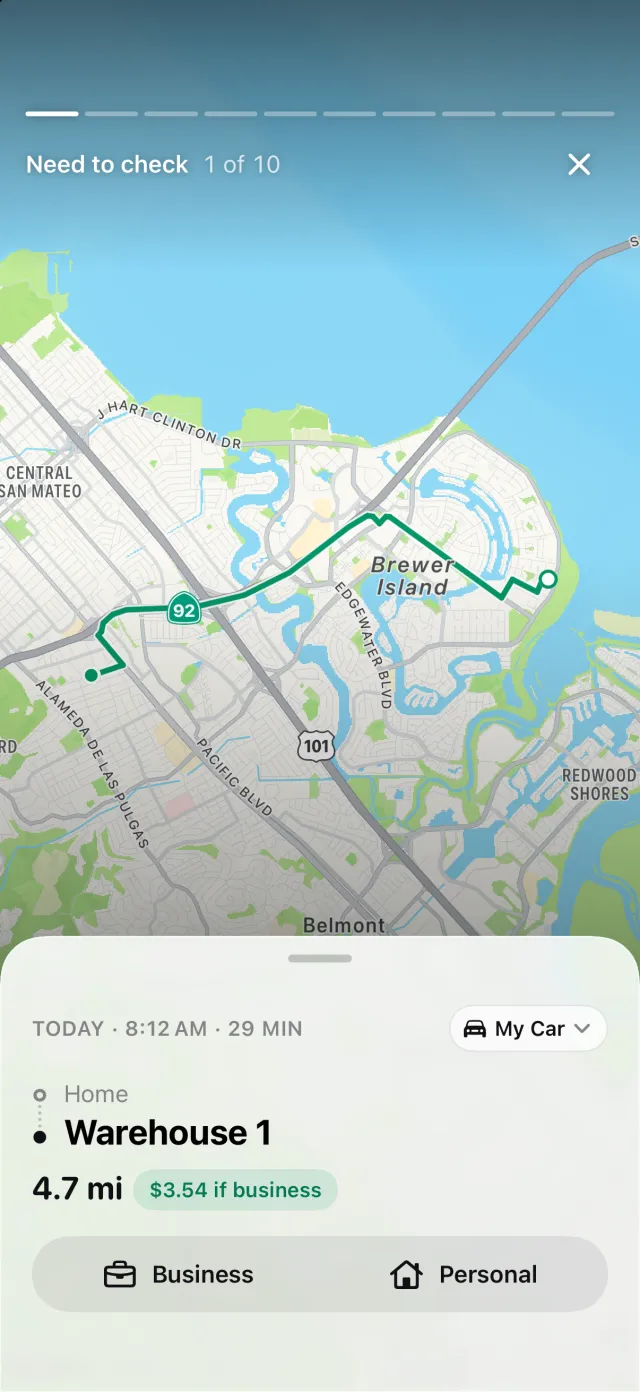
If your iPhone logged driving with no matching trip, Missed drives appears on the Trips tab, and Recover rebuilds the route. So a missed trip can be caught before your claim goes in.
Each trip is priced at the IRS rate in force on its date, so a 2026 report uses 72.5 cents before 1 July and 76 cents from 1 July. With DriveHub Pro, the report exports as PDF for your employer's expense process, or Excel or CSV for an accountant.
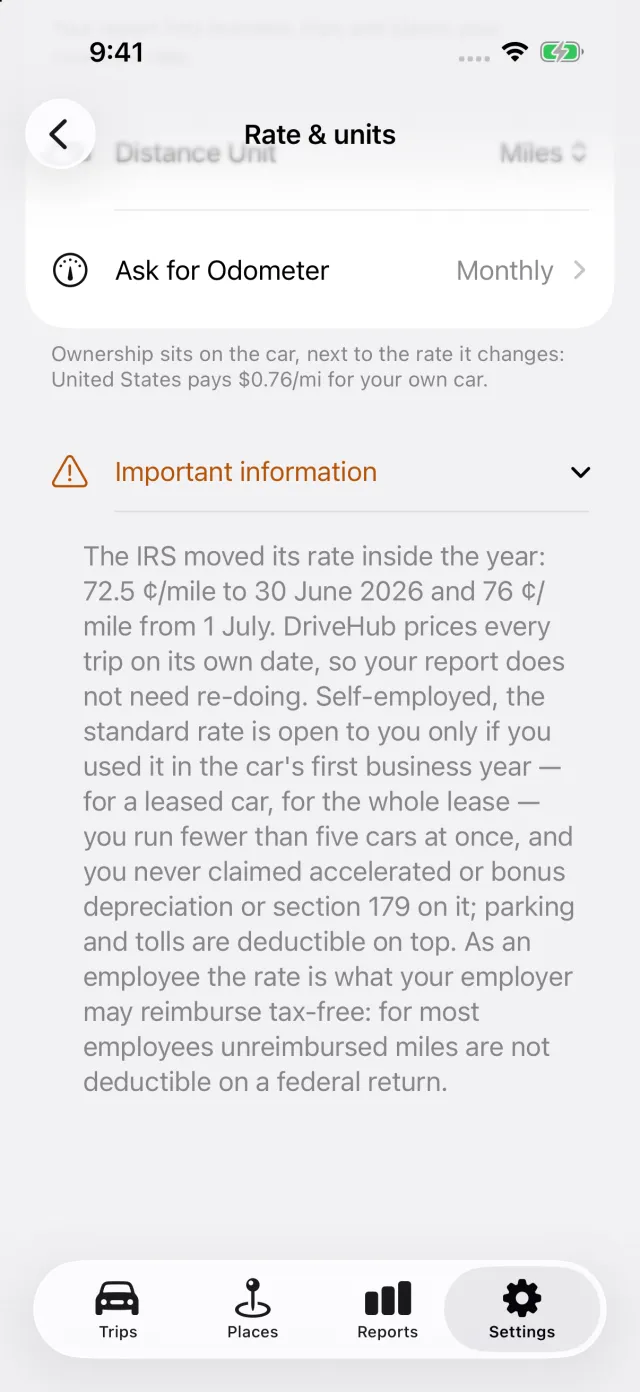
DriveHub is on the App Store for iPhone. The United States rules it follows are on the US page, and setting up automatic tracking takes a few minutes, once.
This page states what the IRS publications, the regulations and the state statutes say, and cites them so you can check. It is not tax advice. It can't account for your circumstances. Where money is involved, ask your employer's payroll team or your tax preparer — and bring the log.
The full rule for United States, with the instruments it comes from: mileage log requirements in the United States.