 DriveHub
Country guide · Germany
Vorsteuer on a mixed-use car, and the Umsatzsteuer you owe back on private use

Two sides of one rule
If a car is used for your business and privately, German VAT law gives you something and then asks for part of it back. You may deduct the Vorsteuer on the car's costs, but only if the car is assigned to the business. Private use of an assigned car is then treated as a service you supply to yourself, and it is taxed. This is the unentgeltliche Wertabgabe, in § 3 Abs. 9a Nr. 1 UStG.
The deduction is in § 15 Abs. 1 UStG and needs an invoice that meets §§ 14 and 14a. Insurance, vehicle tax and fines carry no VAT, so no Vorsteuer.
Below 10% business use the car cannot be assigned. § 15 Abs. 1 Satz 2 UStG says a thing used for "zu weniger als 10 Prozent" for the business is not treated as supplied for the business. No deduction on the car, and no VAT on private use.
The rate on private use is 19% (§ 12 Abs. 1 UStG).
Who the estimate is for
DriveHub's car-VAT estimate for Germany covers a sole trader or partnership that is a Regelbesteuerer with fully taxable turnover, for the calendar years 2025 and 2026. It follows the Umsatzsteuer-Anwendungserlass (UStAE) as of 2 June 2026, mainly Abschn. 15.23.
It does not calculate mixed taxable and exempt turnover (it says so instead of guessing) or corrections under § 15a UStG for later changes in use. A Kleinunternehmer under § 19 UStG deducts no Vorsteuer and owes no VAT on private use; DriveHub marks that as not applicable.
What DriveHub asks
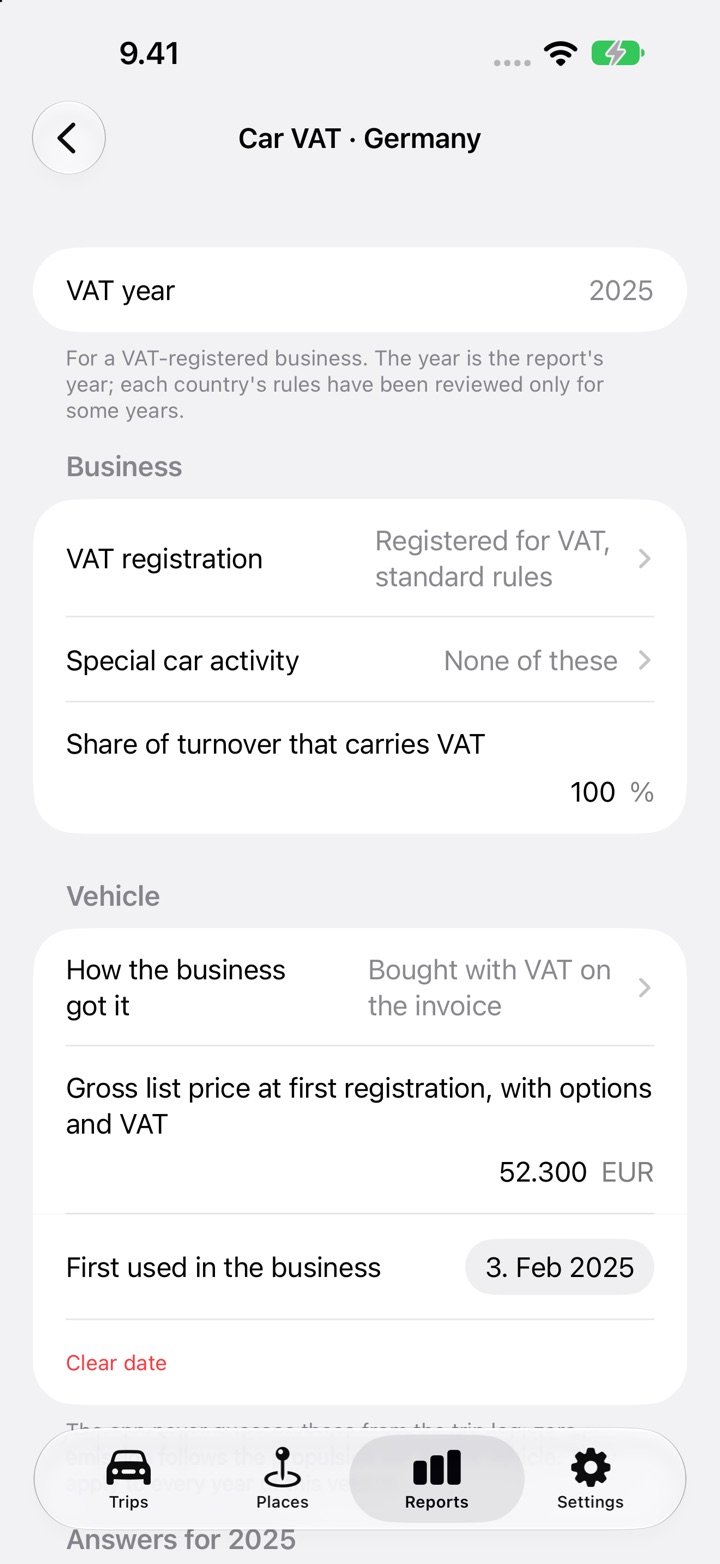
The setup screen is titled Car VAT · Germany. It asks:
- VAT registration, Special car activity, and the Share of turnover that carries VAT.
- How the business got it: bought with VAT on the invoice, bought without VAT (private seller, margin scheme), or leased or rented.
- Gross list price at first registration, with options and VAT, which only the 1 % method uses, and First used in the business, which dates the spread of the purchase price.
- Assigned to the business: In full, Business share only, or Not assigned. For a lease: Lease VAT, either "Deduct in the business share" or "Deduct in full and tax private use".
- Private-use method: 1 % method, Logbook or Estimate. Choose the one you use for income tax.
- Full-year distance from the odometer, and All of the year's car invoices are entered.
- Every invoice, entered with Add invoice: date, type, amount excluding VAT, and the VAT shown.
It never guesses an answer from the trip log. The result lists any answer still missing.
What it computes
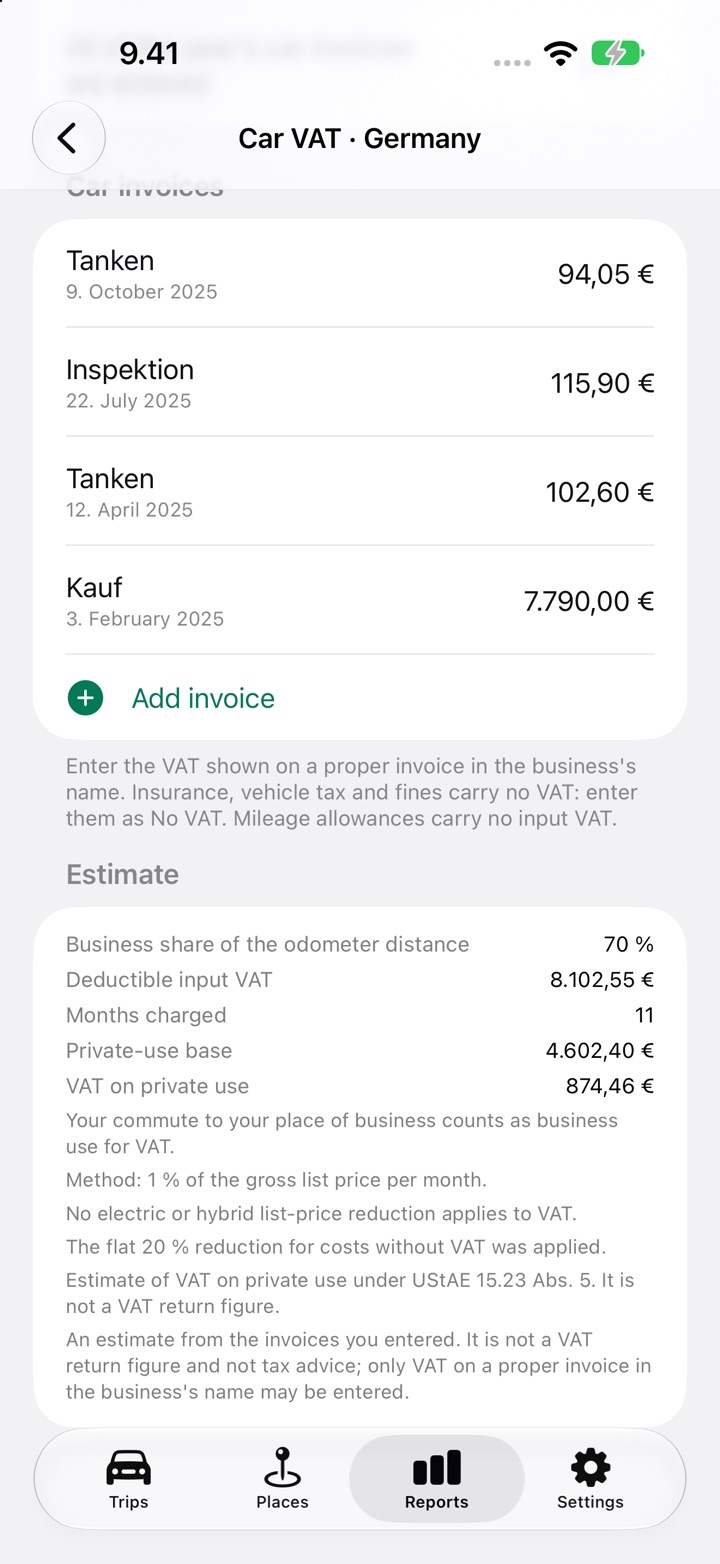
The Estimate section prints Deductible input VAT and VAT on private use, and the rule behind each.
Deductible input VAT. Assigned In full: all the VAT on a purchase invoice dated in that year, if the car was bought with VAT, plus all the VAT on running costs. Business share only: the same VAT times your business share of the odometer distance, and then private use is not taxed (UStAE 15.23 Abs. 3 Satz 4–5). A lease works the same way. Split by use, you deduct in the business share and owe nothing on private use (UStAE 15.23 Abs. 7). Deduct in full, and private use is taxed.
Business share. Business kilometres plus commute kilometres, divided by the full-year odometer distance. Your own commute to your place of business counts as business use for VAT (UStAE 15.23 Abs. 2 Satz 2). Odometer distance that is not in the log counts as private.
VAT on private use, by method:
- 1 % method. 1 % of the gross list price per month, times the months you enter, less a flat 20 % for costs without VAT if you say you apply it, times 19%. It needs more than 50 % business use, as for income tax (§ 6 Abs. 1 Nr. 4 Satz 2 EStG); below that DriveHub asks you to choose Logbook or Estimate. If the 1 % value was capped at actual costs for income tax, DriveHub refuses it for VAT and asks you to choose Logbook or Estimate. No electric or hybrid reduction applies.
- Logbook. The private share is the private part of the odometer distance.
- Estimate. With representative records, the private share is the one they show. Without them, it is no less than 50 %.
For Logbook and Estimate the VAT is 19% of the private share times the net amount of the year's running-cost and lease invoices that carried VAT, plus, for a car bought with VAT, the year's part of its net purchase price. A purchase price of EUR 500 or more is spread evenly over the five-year § 15a period (§ 10 Abs. 4 Satz 1 Nr. 2 UStG), so 60 months from first use. A first use on or before the 15th counts that month, and a later one starts the next (UStAE 15a.3 Abs. 1). A price below EUR 500 counts in full in the year of the invoice.
What it will not give you
- No figure before the year ends. The Germany estimate waits for the end of the calendar year, and for every trip of the year to be reviewed.
- No zero for missing invoices. With no invoice carrying VAT it shows "Insufficient data — no amount is stated."
- Not a return figure. The printed note says it is an estimate, not a VAT return figure and not tax advice. You still file the Voranmeldung and the annual return yourself.
How to do it in DriveHub
- Open Reports and choose the full calendar year. For a smaller range the card says to select a full year.
- On the car's Car VAT · Germany card, tap Set up car VAT, or Edit car VAT if you started before.
- Under Business, answer VAT registration, Special car activity and Share of turnover that carries VAT.
- Under Vehicle, set how the business got the car, the gross list price if you use the 1 % method, and the first-use date if you bought it with VAT.
- Under Answers for 2026, pick Assigned to the business and the Private-use method, then enter the odometer distance and answer the follow-up questions.
- Tap Add invoice for each car invoice, then switch All of the year's car invoices are entered to Yes.
- Read the Estimate section. The same block prints in the PDF and workbook.
Review every drive first, because the business share comes from your trips. For the income-tax side, see Fahrtenbuch or the 1% rule and a Fahrtenbuch written afterwards. More Germany guides are at /help/de.
This page states what the statute and the guideline say, and names them so you can check. It is not tax advice. It can't account for your circumstances. Where the money matters, ask your Steuerberater, and bring the invoices and the log.
The full rule for Germany, with the instruments it comes from: mileage log requirements in Germany.