 DriveHub
Country guide · United Kingdom · 7 min
Self-employed mileage in the UK: 55p a mile or actual costs
You're self-employed in the UK and the car you drive for the business is your own. HMRC gives you two ways to claim it: simplified expenses, a flat rate per business mile, or the business share of what the car actually costs. Both start from the same log.

The short answer
- Two routes. Simplified expenses: a flat rate per business mile. Or actual costs: the business share of running costs, plus capital allowances on the car.
- The flat rate for 2026-27 is 55p a mile for the first 10,000 business miles and 25p after. Before 6 April 2026 it was 45p and 25p. A motorcycle is 24p.
- One 10,000-mile band covers all your cars and vans together, not one band per vehicle.
- Parking, tolls and congestion charges go on top of the flat rate. Fines never do.
- The choice is per vehicle, and it sticks. Once a car is on the flat rate, it stays there until you replace it. A car you've claimed capital allowances on can never use it.
- Which is better? HMRC gives no break-even. The flat rate is simpler and fixed per mile; actual costs can pay more for a car that is expensive to buy or run. If you've already claimed capital allowances on this car, the choice is made: actual costs.
- Who can use it: sole traders and partnerships of individuals. Not a limited company, and not a partnership with a company as a partner.
- Home to your usual base isn't business travel, on either route.
- The log is the claim. HMRC wants "a contemporaneous record of business mileage".
Who can use the flat rate
The flat rate is in the Income Tax (Trading and Other Income) Act 2005, Part 2, Chapter 5A. It is income tax on trading profits, so a limited company can't use it: its profits are charged to corporation tax. Professions and vocations can, as trades do.
It is optional, works with or without the cash basis, and HMRC's Business Income Manual, BIM75001, adds: "There is no business income limit to using simplified expenses."
The statute is wider than gov.uk's wording. Under s. 94C, if any partner at any time in the period "was not an individual", the whole firm is out for that period.
The rates for 2026-27
Parliament raised 45p to 55p with effect from 6 April 2026 (Taxation (Energy and Vehicles) Act 2026 s. 2). gov.uk and HMRC's manual print both columns:
| Vehicle | 2026-27 | Before 6 April 2026 |
|---|---|---|
| Car or goods vehicle, first 10,000 miles | 55p | 45p |
| Car or goods vehicle, after 10,000 miles | 25p | 25p |
| Motorcycle | 24p | 24p |
The figure can move again. HMRC's policy paper of 17 June 2026: "AMAPs and simplified mileage rates are currently under review, as announced in March 2026 and will be set out at Budget 2026." That Budget is on 28 October 2026.
How the amount is worked out
The deduction is business miles times the rate, for each vehicle. But the 55p band is shared: once the business miles of all your flat-rate cars and vans pass 10,000 in the period, the rest go at 25p (s. 94F(3)–(4)). Motorcycle miles sit outside the band at 24p. An identifiable part of a journey counts too, if that part is made "wholly and exclusively" for the business (s. 94F(5)).
Two vehicles, one band (illustrative). In 2026-27 you drive 7,000 business miles in your car and 5,000 in your van, both on the flat rate.
- Total: 7,000 + 5,000 = 12,000 miles
- First 10,000 × 55p = £5,500
- Remaining 2,000 × 25p = £500
- Deduction: £5,500 + £500 = £6,000
Counting each vehicle's band separately would give 12,000 × 55p = £6,600. That's £600 too much.
If your accounts don't end on 5 April
The band runs over your period of account, and a period can straddle 6 April 2026. HMRC prices the whole period at each tax year's rates and then apportions. Its example in BIM75005, 12,000 miles to 31 December 2026, gives £5,000 for the 2025-26 computation and £6,000 for 2026-27. That computation is yours or your accountant's.
What the flat rate covers, and what goes on top
The rate replaces the car's real costs: buying it, fuel, oil, servicing, repairs, insurance, vehicle excise duty, MOT and depreciation (BIM75005).
Costs of a particular journey stay outside it. BIM75005 names "tolls, congestion charges and parking fees": they are deductible on top "where they are incurred solely for business purposes." Fines never are. gov.uk: "You cannot claim for: non-business driving or travel costs; fines or penalty charges; travel between home and work".
There is no bicycle rate for the self-employed; the 20p cycle rate is for employees only. Passengers don't change it either: "The number of people in the vehicle does not affect the rates."
Which vehicles qualify
gov.uk lists them: "cars (except those designed for commercial use, for example, black cabs, hackney carriages or dual control driving instructors’ cars); goods vehicles (for example, vans); motorcycles". A van has no weight limit.
The choice is per vehicle, and it sticks
gov.uk: "Once you use the flat rates for a vehicle, you must continue to do so as long as you use that vehicle for your business." BIM75005: "The business can only change to or from an ‘actual’ basis when a vehicle is replaced."
So your car can be on the flat rate and your van on actual costs, but neither can switch while you keep it.
Capital allowances close the door the other way
A vehicle you have ever claimed capital allowances on can't go on the flat rate. gov.uk: "You cannot claim simplified expenses for a vehicle you’ve already claimed capital allowances for, or you’ve included as an expense when you worked out your business profits." BIM75005 gives the reason: "This is because the rate already contains an element to allow for depreciation."
The other route: actual costs plus capital allowances
BIM75005: "Instead, the business proportion of the actual costs of running and maintaining the vehicle may be claimed as an allowable deduction in calculating the profits of the trade or profession, alongside capital allowances."
The law allows the part of a mixed expense that is "wholly and exclusively" for the trade (ITTOIA s. 34(2)). The mileage log is what identifies that part. No source prescribes the formula; business miles divided by all miles is the obvious one.
Private use cuts the capital allowances to the business share too (CAA 2001 ss. 206–207). The rates, from gov.uk's Capital allowances: business cars, for cars bought from April 2021:
- 100% first-year allowance for a new, unused car with 0 g/km, or electric. For income-tax payers this ends on 5 April 2027, unless extended.
- 14% a year (main rate) for 50 g/km or less. It was 18% before April 2026.
- 6% a year (special rate) for over 50 g/km.
Cars can't take the annual investment allowance. Vans and motorcycles can.
An actual-cost year (illustrative: a 12-month period of account starting on or after 6 April 2026). You drive 12,000 miles in the year, 9,000 of them for the business. Fuel, insurance, servicing and repairs come to £4,000.
- Business share: 9,000 ÷ 12,000 = 75%
- Running costs allowed: £4,000 × 75% = £3,000
- Capital allowances come on top. On a £20,000 car at the 14% main rate, the year's allowance is £20,000 × 14% = £2,800. If 75% is the just and reasonable share, you claim £2,800 × 75% = £2,100.
The same 9,000 miles on the flat rate would give 9,000 × 55p = £4,950. One year doesn't settle it: the answer depends on the car, its price and the miles over the years you keep it, and no HMRC source gives a break-even point.
On the cash basis you can still use the flat rate, but only for a vehicle you haven't claimed capital allowances on or deducted the purchase of.
Which journeys are business miles
On both routes, only journeys made "wholly and exclusively" for the trade count. The employee rules on permanent and temporary workplaces don't apply to you; the self-employed test is different.
BIM37605: "The cost of travelling from home to place of work is generally disallowed", even if you sometimes work or keep your records at home.
The exception is the itinerant trader whose base of operations is home: travel between home and the sites where they work is allowed (BIM37620).
Mixed trips are out too. BIM75005: the rate "is not available for private journeys, such as travel from home to work, or for journeys that serve both a business and a private purpose." If you're an employee as well, the employee test is in commuting or a temporary workplace.
What to record, and for how long
The claim is business miles times the rate, so the business miles are the record. gov.uk says simply: "Keep records of your business miles for vehicles". BIM75005 is sharper: "It is therefore important that a contemporaneous record of business mileage is maintained to support any claim using the flat rate." On the actual-cost route, the same log proves the business share.
No HMRC text sets the fields for a sole trader. What it asks employees to show is a good model: the date, the reason for each journey, the start and end postcodes and the miles. That lets each business mile be substantiated. gov.uk's rule for Self Assessment records is short: "There are no rules on how you must keep records." But "HMRC can charge you a penalty if your records are not accurate, complete and readable."
Keep the records for at least five years after the 31 January submission deadline for the tax year (TMA 1970 s. 12B(2)(a)) — longer if HMRC has opened an enquiry into that return. For 2026-27, that deadline is 31 January 2028, so keep the log until at least 31 January 2033. The six years often quoted is the VAT rule.
Paper, a spreadsheet and an app can all produce this record; four ways to keep a mileage log compares them. If you're employed and drive your own car for an employer, the rules are different: see own car for work in the UK. How the band works for employees with two jobs is in postcodes and the 10,000-mile band.
How DriveHub makes this easier
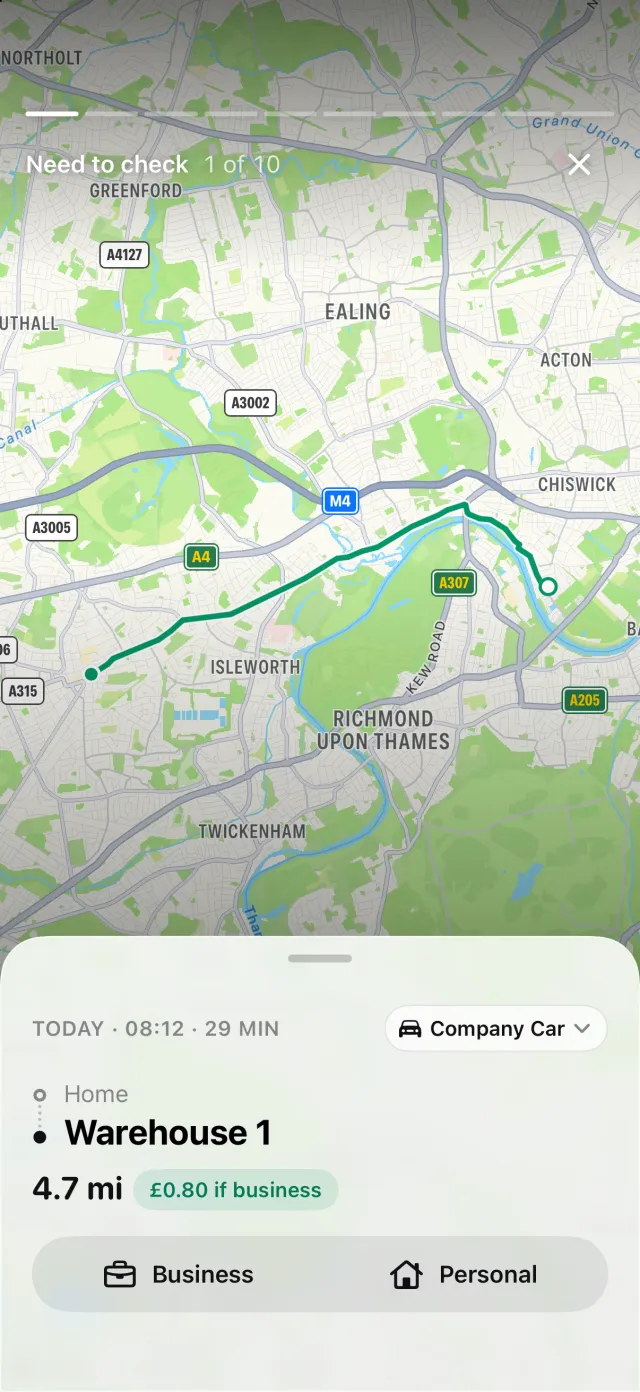
With location access set to Always, DriveHub records every drive in the background — and if it ever misses one, it tells you. Each trip keeps its date, where it started and ended, and the distance. Afterwards you mark it Business or Personal, and add the reason in your own words.
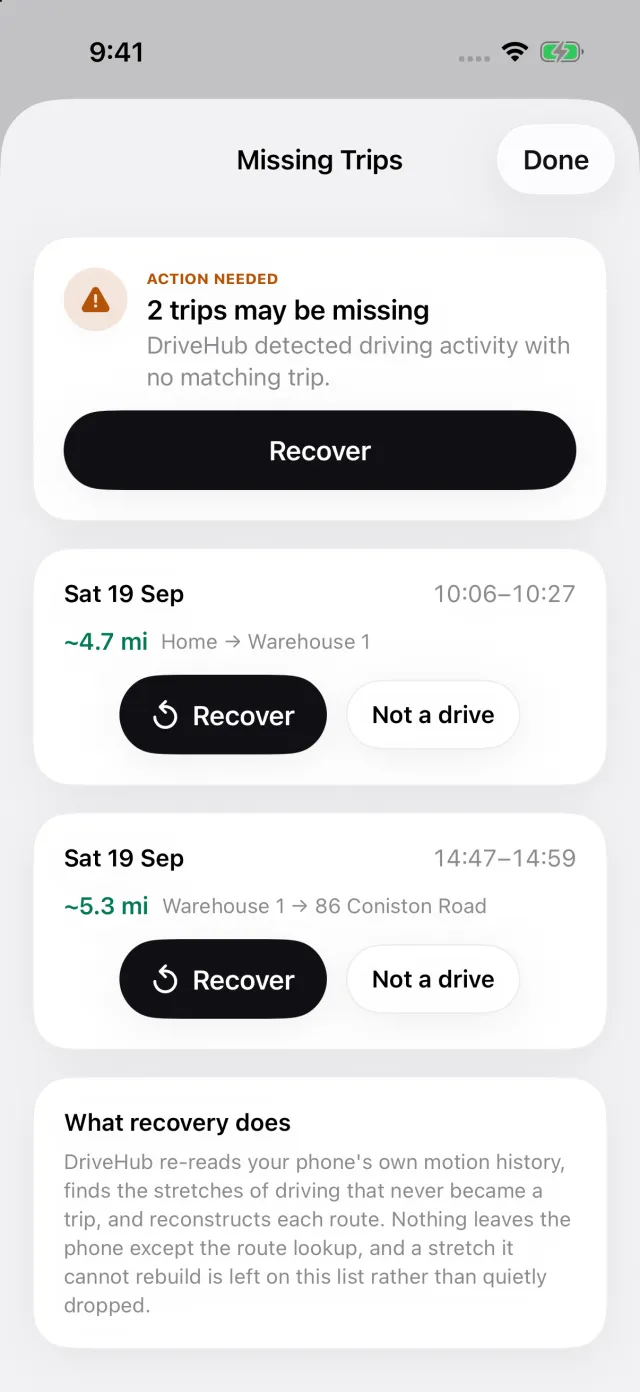
If your iPhone logged driving that DriveHub has no trip for, a Missed drives story appears on the Trips tab. It opens Missing Trips: each gap has Recover, which rebuilds the route, and Not a drive. You see the gap before the return goes in.
A report covers any day, week, month, quarter or year, or a range you choose, such as your period of account. It gives the business and personal miles, and with Pro exports as PDF, Excel or CSV for your accountant. The business-mile total is the M in the flat-rate formula for your cars and vans, and the business share on the actual-cost route.
Where DriveHub stops: it doesn't file your Self Assessment return, work out capital allowances or decide which route suits your car. It doesn't record parking, tolls or congestion charges. DriveHub prices each trip at the rate for its day. For a period of account that straddles 6 April 2026, HMRC's two-rate computation is different, and it's yours or your accountant's. And it reports only drives it recorded.
DriveHub is on the App Store for iPhone. The UK rules it follows are on the UK page, and setting up automatic tracking takes a few minutes, once.
This page states what HMRC and the legislation say, and cites them so you can check. It is not tax advice. It can't account for your circumstances. Where money is involved, ask your accountant — and bring the log.
The full rule for United Kingdom, with the instruments it comes from: mileage log requirements in the United Kingdom.