 DriveHub
Country guide · Malta · 7 min
A company car in Malta is taxed on its value, not your kilometres, unless you drive point to point
Malta's company-car fringe benefit is a formula on the car's value, and no distance goes into it. The one route where your journeys decide the figure is the point-to-point 0 % band, and it needs the Commissioner's written approval.

The short answer
If your employer gives you a company car in Malta, the fringe benefit is worked out from the car's value. Your kilometres do not enter the formula. A mileage log does not lower the figure, and the Fringe Benefits Rules, S.L. 123.55, do not ask the employer for one.
There is one exception. Under rule 14(2), the private-use rate drops to 0 % on three conditions. The car is worth 16 310 € or less. It is used "wholly or mainly for point to point services by an employee who is a salesman or a support person". And the Commissioner approves in writing. That is the case where your journeys matter, and a record of them is the evidence you can point to.
How the normal company-car benefit is valued
Rule 10 adds three values together and then multiplies the total by a private-use percentage. Every step is a percentage of the car's value:
- Use value, rule 11(1): "17% of the vehicle value" if the car is not more than six years old, and 10 % after that. The six years run from first registration, "whether in Malta or outside Malta" (rule 11(2)).
- Maintenance, rule 12(1), and fuel, rule 13(1): 3 % of the vehicle value each if the value does not exceed 28 000 €, and 5 % each above it. A car worth exactly 28 000 € takes 3 %.
- Maintenance is fixed. It applies "regardless of the cost actually incurred", even where you pay some or all of it yourself (rule 12(2)).
- Fuel can be zero. It is 0 € where you pay all your fuel and are not reimbursed (rule 13(3)). Where fuel is paid other than against receipts, the fuel value is also 0 €, but those payments are a separate benefit under rule 17 (rule 13(4)).
- Private-use percentage, rule 14(1): set by the vehicle value alone, not by age or by use:
| Vehicle value | Private use |
|---|---|
| 16 310 € or less | 30 % |
| over 16 310 €, up to 21 000 € | 40 % |
| over 21 000 €, up to 32 620 € | 50 % |
| over 32 620 €, up to 46 600 € | 55 % |
| over 46 600 € | 60 % |
The vehicle value (rule 15) is the invoice price including taxes and delivery, plus discounts not generally available and fitted accessories. For a leased, second-hand or own-stock car it comes from the Commissioner's price list.
There is no passenger supplement anywhere in S.L. 123.55.
A worked example
A car with a vehicle value of 25 000 €, three years old, the employer paying the fuel against receipts:
- Use value: 17 % × 25 000 € = 4 250 €
- Maintenance: 3 % × 25 000 € = 750 € (the value is under 28 000 €)
- Fuel: 3 % × 25 000 € = 750 €
- Total: 4 250 € + 750 € + 750 € = 5 750 €
- Private use: 25 000 € falls in the band over 21 000 € and up to 32 620 €, so 50 %
- Fringe benefit: 50 % × 5 750 € = 2 875 € a year
Nothing in that chain is a kilometre. Drive 5 000 km or 50 000 km in that car and the figure is the same.
What the employer keeps instead: a fleet register
For a company car, the employer keeps a fleet register covering every car it owns, hires or leases, "irrespective of whether they use them to provide fringe benefits". For each car, the Malta Tax and Customs Administration's guidelines list:
- the registration number, make and model;
- the year of first registration, and for a second-hand import also "the year of first registration outside Malta";
- the value when new;
- whether the car is "owned by the employer, or leased or hired";
- the beneficiary, "indicating also if he is a salesman or support person";
- where the car is garaged, "if car is garaged/kept overnight by the employer".
It has no distance field at all.
Where the car sleeps counts, not how far it goes
Rule 9(2) says private use "shall be deemed" in any of four circumstances:
- (a) the car is at your exclusive disposal;
- (b) it is regularly available to you outside duty hours;
- (c) it is "regularly kept overnight or during weekends…in any place which is not the business premises of the provider of the benefit or within 100 meters thereof";
- (d) it is regularly used for purposes not directly linked with your employment.
That is a deeming, and the Rule gives no general way to argue it down with evidence. It gives two exits only:
- Rule 9(3): paragraph (c), and only (c), does not apply to an employee required to use the car "wholly in the performance of his duties as a messenger or a driver". The guidelines narrow this to drivers "not permitted to use the vehicle outside working hours".
- Rule 9(4): use is not private if the Commissioner determines that it is an official use.
The guidelines warn: "Penalties will apply in cases where the private use element of cars is not properly certified."
Again, the test in (c) is a place, not a distance. And a car approved under rule 14(2) is still presumed to be used privately; the private use is simply valued at 0 %.
The point-to-point 0 %: three conditions
Rule 14(2) sets the private-use rate at 0 % where all three hold:
- (a) The vehicle value "does not exceed €16,310".
- (b) The car is "used wholly or mainly for point to point services by an employee who is a salesman or a support person in the performance of his duties", or for "such other similar services as may be approved by the Commissioner".
- (c) The Commissioner "approves in writing the applicability of this rule to that case".
With the 0 %, the private-use multiplier in rule 10 is zero, so the car's fringe-benefit value under rule 10 is 0 €.
What "point to point" means
The Rule does not define it. The guidelines give a presumption, not a test: a point-to-point service "is presumed to exist when the relevant car is heavily used for business purposes such as in the case when an employee is required to deliver goods or services or provide transport to clients and other employees".
No percentage or distance threshold for "mainly" or "heavily used" appears in the Rules, the guidelines or the government's service page. "Wholly or mainly" is a description of how the car is actually driven. It is the one place in Malta's company-car rules where the journeys themselves are the question. The Rule does not name a record for it. A log of each journey, with its purpose and destination, is the evidence of that pattern you can put in front of somebody.
Who applies, and on what
The guidelines say "the employer is required to apply". The government service page is titled "Fringe Benefits - Application for a Reduced Rate for Point to Point Service or Delivery". It gives eligibility as "Employers.", the method as "Fill in the online form and submit.", and delivery of service as "1 day". The guidelines call this application Form FB2. The form itself sits behind an eID or corporate login, so what it asks and what evidence it wants are not public.
0 % or 20 %? The Rule wins
The tax authority's own guidelines disagree with themselves here. The point-to-point text says the private-use rate is reduced to 0 %, and so does the current service page. The description of Form FB2 in the guidelines' appendix says 20 %.
The Rule settles it. Rule 14(2) itself sets 0 %, and rule 47(1) gives the guidelines effect only "to the extent that they are not in conflict with any rules prescribed". Where the guidelines say 20 %, they conflict with the Rule, and the Rule's 0 % governs.
Vans, motorcycles and heavy vehicles
Rule 16 says private use of a van, a motorcycle, a vehicle over 3 500 kg or a vehicle adapted for a severely disabled person "shall be deemed to have no value". Rule 8 takes those out of the definition of a "vehicle". If your work vehicle is one of these, the percentages above do not apply to its private use.
How long to keep the records
No rule names a point-to-point record. But rule 48(1) requires "proper and sufficient records" to determine "the categorisation, valuation and tax treatment" of a benefit, and the 0 % changes the valuation. Records showing "wholly or mainly" point-to-point use therefore fall under rule 48, and rule 48(3) says they "shall be kept for a period of not less than 6 years". That is an inference from the Rule's general wording, not a passage that names these records.
Your own car instead
If you drive your own car for work and are paid per kilometre, it is a different regime with a different edge. The reimbursement escapes fringe-benefit treatment only up to 35 cents a kilometre, and only with a log of each journey's purpose, destination and distance. Fail one condition and the whole payment is in charge. See Malta's 35 cents is all or nothing, and for the columns themselves, a mileage log template for Malta.
Paid a cash car allowance instead? See car allowance or mileage allowance in Malta. If you are a director driving for your own company, see director mileage in Malta.
Before the employer applies for the 0 %
- Check the car's value against 16 310 €.
- Check that the driver is a salesman or support person, and that the fleet register says so.
- Know whether the car is used wholly or mainly point to point, and be able to show it journey by journey.
- The employer applies online; the 0 % needs the Commissioner's written approval.
- Note where the car is kept overnight and at weekends, because of rule 9(2).
- Keep the records for at least six years (rule 48, by inference).
How DriveHub makes this easier
For the ordinary company car, DriveHub changes nothing in the fringe-benefit figure, since that comes from the car's value. Where it helps is the point-to-point case, where the journeys are the evidence.
With location access set to Always, DriveHub records every drive in the background — and if it ever misses one, it tells you. DriveHub files most trips as Business or Personal by your places, past routes and working hours, and asks you about the rest under Need to check.
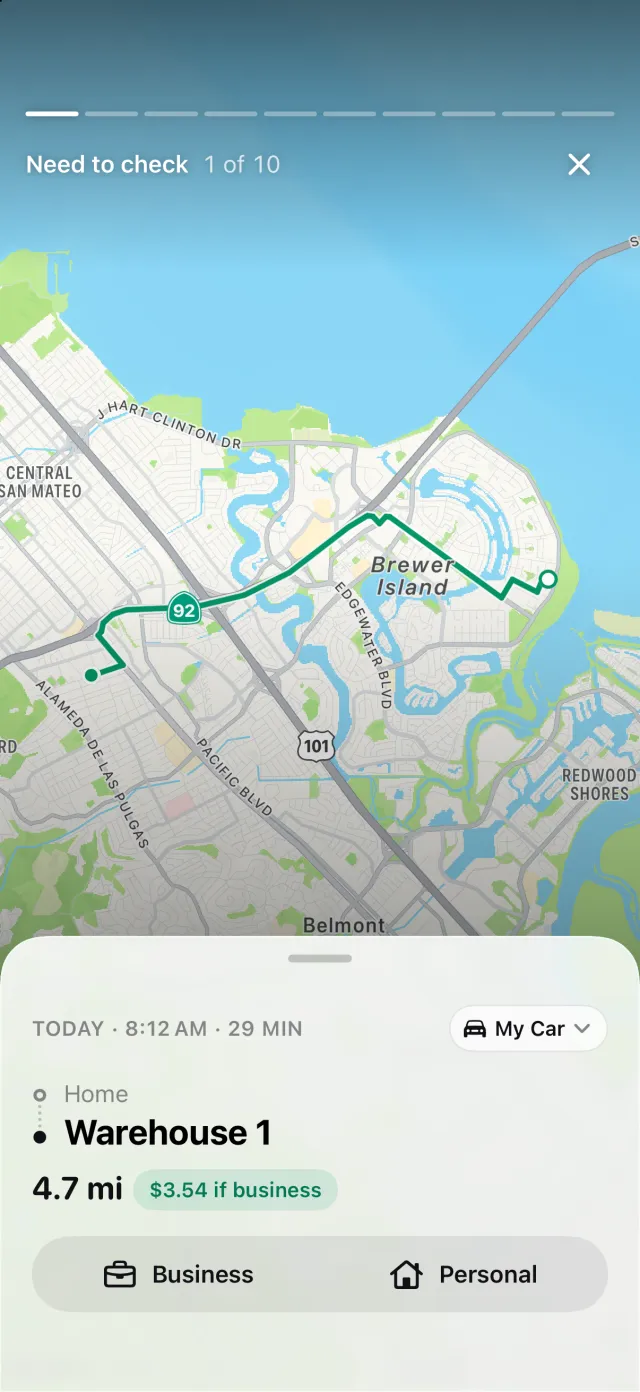
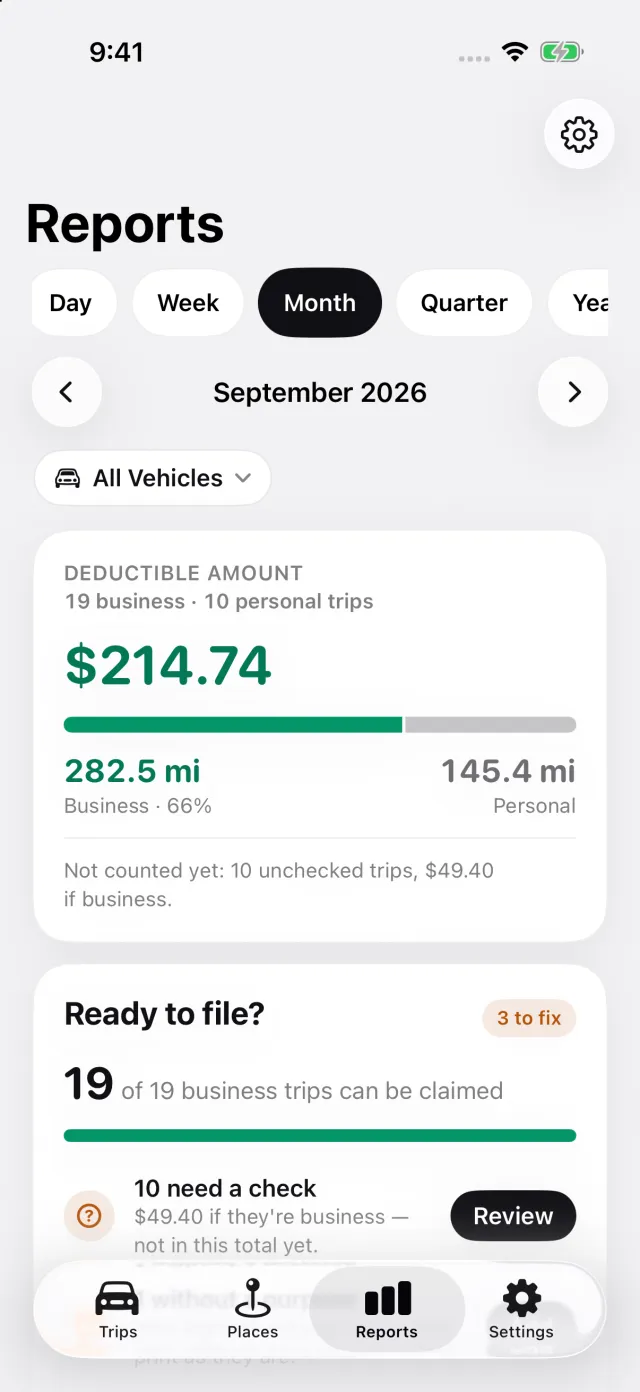
For Malta, the report prints all three items on every row: the purpose you entered in your own words, the destination and the distance. Reports shows the business and personal split for a day, week, month, quarter or year, so how much of the car's driving is business has numbers behind it.
Where DriveHub stops: it does not know the car's value, it does not calculate the fringe benefit, and it does not decide whether your driving counts as point to point. It does not apply for the reduced rate or send anything to your employer or the Commissioner. Exporting a report needs DriveHub Pro.
DriveHub is on the App Store for iPhone. The Malta rules are on the Malta page. Setting up automatic tracking takes a few minutes, once.
This page states what the Rules themselves say, and names the rule so you can check. It is not tax advice. It can't account for your circumstances. Where money is involved, ask your accountant — and bring the log.
Do it in DriveHub
File business and personal trips →
Review suggestions, set working hours and check place rules.
The full rule for Malta, with the instruments it comes from: mileage log requirements in Malta.