 DriveHub
Country guide · Malta · 7 min
Director mileage from your own Malta company: the 35 cents still needs a log
A director's mileage claim in Malta follows the same 35-cent rule as an employee's, because the tax authority's guide reads "employee" to include a company officer. So your company keeps the log, and one missing journey makes the whole payment a fringe benefit.

The short answer
Yes, your own Malta company can reimburse you per kilometre for business use of your own car. The reimbursement escapes fringe-benefit tax on the same terms as an employee's:
- The payment covers only business use.
- It is worked out from the distance actually covered, at no more than 0,35 € per kilometre.
- The company has logged the purpose, destination and distance of each journey.
- The log is "readily available at any time" and kept for at least six years.
Fail any one and the whole reimbursement is a fringe benefit, not just the excess. For a director in a controlling position, nothing then comes off it.
For a controlling director, this per-kilometre route with a log is the only untaxed way to be paid for the car: a flat car allowance from your own company is taxed in full.
One honest caveat. This rests on the Malta Tax and Customs Administration's guide reading "employee" to include an officer. No ruling, circular or court case was found that deals with a director's per-kilometre claim directly.
A director is an "officer", not an "employee"
The Fringe Benefits Rules, S.L. 123.55, define two different people in rule 2(1):
- "'employee' means an individual who performs services under a contract of employment whether written or not with another person"
- "'officer' means the holder of an office and includes also an individual who - (a) is a director of a company; or (b) holds directly or indirectly more than 5% of the ordinary share capital or of the voting rights in a company; or (c) is a partner in a partnership"
The Rules still catch what your company pays you. A benefit from a company to its officer is "deemed to be provided by reason of an employment or office" (r. 3(1)(b)). A vehicle allowance to "an individual" is a benefit (r. 17(1)), and r. 17(2)(a) defines one as "any payment to that individual relating to the use of his vehicle whether by way of reimbursement of costs or otherwise". Rule 18(1) values it at "the total amount so paid".
The gap is in the exemption. Rule 18(5), the 35-cent rule, speaks of "costs incurred by the employee", "the employer's business" and "the employer has logged". Read alone, its words do not reach a director who has no contract of employment.
The guide closes the gap, with the effect r. 47(1) gives it
The tax authority's Fringe Benefits Tax Guide closes it in terms. Page 3:
"References in these guidelines to 'employee' include a reference to an officer … In the case of benefits provided to an officer, references in these guidelines to 'employer' include a reference to the company or partnership of which that beneficiary is an officer"
And page 2:
"In respect of benefits provided to an officer of a company or a partnership, the company or partnership has the same obligations for fringe benefits purposes as an employer even if the officer is not engaged under a contract of employment."
This is not only guidance. Rule 47(1)(a) gives guidelines that "give a definition of any term or an interpretation of any provision" the same effect as the Rules, "to the extent that they are not in conflict with any rules prescribed".
So the guide's per-kilometre conditions apply to you as a director paid by your own company, logbook included. Your company is the "employer" that keeps the log.
The four conditions, as the guide words them
Page 14 of the guide, "Reimbursements on rate per kilometre basis", sets out the conditions:
- "the rate of payment for each kilometre travelled does not exceed 35 cents per kilometre,"
- "payments only cover the business use element,"
- "all reimbursable travel is recorded in a logbook readily available at any time for verification by the CfR, and"
- "the log book is retained by the employer for at least 6 years."
Rule 18(5)(c) names what the log holds: "the employer has logged the details to which any such reimbursement refers, including the purpose, destination and distance of each journey". A blank log with those columns is in Malta's mileage log template.
The six years are hard law as well. Rule 48(1) puts the record duty on "every company and partnership that … makes any payment in cash or in kind to any employee or an officer", and r. 48(3) says the records "shall be kept for a period of not less than 6 years."
What happens if a condition fails
The guide ends the per-kilometre conditions plainly: "If any one of these conditions is not met, the full reimbursement value will be considered as a fringe benefit and will be subject to the same valuation criteria as a car cash allowance."
That valuation starts from the whole amount. A 50 % reduction, capped at 1 170 € a year, can come off it only where the r. 18(2) conditions hold, and one of them is that "the beneficiary is not a person in a controlling position". For a controlling director, the failed reimbursement is therefore taxed in full.
The trap is the same one employees face, explained in Malta's 35 cents is all or nothing. A controlling director simply has no 50 % cushion under it.
Are you in a "controlling position"?
Rule 2(2) puts a person in a controlling position if any one of these applies:
- "(a) he is an individual who holds directly or indirectly 25% or more of the ordinary share capital or the voting rights in that company or in an associated company;"
- (b) your holding, together with your family's holdings, exceeds 50 %;
- "(c) he is an individual who is a director of that company or of an associated company but is not registered with the competent authority set up under the Employment and Training Services Act as a whole time employee with that company or with an associated company."
The guide (p. 3) says "full time employee" where the Rule says "whole time".
A director who owns 25 % or more of the company is in a controlling position under (a), whatever else is true. So is a director who is not registered as a whole-time employee, under (c), even with a small holding.
Why a flat car allowance does not work for you
A flat car cash allowance is the other way to be paid for the car. Its value is cut by 50 %, capped at 1 170 € a year, only where the three conditions of r. 18(2) hold, and (b) excludes anyone in a controlling position. The guide (p. 13) goes further and excludes every director, and ends: "When any of the above conditions is not met the full cash allowance is taxable."
So for a controlling director, a flat allowance from your own company is taxed in full, under the Rule and the guide alike. The per-kilometre reimbursement at or under 35 cents, with the log, is "deemed to have no value". For a director who is not in a controlling position, the Rule and the guide disagree on the allowance. That conflict, and how the two routes compare in figures, is in car allowance or mileage allowance in Malta.
A worked year
Say you drive 1 200 business kilometres in a year in your own car, and hold all the shares. The company pays your mileage as one reimbursement at the end of the year.
- Reimbursed at 0,35 €, with every journey logged: 1 200 × 0,35 € = 420 €. Every condition holds, so the reimbursement is deemed to have no value.
- Same 420 €, one journey missing from the log: a condition fails, so the whole 420 € is a fringe benefit. You hold 25 % or more, so there is no 50 % reduction. All 420 € is in charge.
- Reimbursed at 0,36 € instead: 1 200 × 0,36 € = 432 €. The rate exceeds 35 cents, so all 432 € is a fringe benefit, not the 12 € above the ceiling.
- A flat allowance of 100 € a month instead: 12 × 100 € = 1 200 € a year. You are in a controlling position, so the full 1 200 € is taxable.
Your company may have to register as an employer
The guide (p. 6) treats a company that gives its officers fringe benefits as an employer even with no staff: "any company or partnership that provides fringe benefits to its officers, even though it may not have any employees, is considered to be an employer by the Office of the Commissioner for Revenue. Such persons, companies and partnerships are therefore to register as employers with the CfR and must obtain a PE number to enable the lodgement of FS3, FS5 and FS7 documents as required."
That applies when the reimbursement is a fringe benefit, for example after a condition fails. Whether a fully compliant reimbursement at or under 35 cents, which has no value, by itself triggers registration is not stated.
Two limits worth knowing
Not every vehicle qualifies. Rule 8 takes a van, a motorcycle and a vehicle over 3 500 kg out of the definition of a vehicle. The 35-cent rule is for a vehicle, so a mileage payment for your own van or motorcycle has no safe harbour.
No dedicated ruling. Everything above rests on the guide's definitions clause and r. 47(1)(a), not on a statement written about directors' mileage. If your situation is unusual, take the guide's pages 2, 3 and 14 to your accountant.
Before your company pays you mileage
- Every reimbursed journey is in the log, with purpose, destination and distance. A blank Malta log (PDF) has those columns.
- The payment is worked out from the kilometres actually driven, at no more than 0,35 € each.
- Only business journeys are paid.
- The company can produce the log at any time, and keeps it for six years.
- You know whether you are in a controlling position, because a failure then costs the whole amount.
How DriveHub makes this easier
As a director you are both sides of the rule: you drive, and your company must hold the log. A short journey on a busy day is the easiest one to leave out of a log. On this rule, leaving out one puts the whole reimbursement into charge.
With location access set to Always, DriveHub records every drive in the background — and if it ever misses one, it tells you. DriveHub files most trips as Business or Personal by your places, past routes and working hours, and asks you about the rest.
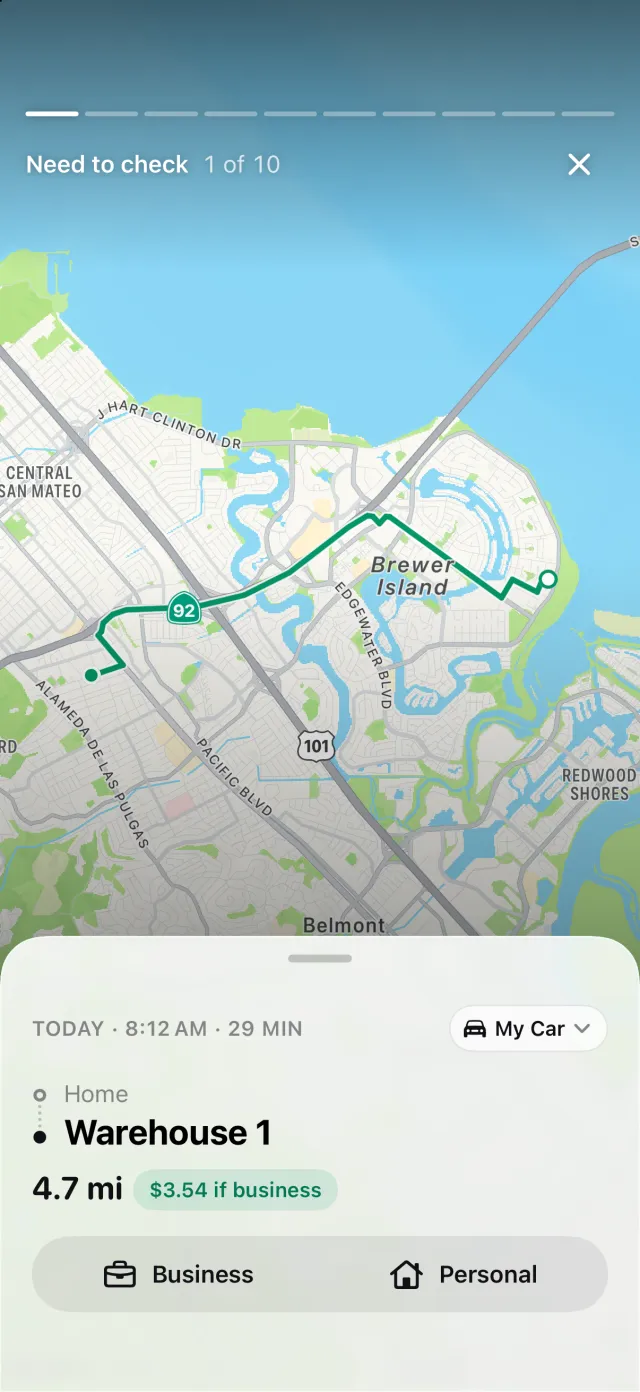
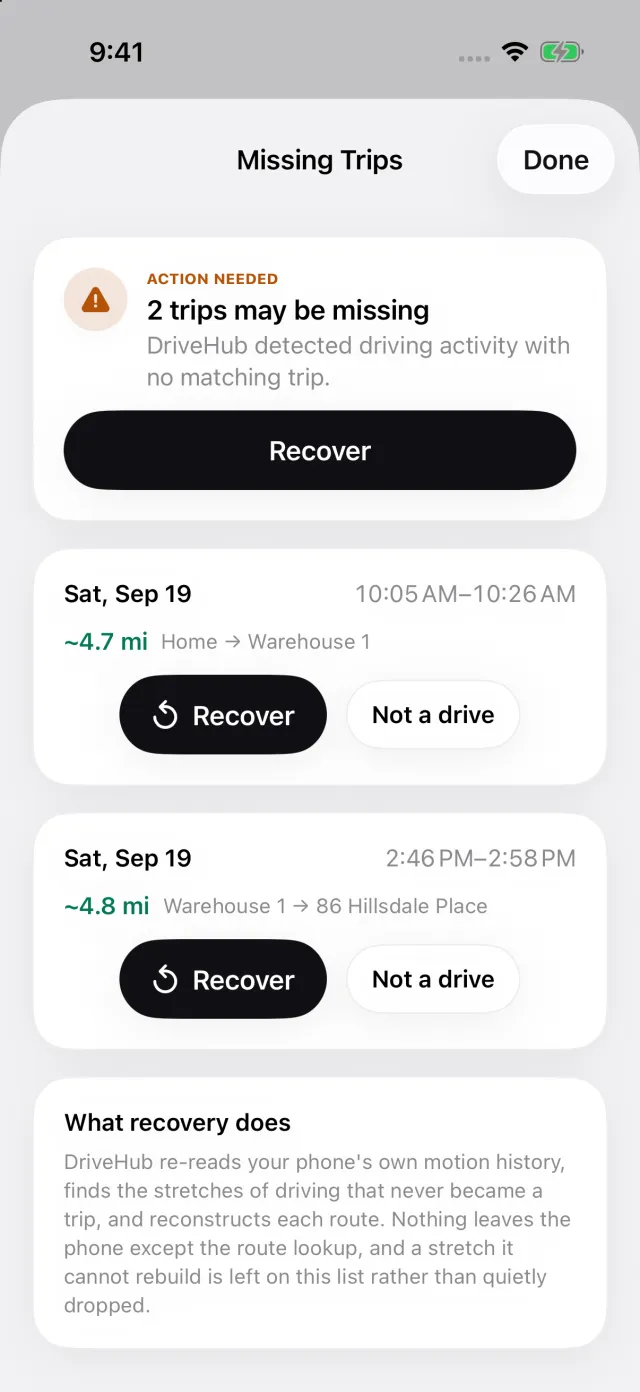
If your iPhone logged driving with no matching trip, a Missed drives story appears on the Trips tab. It opens Missing Trips, where each drive has Recover, so a journey can be put back before the company pays you.
For Malta, the report prints all three prescribed items on every row: the purpose in your own words, the destination and the distance. On a report for one car, the driver and the plate print once in the header. DriveHub does not decide whether you are in a controlling position, register your company or file anything. Tracking and the missing-drive check are free; the report is part of DriveHub Pro.
DriveHub is on the App Store for iPhone. The Maltese rules it follows are on the Malta page, and setting up automatic tracking takes a few minutes, once.
This page states what the Rules themselves say, and names the rule so you can check. It is not tax advice. It can't account for your circumstances. Where money is involved, ask your accountant — and bring the log.
Do it in DriveHub
Employment dates, different rates and trips for more than one job.
The full rule for Malta, with the instruments it comes from: mileage log requirements in Malta.