 DriveHub
Country guide · Malta · 5 min
Malta's mileage log has three fields: a template and how to fill it
A mileage log template for Malta needs three columns, because Malta's Fringe Benefits Rules name three items: the purpose, destination and distance of each journey. Here is the blank log, and what goes in each column.

The short answer
Malta's mileage log is the record an employer keeps when it pays an employee per kilometre for business use of the employee's own car. The Fringe Benefits Rules, S.L. 123.55, name its contents in rule 18(5)(c): "the employer has logged the details to which any such reimbursement refers, including the purpose, destination and distance of each journey".
So a Malta log has three columns that matter: purpose, destination, distance. The Rule says "including", so these three are the minimum it names, not a complete list. Every reimbursable journey goes in it. It must be "readily available at any time" for verification, and kept for six years.
A blank log with exactly those columns is free to download: Malta mileage log (PDF), printable on A4, or the same log as a CSV for Excel or any spreadsheet.
Why the log exists at all
Rule 18(5) lets a per-kilometre reimbursement for business use of an employee's own car be "deemed to have no value" — no fringe benefit — only where all its conditions hold:
- The travel is business use
- The reimbursement is "made by reference to the distance actually covered at a rate not exceeding 35 cents per kilometre"
- The employer has logged the purpose, destination and distance of each journey
The Malta Tax and Customs Administration's guidelines add a fourth: the log is "readily available at any time". Fail any one and the whole reimbursement is a fringe benefit, not just the part above the ceiling. That trap has its own article: Malta's 35 cents is all or nothing.
The log is therefore not paperwork beside the reimbursement. It is one of the conditions that keeps the reimbursement out of tax.
The three columns, one by one
Purpose of the journey. Why this drive was business. One condition of r. 18(5) is that the travel is business use, and the purpose is the column that shows it. "Client meeting, quarterly review" says why you drove; "Meeting" says much less.
Destination. Where the journey went: the client's address, the site, the supplier. Name the place clearly enough that someone reading the log later can tell where you were.
Distance (km). The kilometres the journey actually covered. Rule 18(5) ties the reimbursement to "the distance actually covered", so this column is what the payment is calculated from. Record the kilometres you drove, not an estimate.
A date is not one of the three items the Rule names. The template has a Date column marked optional, because a dated row is easier to match to the reimbursement it supports.
A filled-in week
An illustrative week: three round trips from an office in Valletta, reimbursed at the ceiling of 0,35 € per kilometre. The places and distances are an example.
| Date (optional) | Purpose of the journey | Destination | Distance (km) |
|---|---|---|---|
| Mon 5 Oct | Client meeting, quarterly review | Client's office, Mosta | 24 |
| Wed 7 Oct | Site inspection, warehouse fit-out | Ħal Far industrial estate | 31 |
| Fri 9 Oct | Collecting samples from a supplier | Supplier's premises, Qormi | 17 |
Total distance: 24 + 31 + 17 = 72 km. At 0,35 €, the reimbursement is 72 × 0,35 € = 25,20 €.
Every row has all three items, and the payment is worked out from the distance column at a rate that does not exceed 35 cents.
Who keeps the log, and for how long
The employer. Rule 18(5)(c) says "the employer has logged" the details, so the record the Rule asks for is the employer's, whoever writes the rows.
Readily available at any time. That condition is about being able to produce the log for verification, not about what is in it.
Six years. S.L. 123.55 rule 48(3): "All records referred to in this rule and all supporting documents… shall be kept for a period of not less than 6 years." Rule 48(2)(a) brings in the rule 18(5)(c) log, so the six years are law, not guidance.
When this template is not the right record
A company car. The 35-cent rule is for an employee's own car. For a car the employer provides, Malta values the benefit as a percentage of the car's value, and what the employer keeps is a fleet register with no distance field. The case where the kilometres do matter, point-to-point driving by a salesman or support person, is in a company car in Malta and point-to-point use.
A van, a motorcycle or a vehicle over 3 500 kg. Rule 8 takes these out of the definition of a vehicle, so a mileage payment for them has no 35-cent safe harbour at all.
Self-employed. Rule 18(5) is about an employer reimbursing an employee. A self-employed person has no per-kilometre figure anywhere in Malta's Income Tax Act. What is left is the actual cost, under art. 14(1). Your own records are kept nine years, counted per transaction: ITMA art. 19(5), "after the completion of the transactions, acts or operations to which they relate."
A flat car allowance. Paid a flat car allowance instead of per kilometre? See car allowance or mileage allowance in Malta.
Before you hand in the log
- One row for every journey the reimbursement covers, with no journey paid that is not in the log.
- Purpose, destination and distance filled in on every row.
- Distances are the kilometres actually driven.
- The rate does not exceed 0,35 € per kilometre.
- The employer can produce the log at any time, and keeps it for six years.
How DriveHub makes this easier
The template's columns are easy. Filling them is not, for the journeys nobody wrote down: the short drive on a busy day, or the purpose of a visit eight months ago. On this rule, one missing journey is not a small gap.
With location access set to Always, DriveHub records every drive in the background — and if it ever misses one, it tells you. It records business and personal drives alike, with the phone in your pocket. DriveHub files most trips as Business or Personal by your places, past routes and working hours, and asks you about the rest.
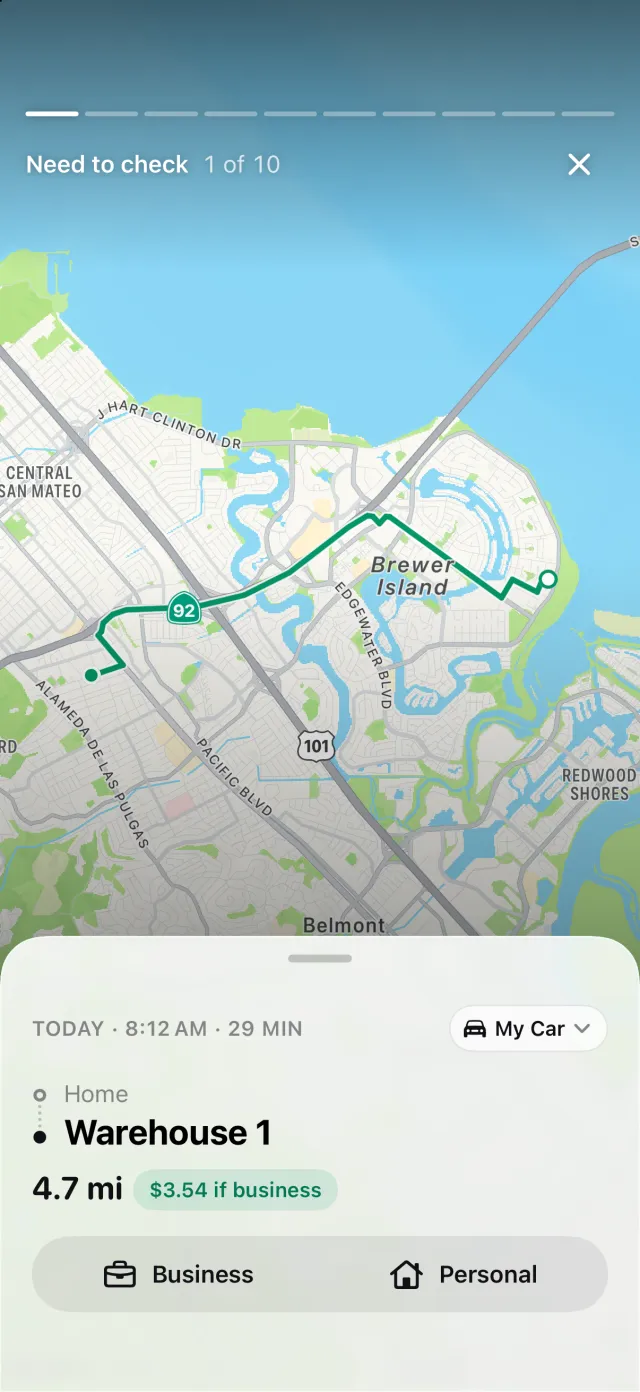
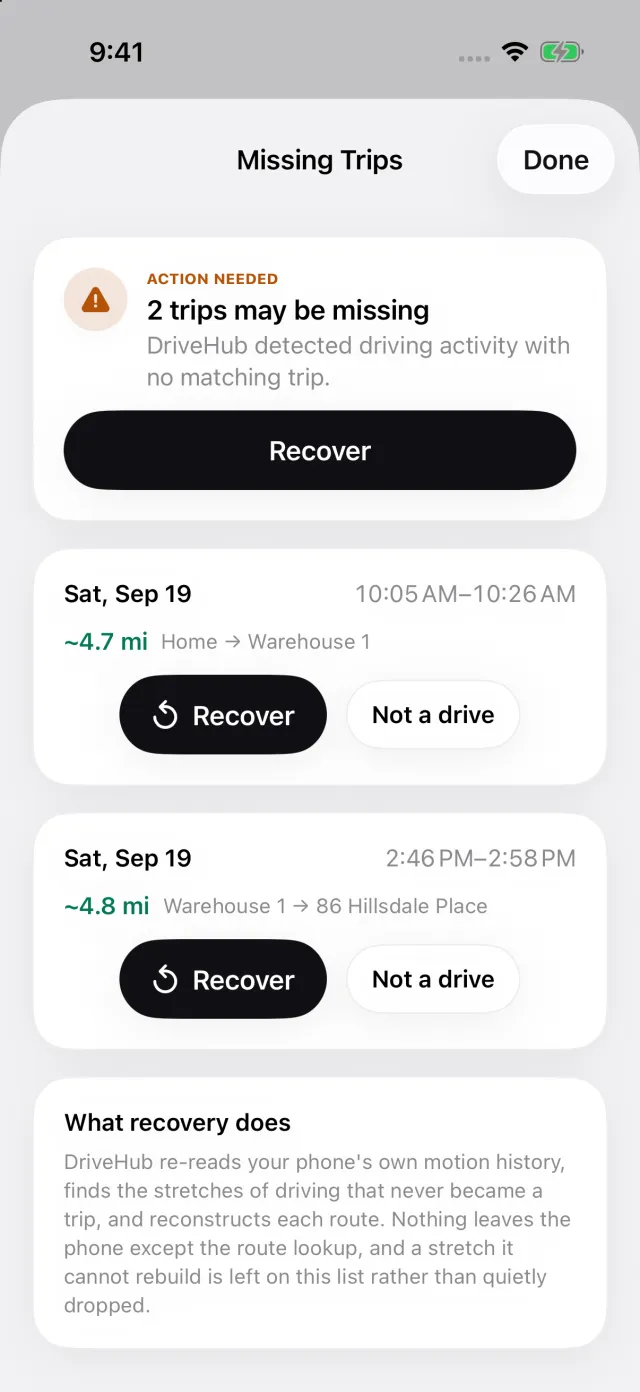
If your iPhone logged driving with no matching trip, a Missed drives story appears on the Trips tab. It opens Missing Trips, where each drive has Recover, so a journey can be put back before the log goes to the employer.
For Malta, the report prints all three prescribed items on every row: the purpose in your own words, the destination and the distance. The identity block names the employee the log belongs to, once you enter the name in the report settings. Tracking and the missing-drive check are free; the report is part of DriveHub Pro.
DriveHub is on the App Store for iPhone. The Maltese rules it follows are on the Malta page, and setting up automatic tracking takes a few minutes, once. For paper, spreadsheets and apps compared, see four ways to keep a mileage log.
This page states what the Rules themselves say, and names the rule so you can check. It is not tax advice. It can't account for your circumstances. Where money is involved, ask your accountant — and bring the log.
Do it in DriveHub
Add your document identity and review which fields appear in the PDF.
The full rule for Malta, with the instruments it comes from: mileage log requirements in Malta.