 DriveHub
Country guide · Germany · 8 min
Dienstreise mit eigenem Auto: €0.30 for every kilometre, and what you must be able to show
Dienstreise mit eigenem Auto absetzen — you drive your own car to clients, sites or another branch, and German tax law values each of those kilometres at €0.30, both ways. Your employer may pay that much tax-free, and whatever it doesn't pay goes on your tax return. Neither needs a Fahrtenbuch, but both need a record.

The short answer
- The rate. €0.30 per kilometre for a car, €0.20 for any other motor vehicle such as a motorcycle (§ 9 Abs. 1 Satz 3 Nr. 4a EStG with § 5 Abs. 2 BRKG). This is what is usually called the Kilometerpauschale for business trips.
- Which kilometres. Every kilometre actually driven on the business trip, there and back. Not the one-way distance the commute uses.
- Higher costs? Not a higher rate. The alternative is your car's actual cost, apportioned by kilometres (R 9.5 Abs. 1 LStR).
- From your employer. Kilometergeld up to €0.30 per km is tax-free under § 3 Nr. 16 EStG. Anything above it is Arbeitslohn.
- On your tax return. Whatever your employer did not pay, up to €0.30 per km, is Werbungskosten. It changes your tax only where all your Werbungskosten together pass the €1,230 Arbeitnehmer-Pauschbetrag.
- What you must show. The business reason, the duration and the route of each trip, recorded and backed by suitable documents (R 9.4 Satz 5 LStR). A Fahrtenbuch is one example of such a document, not a condition.
- Company car? Then no €0.30 at all, neither tax-free nor as Werbungskosten.
Where the €0.30 comes from
The statute doesn't print the figure. § 9 Abs. 1 Satz 3 Nr. 4a EStG makes Werbungskosten of "Aufwendungen des Arbeitnehmers für beruflich veranlasste Fahrten, die nicht Fahrten zwischen Wohnung und erster Tätigkeitsstätte im Sinne des Absatzes 4 sowie keine Familienheimfahrten sind."
Satz 2 then lets you skip the actual costs: the trips may be valued "mit den pauschalen Kilometersätzen …, die für das jeweils benutzte Beförderungsmittel (Fahrzeug) als höchste Wegstreckenentschädigung nach dem Bundesreisekostengesetz festgesetzt sind."
The figure is in the civil-service travel law. § 5 Abs. 2 Satz 1 BRKG: "beträgt die Wegstreckenentschädigung 30 Cent je Kilometer zurückgelegter Strecke." For any other motor vehicle, § 5 Abs. 1 Satz 2 sets "20 Cent je Kilometer zurückgelegter Strecke". The other conditions in § 5 BRKG apply only to civil servants; the EStG takes over the rate alone.
The BMF's travel-expense letter of 25 November 2020, Rz. 37, states the figures outright: "PKW 0,30 €, für jedes andere motorbetriebene Fahrzeug 0,20 €", "für jeden gefahrenen Kilometer". And: "Eine Prüfung der tatsächlichen Kilometerkosten ist demnach nicht mehr erforderlich, wenn der Arbeitnehmer von dieser gesetzlichen Typisierung Gebrauch macht."
Every kilometre, both ways
The rate is per kilometre gefahren — driven — not per kilometre of distance. H 9.5 LStH counts as travel costs the trips "zwischen Wohnung oder erster Tätigkeitsstätte und auswärtiger Tätigkeitsstätte … einschl. sämtlicher Zwischenheimfahrten". It also counts trips "zwischen mehreren auswärtigen Tätigkeitsstätten oder innerhalb eines weiträumigen Tätigkeitsgebietes".
Illustrative figures. You drive from home to a client 42 km away and back the same day. That is 84 km × €0.30 = €25.20.
The commute works the other way. The Entfernungspauschale is €0.38 per full kilometre of the one-way distance, once per day at your erste Tätigkeitsstätte, and it covers all car costs of that trip. Which drives are which is the most expensive mix-up here:
- Home → client, not touching the office: a business trip at €0.30 per km driven.
- Home → office, then office → client: home to the office stays a commute, even if you went there only to set off (H 9.10 LStH). Office → client is the business trip.
Where your erste Tätigkeitsstätte is, and when you have none, is in commute or business trip: the erste Tätigkeitsstätte. The commute itself is in the Pendlerpauschale 2026.
The alternative is actual cost, not a higher rate
If €0.30 doesn't cover what your car costs, there is no higher flat rate. There is only the actual figure. R 9.5 Abs. 1 Satz 3 LStR: "Benutzt der Arbeitnehmer sein Fahrzeug, ist der Teilbetrag der jährlichen Gesamtkosten dieses Fahrzeugs anzusetzen, der dem Anteil der zu berücksichtigenden Fahrten an der Jahresfahrleistung entspricht."
That needs the car's total costs for the year and its total kilometres, so that the business share can be worked out. A per-km figure computed from twelve months of costs may then be used "bis sich die Verhältnisse wesentlich ändern" (Satz 4). Satz 5 keeps the flat rate open as the alternative.
H 9.5 LStH ("Einzelnachweis") lists what the Gesamtkosten include: fuel, maintenance, repairs, a garage at home, Kfz-Steuer, insurance, loan interest and depreciation, "i. d. R. eine Nutzungsdauer von 6 Jahren". Accident costs, parking and tolls are not in them; they are Reisenebenkosten.
On top of the €0.30, only the unforeseeable. H 9.5 ("Pauschale Kilometersätze") allows "etwaige außergewöhnliche Kosten" beside the flat rate. That means "nur die nicht voraussehbaren Aufwendungen für Reparaturen, die nicht auf Verschleiß … oder die auf Unfallschäden beruhen", and theft damage. Comprehensive insurance is not such a cost, and a Leasingsonderzahlung is already covered by the flat rate.
What you must be able to show
You don't need an ordnungsgemäßes Fahrtenbuch for your own car. That requirement belongs to the valuation of a company car's private use. It appears nowhere in § 9 EStG.
The rule for business trips is R 9.4 Satz 5 LStR:
"Die berufliche Veranlassung der Auswärtstätigkeit, die Reisedauer und den Reiseweg hat der Arbeitnehmer aufzuzeichnen und anhand geeigneter Unterlagen, z. B. Fahrtenbuch (>R 8.1 Abs. 9 Nr. 2 Satz 3), Tankquittungen, Hotelrechnungen, Schriftverkehr, nachzuweisen oder glaubhaft zu machen."
Two steps: you record (aufzeichnen), and you prove or make credible (nachweisen oder glaubhaft machen). The Fahrtenbuch is named only as one example of a suitable document, beside fuel receipts, hotel bills and correspondence.
In practice, a line per trip with these covers the three items the guideline names:
| What R 9.4 asks for | What to write down |
|---|---|
| Reiseweg (the route) | date, where you started, where you went, the kilometres driven |
| berufliche Veranlassung (the business reason) | the purpose and whom you visited, e.g. "Abnahme Baustelle, Firma Weber" |
| Reisedauer (the duration) | when you left and when you were back |
R 9.4 sets no further field list. It also sets no form requirement such as zeitnah or in geschlossener Form. Those come from the case law on company-car logbooks, which this regime doesn't import.
Private errands on the way. R 9.4 Satz 3–4 LStR: a private part of more than minor extent inside a business trip must be separated out. If that is impossible, "– auch nicht durch Schätzung –", the whole cost counts as private living expenses. A detour to the shops is easy to separate if the record shows it as its own leg.
When your employer pays: Kilometergeld up to €0.30 is tax-free
§ 3 Nr. 16 EStG makes tax-free what employers outside the public sector pay "zur Erstattung von Reisekosten …, soweit sie die nach § 9 als Werbungskosten abziehbaren Aufwendungen nicht übersteigen". For the public sector, § 3 Nr. 13 does the same. So up to €0.30 per km by car, or €0.20 by another motor vehicle, is tax-free. Anything above it is Arbeitslohn.
R 3.16 LStR lets the employer pool the types of travel reimbursement and settle several trips together: "Hierbei können mehrere Reisen zusammengefasst abgerechnet werden."
What the claim must show — R 9.5 Abs. 2 LStR.
- Satz 1: "Der Arbeitnehmer hat seinem Arbeitgeber Unterlagen vorzulegen, aus denen die Voraussetzungen für die Steuerfreiheit der Erstattung … ersichtlich sein müssen." Where the employer reimburses actual costs instead of the flat rate, the documents must also show "die tatsächlichen Gesamtkosten des Fahrzeugs".
- Satz 2: "Der Arbeitgeber hat diese Unterlagen als Belege zum Lohnkonto aufzubewahren."
Your employer records the tax-free payment in the Lohnkonto (§ 4 Abs. 2 Nr. 4 LStDV) and keeps it for six years (§ 41 Abs. 1 Satz 9 EStG). Your trip record becomes part of the payroll file.
One exception from the commute side. Without an erste Tätigkeitsstätte, you may have to report every day to the same Sammelpunkt, such as a bus depot. The trips from home to that point are then treated like the commute. Your employer may not reimburse them tax-free (BMF 25.11.2020, Rz. 38, 40). Commute or business trip: the erste Tätigkeitsstätte covers this case.
Paid less than €0.30? The rest is Werbungskosten
H 9.5 LStH: travel costs "können als Werbungskosten abgezogen werden, soweit sie nicht vom Arbeitgeber steuerfrei erstattet worden sind (§ 3c)." H 9.6 adds the general rule. After a partial reimbursement, the deduction is limited to the amount by which the deductible costs exceed the tax-free reimbursement (BFH 15.11.1991 – VI R 81/88).
Illustrative figures, not taken from any rule. You drive 4,000 business kilometres in the year, and your employer pays €0.20 per km.
| Calculation | Amount | |
|---|---|---|
| Deductible at €0.30 | 4,000 × €0.30 | €1,200 |
| Paid tax-free by your employer | 4,000 × €0.20 | €800 |
| Werbungskosten for the difference | €1,200 − €800 | €400 |
If your employer paid €0.35 instead, the year comes to 4,000 × €0.35 = €1,400. That is €200 above the €1,200 that can be tax-free. Unless your employer offsets them against other travel costs it did not reimburse (R 3.16 LStR), those €200 are Arbeitslohn.
A reimbursement paid only in the following year still reduces the Werbungskosten: H 9.4, "auch dann, wenn sie erst im Folgejahr geleistet werden" (BFH 20.09.2006 – I R 59/05).
The €1,230 that comes first
§ 9a Satz 1 Nr. 1 Buchst. a EStG gives every employee "ein Arbeitnehmer-Pauschbetrag von 1 230 Euro", "wenn nicht höhere Werbungskosten nachgewiesen werden". The €400 from the example changes your tax only to the extent that all your Werbungskosten together pass €1,230.
If they already come to €1,500 without the trips, the €400 lifts them to €1,900, and all €400 count. If the €400 are your only Werbungskosten, the Pauschbetrag is higher, and the trips change nothing. It is worth checking before you spend an evening on last year's trips.
With a company car there is no €0.30
R 9.5 Abs. 2 Satz 3 LStR: "Wird dem Arbeitnehmer für die Auswärtstätigkeit im Rahmen seines Dienstverhältnisses ein Kfz zur Verfügung gestellt, darf der Arbeitgeber die pauschalen Kilometersätze nicht – auch nicht teilweise – steuerfrei erstatten." ELSTER's help for Anlage N says the same for your return: "Ein Abzug von Werbungskosten ist nicht möglich, wenn Sie für die Fahrten ein vom Arbeitgeber gestelltes Beförderungsmittel benutzt haben (Firmenwagengestellung, unentgeltliche Sammelbeförderung)."
The company car has its own question, how its private use is taxed. That is Fahrtenbuch or the 1% rule, and there the logbook does have to be ordnungsgemäß.
How DriveHub keeps this record for you
What usually goes missing from a travel claim is the short trip: the second client in the afternoon, a site visit on the way home. Each is worth only a few euros, but there are many of them.
With location access set to Always, DriveHub records every drive in the background — and if it ever misses one, it tells you. It keeps the date, the times, both ends and the distance of each drive. If your iPhone logged driving with no matching trip, a Missed drives story appears under For you on the Trips tab, and Recover rebuilds the route.
DriveHub files most trips as Business or Personal by your places, past routes and working hours, and asks you about the rest.
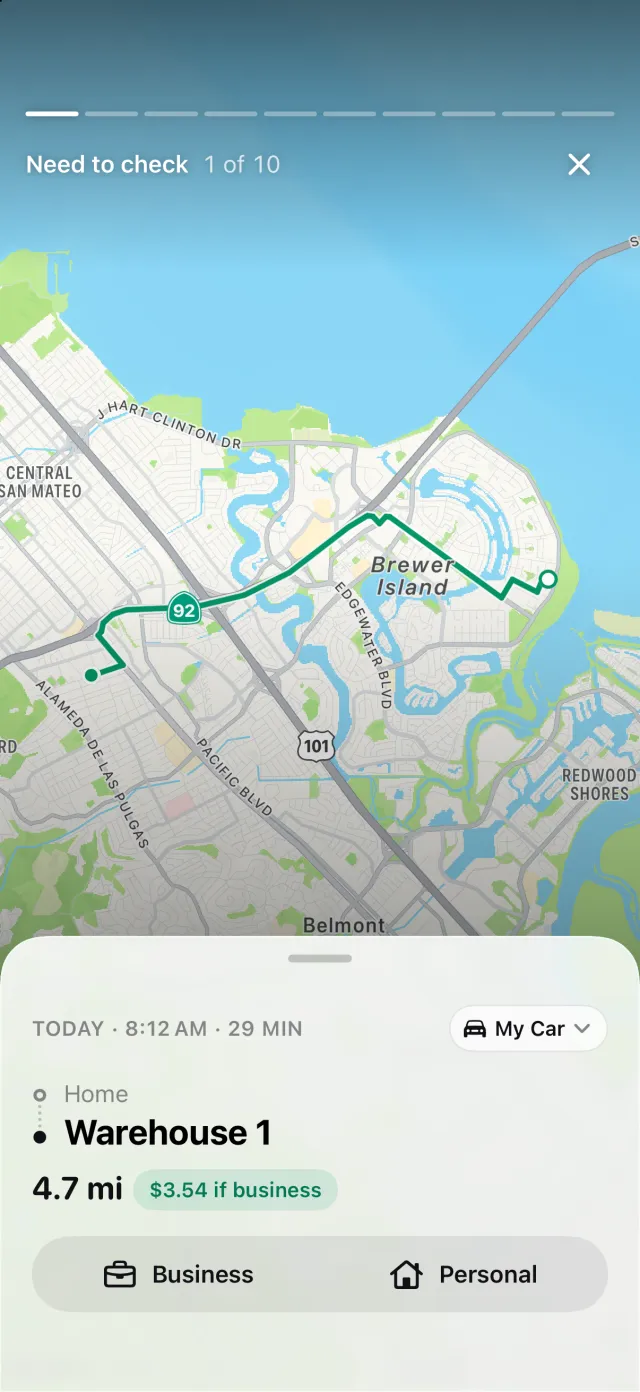
Germany's €0.30 is built in, and each trip is priced at the rate in force on its date. The report, a PDF, Excel or CSV file with DriveHub Pro, lists each business trip with its date, both addresses and the distance. Add the purpose in your own words, "Abnahme Baustelle, Firma Weber", rather than leaving the trip marked only as business. That part stays yours.
Where DriveHub stops: it doesn't decide whether a drive is your commute or a business trip, and it doesn't know where your erste Tätigkeitsstätte is. When it asks about a drive from home to that place, answer Commute, not Business or Personal. It files nothing with your employer or the Finanzamt. A drive it didn't record and can't recover, because the phone was off or flat, stays out until you add it by hand.
DriveHub is on the App Store for iPhone. Germany's other rules are on the Germany page, and setting up automatic tracking takes a few minutes, once.
Sources
- § 3 Nr. 13, 16, § 9 Abs. 1 Satz 3 Nr. 4a, § 9a Satz 1 Nr. 1 Buchst. a, § 41 Abs. 1 Satz 9 EStG; § 5 BRKG; § 4 Abs. 2 Nr. 4 LStDV.
- R 3.16, R 9.4, R 9.5 LStR; H 9.4, H 9.5, H 9.6, H 9.10 LStH — Amtliches Lohnsteuer-Handbuch 2026.
- BMF-Schreiben vom 25. November 2020 – IV C 5 – S 2353/19/10011 :006, Rz. 37, 38 and 40 (LStH 2026 Anhang 25 III).
- ELSTER, Anleitung zur Einkommensteuererklärung, Anlage N.
- BFH, 15 November 1991 – VI R 81/88; BFH, 20 September 2006 – I R 59/05.
This page states what the Einkommensteuergesetz, the Lohnsteuer-Richtlinien and the BMF say, and cites them so you can check. It is not tax advice. It can't account for your circumstances. Where the money matters, ask your Steuerberater — and bring the record of your trips.
Do it in DriveHub
Country, official rates, your own rate and when a change applies.
The full rule for Germany, with the instruments it comes from: mileage log requirements in Germany.