 DriveHub
Country guide · Germany · 8 min
Erste Tätigkeitsstätte oder Dienstreise: one is €0.38 once, the other €0.30 both ways
Erste Tätigkeitsstätte oder Dienstreise — the answer decides how a drive in your own car counts. The same 30 km is €11.40 a day as a commute and €18.00 as a business trip. What decides it is the place at the end of the drive, and usually your employer names that place.

The short answer
A drive from home to your erste Tätigkeitsstätte is the commute. Every other work drive in your own car is a business trip. The law calls it an Auswärtstätigkeit; most people say Dienstreise. The two are priced differently:
- Commute: €0.38 for each full kilometre of the one-way distance, once per working day on which you go there. That covers the way there and back (§ 9 Abs. 1 Satz 3 Nr. 4 EStG, since 1 January 2026).
- Business trip: €0.30 for every kilometre actually driven, there and back and every leg in between, or your actual car costs (§ 9 Abs. 1 Satz 3 Nr. 4a EStG with § 5 BRKG).
That is why the same 30 km can be worth €11.40 or €18.00 a day (worked example below). Your erste Tätigkeitsstätte is, first of all, the place your employer has permanently assigned you to. Only without a clear assignment do the working days count: daily, two full days a week, or a third of your agreed hours. You have at most one per employment, and a home office is never it.
This is the rule for employees. The rest of the page takes each part in turn.
What the statute says an erste Tätigkeitsstätte is
§ 9 Abs. 4 EStG, Satz 1: "Erste Tätigkeitsstätte ist die ortsfeste betriebliche Einrichtung des Arbeitgebers, eines verbundenen Unternehmens (§ 15 des Aktiengesetzes) oder eines vom Arbeitgeber bestimmten Dritten, der der Arbeitnehmer dauerhaft zugeordnet ist."
Three things have to meet. There must be a fixed site. It must belong to your employer, a group company or a third party your employer names. And you must be permanently assigned to it.
Step 1 — your employer's assignment. Satz 2: the assignment "wird durch die dienst- oder arbeitsrechtlichen Festlegungen sowie die diese ausfüllenden Absprachen und Weisungen bestimmt." Satz 3 says when it is permanent: "Von einer dauerhaften Zuordnung ist insbesondere auszugehen, wenn der Arbeitnehmer unbefristet, für die Dauer des Dienstverhältnisses oder über einen Zeitraum von 48 Monaten hinaus an einer solchen Tätigkeitsstätte tätig werden soll."
Step 2 — only if there is no clear assignment, the working days. Satz 4 makes a site the erste Tätigkeitsstätte where you are to work permanently and "1. typischerweise arbeitstäglich tätig werden soll oder 2. je Arbeitswoche zwei volle Arbeitstage oder mindestens ein Drittel seiner vereinbarten regelmäßigen Arbeitszeit tätig werden soll."
Never more than one. Satz 5: "Je Dienstverhältnis hat der Arbeitnehmer höchstens eine erste Tätigkeitsstätte." If several sites qualify, the employer picks one (Satz 6). If it does not, it is "die der Wohnung örtlich am nächsten liegende Tätigkeitsstätte" (Satz 7).
How the tax administration applies it
The BMF letter on travel expenses of 25 November 2020 (LStH 2026, Anhang 25 III) fills in the detail.
The assignment need not be written down. Rz. 11: it can be oral or implied, and "Die Zuordnungsentscheidung muss nicht dokumentiert werden." It can follow from your contract, rosters, travel policies or expense claims.
Your employer cannot assign you to nothing. Rz. 13: the employer "kann … nicht festlegen, dass der Arbeitnehmer keine erste Tätigkeitsstätte hat (Negativfestlegung)". Whether you have one is decided by the statute's tests, not by a line saying you don't.
Calling at the depot is not working there. Rz. 27: for the day-count test you must do "seine eigentliche berufliche Tätigkeit" at the site. Calling in for short preparation, reports, "zur Abholung oder Abgabe von Kundendienstfahrzeugen", or to hand in order confirmations and timesheets does not count. In the letter's Beispiel 14, a Kundendienstmonteur who collects the van every morning "hat keine erste Tätigkeitsstätte".
With no erste Tätigkeitsstätte, every work drive is a business trip. Rz. 2: "Ein Arbeitnehmer ohne erste Tätigkeitsstätte ist außerhalb seiner Wohnung immer auswärts tätig."
Is the home office a first workplace?
No, never. Rz. 4: "Das häusliche Arbeitszimmer des Arbeitnehmers ist keine betriebliche Einrichtung des Arbeitgebers oder eines Dritten und kann daher keine erste Tätigkeitsstätte sein."
That does not turn the drive to the office into a business trip. In the letter's Rz. 28 Beispiel 17, someone works three days at home and two full days at the employer's site. The site is the erste Tätigkeitsstätte, so home to the office is the commute.
Some days you work mainly at home and don't go to the erste Tätigkeitsstätte. For those, the home-office Tagespauschale of €6 a day applies instead, up to €1,260 a year (§ 4 Abs. 5 Satz 1 Nr. 6c EStG). As a rule, a day is either a commute day or a home-office day. The exception: where no other workplace is permanently available for that work, the Tagespauschale is allowed even on a day you also work at the erste Tätigkeitsstätte (Nr. 6c Satz 2).
Office first, then the client: which part is which?
Home to the office stays a commute, even if you go there only to set off to a client. H 9.10 LStH 2026: "Hat der Arbeitnehmer eine erste Tätigkeitsstätte, ist die Entfernungspauschale auch dann anzusetzen, wenn der Arbeitnehmer seine erste Tätigkeitsstätte deshalb aufsucht, um von dort eine Auswärtstätigkeit anzutreten" (BFH, 18 January 1991 – VI R 132/86).
- Office → client and back is the business trip, at €0.30 per km driven.
- Home → client directly, without touching the office, is a business trip from the first kilometre (H 9.5).
- Only one commute leg. You drive to the office, then to a client, and home from there. H 9.10 then allows "nur die Hälfte der Entfernungspauschale je Entfernungskilometer und Arbeitstag".
- A detour on the way to work, for example to collect the post. The commute stays a commute, and "die erforderliche Umwegstrecke ist als Auswärtstätigkeit zu werten" (H 9.10, BFH 12 October 1990 – VI R 165/87).
Sammelpunkt and weiträumiges Tätigkeitsgebiet
Two groups have no erste Tätigkeitsstätte and still get only the commute rate for part of their driving. The rule is § 9 Abs. 1 Satz 3 Nr. 4a Sätze 3–4 EStG. It applies where your employer's instructions require you to go "dauerhaft denselben Ort oder dasselbe weiträumige Tätigkeitsgebiet typischerweise arbeitstäglich aufzusuchen".
Sammelpunkt. The BMF's examples are "Treffpunkt für einen betrieblichen Sammeltransport, das Busdepot, der Fährhafen" (Rz. 38). Home to that point "dürfen nur durch den Ansatz der Entfernungspauschale … steuerlich berücksichtigt werden". A car-pool meeting point you arranged privately is not a Sammelpunkt (Rz. 39).
Weiträumiges Tätigkeitsgebiet. Typically "Zusteller oder Forstarbeiter" (Rz. 42). Not "Bezirksleiter und Vertriebsmitarbeiter, die verschiedene Niederlassungen betreuen", mobile care staff in a set area, or chimney sweeps. Home to the nearest access point of the area takes the commute rate. Driving inside the area, and the extra kilometres to a farther access point, take €0.30 per km driven or actual cost (Rz. 43–44).
You stay auswärts tätig for per diems and overnight costs (Rz. 40, 45). But your employer may not reimburse the home-to-Sammelpunkt or home-to-area drives tax-free under § 3 Nr. 13 or 16 EStG.
The commute: €0.38 from the first kilometre
Since 1 January 2026, § 9 Abs. 1 Satz 3 Nr. 4 Satz 2 EStG gives "für jeden vollen Kilometer der Entfernung zwischen Wohnung und erster Tätigkeitsstätte" €0.38. The Steueränderungsgesetz 2025 (BGBl. 2025 I Nr. 363, Art. 2 Nr. 3) replaced "0,30 Euro" with "0,38 Euro" and struck the old rule for kilometre 21 onwards. Pages that still show two bands describe the law before 2026.
- One-way distance, full kilometres, once a day. It is the distance, not the kilometres driven, and it covers "arbeitstäglich zwei Wege" (H 9.10; BMF 18 November 2021, Rz. 12 and 23).
- Only days at the erste Tätigkeitsstätte. Sick, holiday, business-trip and home-office days do not count (ELSTER, help for Anlage N).
- Everything is covered. "Durch die Entfernungspauschalen sind sämtliche Aufwendungen abgegolten" (§ 9 Abs. 2 Satz 1). Fuel, wear and insurance cannot be added. One exception is accident costs on the way to work, which stay deductible beside the Pauschale (H 9.10).
- No €4,500 cap for a car. The cap does not apply "soweit" you use your own or a provided Kraftwagen (BMF 18 November 2021, Rz. 11).
Days, distance and proof for the commute are the subject of the Pendlerpauschale in 2026.
The business trip: €0.30 for every kilometre driven
§ 9 Abs. 1 Satz 3 Nr. 4a EStG covers "beruflich veranlasste Fahrten, die nicht Fahrten zwischen Wohnung und erster Tätigkeitsstätte im Sinne des Absatzes 4 … sind". For a car, the BMF states the figure: "PKW 0,30 €" for "jeden gefahrenen Kilometer" (BMF 25 November 2020, Rz. 37).
Both ways count, every leg counts, and trips between several clients count (H 9.5). Instead of the flat rate you may claim the share of your car's actual yearly costs that these trips make up (R 9.5 Abs. 1 LStR). If your employer pays you up to €0.30 per km, that is tax-free (§ 3 Nr. 16 EStG); whatever it does not pay is Werbungskosten. For what you must record and what you may claim on top, see business trips in your own car.
A worked example: the same 30 km, three ways
Illustrative figures, not taken from any rule. Your home is 30 km from your employer's office, the site you are assigned to. A client is also 30 km from home and 25 km from the office.
| Day | Drives | How each counts | Amount |
|---|---|---|---|
| A — office only | Home → office → home, 60 km driven | Commute: 30 km × €0.38, once | €11.40 |
| B — client only | Home → client → home, 60 km driven | Business trip: 60 km × €0.30 | €18.00 |
| C — office, then client | Home → office (30) → client (25) → home (30) | Commute, one leg only: 30 km × €0.19 = €5.70 · Business trip: 55 km × €0.30 = €16.50 | €22.20 |
The arithmetic: 30 × 0.38 = 11.40. 60 × 0.30 = 18.00. Half the Pauschale is €0.19, and 30 × 0.19 = 5.70. Day C's business part is 25 + 30 = 55 km, and 55 × 0.30 = 16.50; 5.70 + 16.50 = 22.20.
Over 20 such days, Day A gives €228 and Day B €360. That is €132 apart, with the same car, the same distance and the same hours.
Whether any of it lowers your tax depends on the total. Werbungskosten only change the bill where they exceed the €1,230 Arbeitnehmer-Pauschbetrag (§ 9a Satz 1 Nr. 1 Buchst. a EStG), and both the commute and the business trips are Werbungskosten.
Before you file
- Ask what you are assigned to. It is decided by your contract and your employer's instructions, and it need not be on paper. If it is unclear, the day-count test of § 9 Abs. 4 Satz 4 decides.
- Count commute days, not working days. Leave out sick days, holidays, business-trip days and home-office days.
- Keep business trips apart from the commute. Record each business trip's purpose, duration and route. Back them with papers such as a logbook or receipts (R 9.4 Satz 5 LStR).
- Watch the mixed days. Office-then-client is a commute plus a business trip, and a one-leg commute day counts half.
How DriveHub keeps the two apart
The rule turns on which drive went where, on which day. That is a log, and the cost of a wrong line is the gap between €0.38 once and €0.30 both ways.
With location access set to Always, DriveHub records every drive in the background — and if it ever misses one, it tells you. The commute is recorded too. DriveHub files most trips as Business or Personal by your places, past routes and working hours, and asks you about the rest under Need to check.
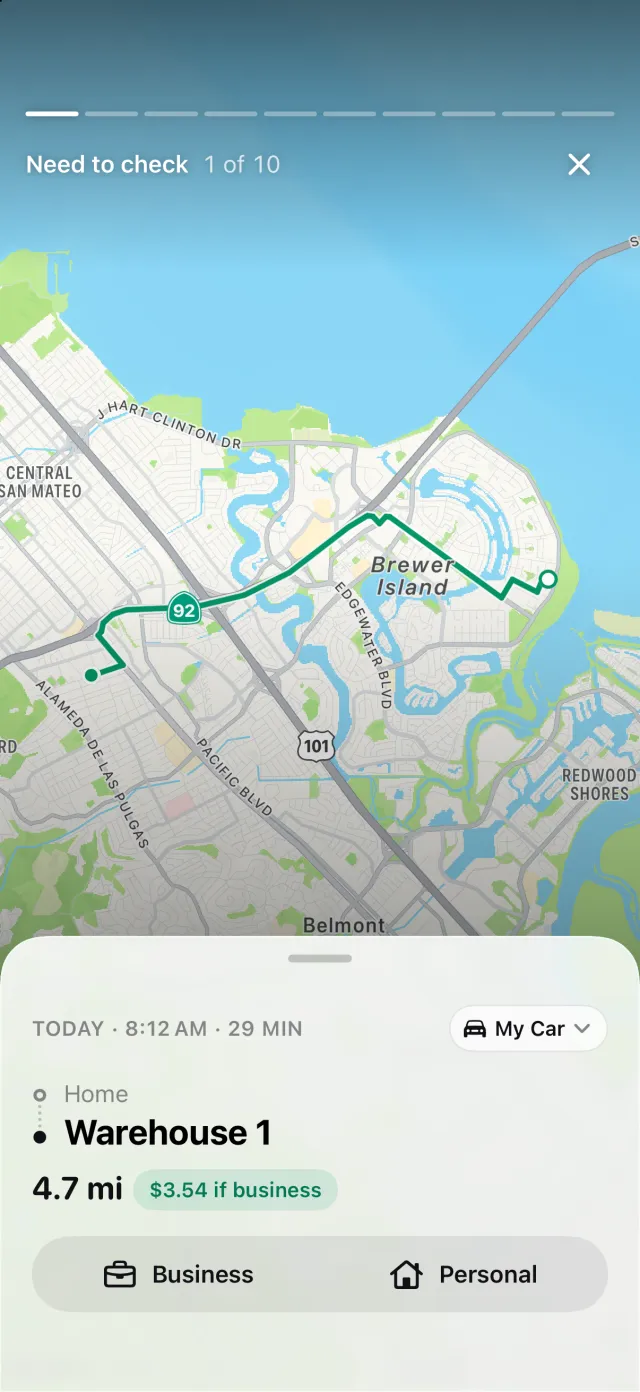
A trip you answer Commute is stored as personal driving, so it stays out of the business kilometres priced at €0.30. Each drive is its own trip, so on Day C the leg to the office and the legs to the client and home are separate lines. The two client legs, filed as Business, each appear on the report (PDF, Excel or CSV with DriveHub Pro) with its date, both addresses and its distance; the purpose is yours to add.
What DriveHub does not decide is which site is your erste Tätigkeitsstätte. That rests on your employer's assignment and your working days, and DriveHub knows neither. When it asks about a drive from home to that site, answer Commute, not Business or Personal.
DriveHub is on the App Store for iPhone. Germany's other rules are on the Germany page. Setting up automatic tracking takes a few minutes, once.
Sources
- § 9 Abs. 1 Satz 3 Nr. 4 and 4a, Abs. 2, Abs. 4 EStG; § 9a EStG; § 4 Abs. 5 Satz 1 Nr. 6c EStG; § 3 Nr. 13 and 16 EStG; § 5 BRKG.
- Steueränderungsgesetz 2025 vom 22. Dezember 2025, BGBl. 2025 I Nr. 363, Art. 2 Nr. 3 and Art. 12 Abs. 2.
- BMF-Schreiben vom 25. November 2020 – IV C 5 – S 2353/19/10011 :006, Rz. 2, 4, 11, 13, 27, 28, 37–45 (LStH 2026 Anhang 25 III).
- BMF-Schreiben vom 18. November 2021 – IV C 5 – S 2351/20/10001 :002, Rz. 11, 12 and 23 (LStH 2026 Anhang 14).
- R 9.4 LStR; H 9.5 and H 9.10 LStH 2026; ELSTER, help for Anlage N.
This page states what the Einkommensteuergesetz, the Lohnsteuer-Richtlinien and the BMF letters say, and cites them so you can check. It is not tax advice. It can't account for your circumstances. Where the money matters, ask your Steuerberater — and bring your log.
Do it in DriveHub
Annual commute deduction (Germany, Denmark) →
Turn it on, mark your home–work trips and fill in the commute year in Reports.
The full rule for Germany, with the instruments it comes from: mileage log requirements in Germany.