 DriveHub
Country guide · Portugal · 6 min
Mapa de km obrigatório: the fields, one map per payment, and what a missing map costs
Your employer pays you per kilometre for using your own car, and someone asks for the mapa de quilómetros. It is not a formality. It is the document that keeps the allowance out of your taxable salary, and the employer's deduction alive.

The short answer
The mapa de quilómetros — the boletim itinerário, or mapa de deslocações — is the record behind a per-kilometre allowance. The employer pays that allowance to an employee who uses their own car on the employer's business. The map must show:
- the reason for the journey
- the places
- the time spent there (tempo de permanência)
- the objective (objetivo)
Time spent and objective are two separate items, not one. Because the car is your own, the map must also show:
- the vehicle and its owner
- the number of kilometres
- the per-kilometre allowance
- the total
For a private employer, the legal basis is CIRC art. 23.º-A n.º 1 al. h), and it wants a map "por cada pagamento efetuado" — one per payment, not one per period. That article names the places, the time spent, the objective, the vehicle and its owner, and the kilometres. The tax authority's (AT) ruling PIV 26595 (2025) adds the reason for the journey, the amount per kilometre and the total. Portaria n.º 1553-D/2008 sets amounts only and names no field.
Without the map, the allowance becomes salary. CIRS art. 2.º n.º 3 al. d) taxes it as employment income (category A), and the employer loses the deduction. Fines can follow.
Is a mapa de km obligatory?
Yes, if the allowance is meant to stay out of your taxable income, and if your employer wants to deduct it. Once an allowance is paid, the map is what proves it was paid for real business journeys.
Two rules work together here. Portaria n.º 1553-D/2008 sets the ceiling per kilometre for using your own car. CIRS art. 2.º n.º 3 al. d) makes anything above that ceiling taxable. The map is how the allowance below the ceiling shows it qualifies.
The ceiling is 0,40 € per kilometre, from 1 January 2024. Why the 0,36 still quoted online is out of date is set out in using your own car for work in Portugal.
An employer may pay more than 0,40 €; the AT's ruling PIV 26595 says companies are free to set the amount, but the part above the limit is employment income.
What each field is for
The reason and the objective. Together they say why this drive was the employer's business. "Client visit" is a reason. What the visit was meant to achieve is the objective.
The places and the time spent. Where you went, and how long you stayed there. These tie the kilometres to real destinations. The time spent is its own item in CIRC art. 23.º-A n.º 1 al. h), separate from the objective.
The vehicle and its owner. The plate identifies the car; the owner line shows it was yours, which is what makes it an own-car allowance at all. A map that names only the car leaves that unproven.
Kilometres, the per-kilometre allowance and the total. The arithmetic of the claim: distance, the rate applied, and the amount paid. Each row should let anyone check that the total follows from the other two.
One row, filled in:
| Date | Places | Time there | Reason | Objective | Km | €/km | Total |
|---|---|---|---|---|---|---|---|
| 12-03-2026 | Lisboa → Setúbal (client office) → Lisboa | 2 h | Client visit | Sign the maintenance contract | 98 | 0,40 | 39,20 € |
Above the rows: the vehicle and its owner. Below them: the signature.
A blank Portuguese mileage log (PDF) has these columns, plus lines for the vehicle, its owner, the employee and the approver. A CSV version is there for a spreadsheet.
One map per payment, not per period
The wording of CIRC art. 23.º-A n.º 1 al. h) is "por cada pagamento efetuado". The map follows the payment. If your employer pays the kilometres with each month's salary, each of those payments needs its map. If it pays one trip on its own, that trip's payment needs one.
A map that spans several payments — one year-end summary for twelve monthly payments, say — does not meet that wording. Each payment has to be traceable to the journeys it paid for.
The signature
The map is signed by the employee it belongs to. The tax authority's binding ruling PIV 21076 (20-06-2021) is direct: "os mapas de kms devem estar assinados pelos colaboradores, para efeitos da comprovação documental." That applies to a map printed from software too, not only to paper.
What happens without a mapa de km
The whole allowance becomes taxable, not just the excess. The failure attacks the exemption itself. CIRS art. 2.º n.º 3 al. d) taxes the allowance as category A income "quando não sejam observados os pressupostos da sua atribuição" — when the conditions for paying it were not met. An allowance paid without a map is, on paper, salary.
Compare an allowance above the ceiling with a map in order: only the part above 0,40 € per kilometre is taxed as employment income.
The employer loses the deduction. Under CIRC art. 23.º-A n.º 1 al. h), the company cannot deduct allowances it cannot support with a map. The cost lands on both sides of the same payment.
Fines. RGIT art. 117.º n.º 1 fines a failure to present or exhibit supporting documents or records, digital ones included, at €150 to €3 750. RGIT art. 120.º n.º 1 fines the absence of required records and the documents related to them at €225 to €22 500. For a company both ranges double under RGIT art. 26.º n.º 4, so an employer company faces €300 to €7 500 and €450 to €45 000.
How long the map is kept
The employer keeps the map. An employer on organised accounts, or VAT-registered, keeps it for ten years from the end of the year it records (DL 28/2019 art. 19.º n.º 1; CIVA art. 52.º n.º 1). Where the caducidade of LGT art. 45.º runs longer, so does the duty.
If you are self-employed
The map above is an employee's document. A category B earner — a trabalhador independente or sole trader — may not pay themselves a per-kilometre allowance for their own car at all: CIRS art. 33.º n.º 1 rules it out. What a sole trader records instead, and why, is in mileage for the self-employed in Portugal. If you run your own company and pay yourself kilometres through it, see kilometres for a sócio-gerente.
Before the next payment
- The map covers exactly the journeys this payment pays for.
- Every journey has a reason, the places, the time spent there and the objective — the last two as separate items.
- The vehicle and its owner are named.
- Each row shows the kilometres, the allowance per kilometre and the total.
- The allowance per kilometre is within the 0,40 € ceiling, or the excess is treated as salary.
- The employee has signed it.
- It is filed where it can be produced for ten years.
How DriveHub makes the mapa easier
A map per payment is only as good as the list of drives behind it. With location access set to Always, DriveHub records every drive in the background — and if it ever misses one, it tells you. DriveHub files most trips as Business or Personal by your places, past routes and working hours, and asks you about the rest.
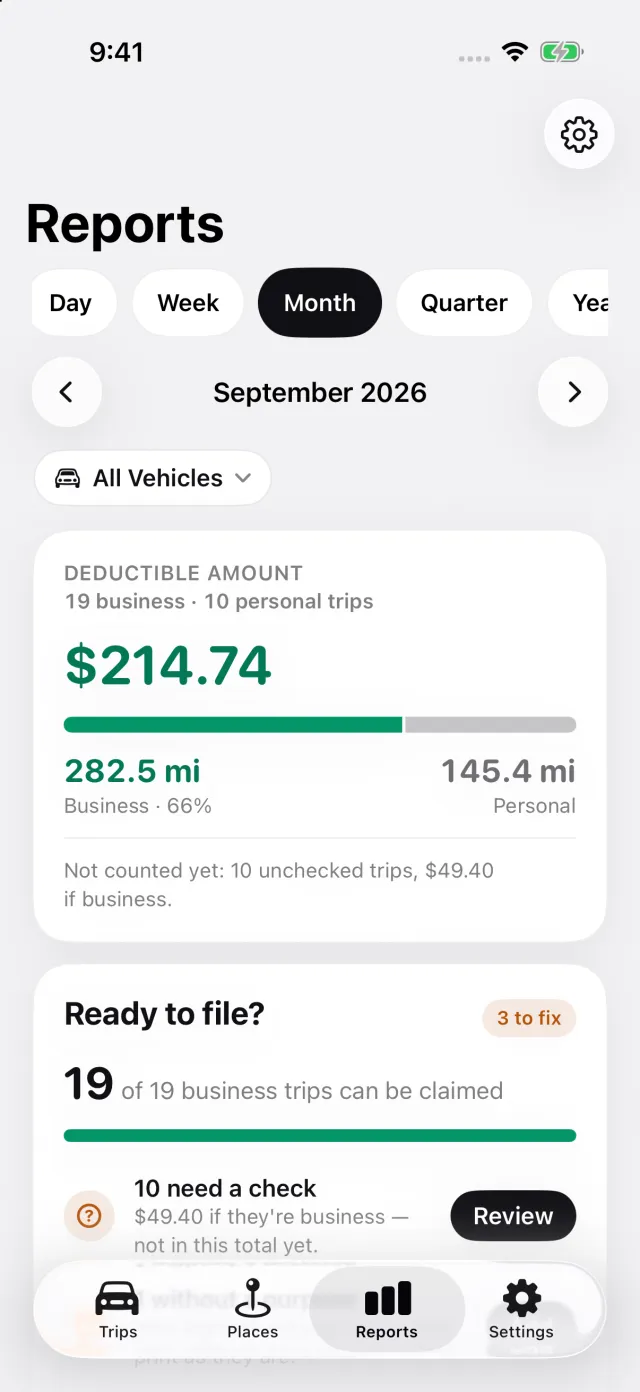
On the Reports tab, set the report to the dates one payment covers: a month, a quarter or a single day. For Portugal, each row carries the places, the kilometres, the amount at the rate and the reason in your own words. Choose the car on the report, and the vehicle's owner gets a line of its own: your name, where the car is yours. Put your name in the report details first, so it has something to print. There is no separate column for the objective or the time spent at each place. Type both into the same note as the reason, so they print on the map.
The final page carries the signature lines: yours, the approver's, and a date. DriveHub leaves the signing to you rather than drawing a signature that would not count. Reports export as PDF, Excel or CSV with DriveHub Pro; tracking is free.
- DriveHub on the App Store
- Portuguese mileage log requirements
- Set up automatic tracking, and know when a drive is missed
This page states what Portaria n.º 1553-D/2008, the CIRS, the CIRC, the CIVA, the RGIT, the LGT, DL 28/2019 and the AT's rulings PIV 21076 and PIV 26595 say, and cites them so you can check. It is not tax advice. It can't account for your circumstances — where an allowance is in question, ask a contabilista certificado before it is paid.
Do it in DriveHub
Add your document identity and review which fields appear in the PDF.
The full rule for Portugal, with the instruments it comes from: mileage log requirements in Portugal.