 DriveHub
Country guide · Portugal · 7 min
Quilómetros as sócio-gerente: no salary needed, 0,40 €/km tax-free, 5 % for the company
You are the sócio-gerente of your own Lda or unipessoal, you drive your own car for it, and you take no salary. Can the company pay you quilómetros? The tax authority answered that exact question in 2025: yes — on conditions, and at a cost to the company.

The short answer
A sócio-gerente — a partner who manages the company — can be paid kilometres for using their own car on the company's business. The tax authority's binding ruling PIV 26595 (despacho of 25 March 2025) says so, and it adds four things:
- Only the managing partner qualifies. A partner who only holds capital is not at the company's service, and their km are not deductible.
- For IRS, the manager is an employee. That is category A income, so the employee ceiling of 0,40 € per kilometre applies.
- No salary is needed. A manager who waives remuneration can still be paid km, as long as each journey is documented.
- The mapa is drawn up per payment, with every field an employee's map needs.
On top of that, the company pays a 5 % autonomous tax on the km it pays (CIRC art. 88.º n.º 9), unless one of three exceptions applies. Without the mapa, the cost is double: the company loses the deduction and you are taxed on the whole amount.
What PIV 26595 decided
The case was close to the typical owner-managed company. Two partners, neither paid a salary, wanted the company to pay both of them kilometres for their own cars, and to re-invoice those km to clients.
The ruling splits the two partners by role, not by shareholding. Point 2 accepts the compensations "dos trabalhadores da empresa ou de um sócio gerente ou um membro do órgão social, pois que apenas estes se encontram ao serviço da empresa".
A partner who only holds capital is outside that list. Point 3: their km "não podem ser aceites fiscalmente … devendo esse valor ser acrescido ao resultado liquido do período" — added back to the company's profit.
Why a sócio-gerente is treated as an employee
Point 4 of the ruling is direct: "os gerentes ou sócios-gerentes têm a natureza de trabalhadores por conta de outrem, como qualquer outro trabalhador".
That puts your kilometres under the same rule as any employee's. CIRS art. 2.º n.º 3 al. d) makes the allowance category A income "… na parte em que ambas excedam os limites legais ou quando não sejam observados os pressupostos da sua atribuição aos servidores do Estado". Two triggers follow:
- Paid above 0,40 €/km: only the excess is taxed as your income.
- Conditions not met — no mapa, or not on the company's service: the whole amount is taxed.
The company may pay more than 0,40 (PIV 26595 point 11), but the excess is your category A income and goes on its Declaração Mensal de Remunerações.
Where the 0,40 comes from — Portaria n.º 1553-D/2008, and the 2024 repeal of the cut to 0,36 — is set out in using your own car for work in Portugal.
Do you need a salary to be paid km?
No. Points 6 and 7 of PIV 26595 accept km paid to a manager who waives remuneration, "desde que a deslocação esteja devidamente documentada e tenha por base a existência de um facto que justifique a natureza do complemento atribuído".
In other words: the journey has to be real company business, and it has to be on paper.
What the mapa must show
Point 8 of the ruling restates CIRC art. 23.º-A n.º 1 al. h) and lists the fields: "a razão da deslocação, os respetivos locais, tempo de permanência, objetivos, tendo, também, que ser identificados: a viatura, o respetivo proprietário, bem como o número de quilómetros percorridos, o valor atribuído por quilómetro e o valor total".
So each map shows:
- the reason for the journey
- the places
- the time spent
- the objectives
- the vehicle and its owner — here, you
- the kilometres, the rate per kilometre, and the total
CIRC art. 23.º-A n.º 1 al. h) wants the map "por cada pagamento efetuado" — one per payment, not one per period. You sign it, too: the AT's ruling PIV 21076 holds that "os mapas de kms devem estar assinados pelos colaboradores" — and that holds for a map printed from software as much as for paper. Each field, and the signature, is explained in the mapa de quilómetros guide.
The 5 % autonomous tax on your km
CIRC art. 88.º n.º 9 taxes the company, not you:
"São ainda tributados autonomamente, à taxa de 5 %, os encargos efetuados ou suportados relativos a ajudas de custo e à compensação pela deslocação em viatura própria do trabalhador, ao serviço da entidade patronal, não faturados a clientes, escriturados a qualquer título, exceto na parte em que haja lugar a tributação em sede de IRS na esfera do respetivo beneficiário."
That rule applies to every employer. A sócio-gerente's company is simply one of them.
When the 5 % does not apply
Three cases, all in art. 88.º:
- The km are re-invoiced to a client and shown expressly on the invoice. PIV 26595 point 10: "se estas forem faturadas ao cliente e se as mesmas se encontrarem expressamente evidenciados na fatura emitida, não há lugar a tributação autónoma."
- The part already taxed as your IRS income — the excess over 0,40, or an amount taxed in full because the conditions failed (n.º 9, "exceto na parte…").
- The company is on the IRC regime simplificado. N.º 16: the autonomous rates of n.os 7, 9, 11 and 13 "não são aplicáveis aos sujeitos passivos a que se aplique o regime simplificado de determinação da matéria coletável."
When it becomes 15 %
Art. 88.º n.º 14 raises every autonomous rate by 10 points — 5 % becomes 15 % — for a company with a tax loss in the period.
For 2025 and 2026 that increase is switched off if the company either:
- had taxable profit in one of the three previous periods and filed its Modelo 22 and IES for the two previous periods on time, or
- is in its first three periods of activity.
The sources are Lei 45-A/2024 art. 116.º n.º 4 and Lei 73-A/2025 art. 95.º n.º 5.
A worked example
You drive 1 000 km on company business in a month, and the company pays you once for that month.
At 0,40 €/km: 1 000 × 0,40 = €400. Nothing is above the ceiling, so none of it is your IRS income. The company owes 5 % autonomous tax: 400 × 0,05 = €20. In a loss year where the increase applies, it is 400 × 0,15 = €60.
At 0,50 €/km: 1 000 × 0,50 = €500. The excess, 1 000 × 0,10 = €100, is your category A income. The 5 % falls only on the part not taxed in IRS: 400 × 0,05 = €20.
Re-invoiced: if the company bills the €400 to a client and the invoice shows the km expressly, there is no autonomous tax on it.
No mapa: the whole €400 is taxed as your income, and the company cannot deduct it. Because the whole amount is taxed in your IRS, the 5 % autonomous tax does not fall on it.
What a missing mapa costs here
For an owner-manager, both sides of the payment are yours, so the loss lands twice.
- The company loses the deduction under CIRC art. 23.º-A n.º 1 al. h).
- You are taxed on the whole amount as category A income, under CIRS art. 2.º n.º 3 al. d) — "quando não sejam observados os pressupostos".
Fines can follow, and for a company both ranges are doubled (RGIT art. 26.º n.º 4). Failing to produce documents when asked costs €300 to €7 500 (art. 117.º n.º 1). Where the records the law requires, and the documents tied to them, do not exist at all, it is €450 to €45 000 (art. 120.º n.º 1).
A company keeps organised accounts, so the maps stay for ten years from the end of the year they record (DL 28/2019 art. 19.º n.º 1; CIVA art. 52.º n.º 1). Where the caducidade of LGT art. 45.º runs longer, keep them longer.
Not the same as a sole trader
A trabalhador independente earns category B income and cannot pay themselves the 0,40 at all: CIRS art. 33.º n.º 1 rules it out. Trading through a company changes that. The owner becomes a category A manager, and the per-kilometre route opens.
What a sole trader records instead is in mileage for the self-employed in Portugal.
Before the company pays your km
- You are a gerente, not only a partner with capital.
- Each journey was on the company's business.
- There is one mapa for this payment, covering exactly its journeys.
- Every journey has a reason, the places, the time spent and the objective.
- The car is named, and so are you as its owner.
- Each row shows the kilometres, the rate and the total; above 0,40, the excess is your income.
- You have signed the map.
- Re-invoiced km appear expressly on the client's invoice.
- The map is filed where it can be produced for ten years.
How DriveHub makes the mapa easier
The hard part of paying yourself km is not the 5 %. It is having every business drive on the map, with the kilometres right, when the payment is made. With location access set to Always, DriveHub records every drive in the background — and if it ever misses one, it tells you. DriveHub files most trips as Business or Personal by your places, past routes and working hours, and asks you about the rest.
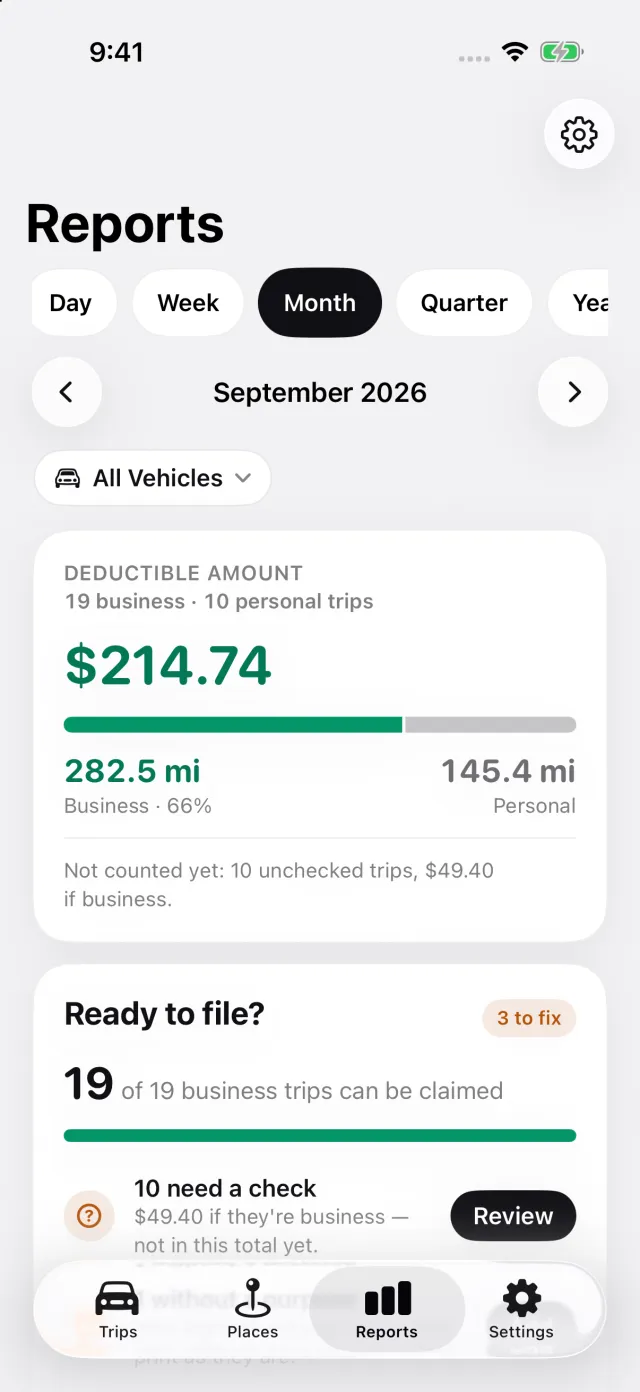
On the Reports tab you choose the period the payment covers — a month, a quarter, a single day — so each map lines up with one payment. For Portugal, the report prints each journey's places and kilometres, the amount at the rate, and the reason in your own words. Choose your car on the report and enter your name in the report details, and you are printed on a line of your own as the vehicle's owner. The objective of a visit and the time spent there are yours to add to the reason.
The last page is for signatures: a line for you, one for whoever approves the map, and a date. DriveHub leaves the signing to you rather than drawing a signature that would not count. Reports export as PDF, Excel or CSV with DriveHub Pro; tracking is free.
- DriveHub on the App Store
- Portuguese mileage log requirements
- Set up automatic tracking, and know when a drive is missed
This page states what the CIRS, the CIRC, the CIVA, the RGIT, the LGT, Portaria n.º 1553-D/2008, DL 28/2019, Leis 45-A/2024 and 73-A/2025, and the AT's rulings PIV 26595 and PIV 21076 say, and cites them so you can check. It is not tax advice. It can't account for your circumstances — before your company pays you km, ask a contabilista certificado how it applies to yours.
Do it in DriveHub
Employment dates, different rates and trips for more than one job.
The full rule for Portugal, with the instruments it comes from: mileage log requirements in Portugal.