 DriveHub
Country guide · Portugal · 6 min
Quilómetros em viatura própria: 0,40 € per km in 2026, and the map behind it
Your employer pays you a kilometre allowance — the compensação pela deslocação em viatura própria — for the kilometres you drive in your own car. In 2026, up to 0,40 € per kilometre stays out of your taxable salary. That holds when the drive was on the employer's service and a mapa de quilómetros backs every payment.

The short answer
- What is the rate in 2026? 0,40 € per kilometre for an employee's own car on the employer's service. It has applied since 1 January 2024.
- Why do some sites say 0,36? A 10 % cut from 2010 that was repealed with effect from 1 January 2024. The 0,36 figure is out of date.
- Must my employer pay 0,40? No. The employer may pay any amount. 0,40 is the ceiling for what stays tax-free.
- When is it taxed? Anything above 0,40 is taxed as employment income. If the conditions are not met — no map, or not driving on the employer's service — the whole amount is taxed.
- What proves it? A mapa de quilómetros for each payment, signed by you.
Where 0,40 € comes from
The figure is set by Portaria n.º 1553-D/2008, n.º 4.º, for civil servants: "a) Transporte em automóvel próprio - (euro) 0,40 por quilómetro".
In 2010, DL n.º 137/2010 art. 4.º n.º 4 cut it by 10 %: "são reduzidos em 10 %". That is the 0,36 still quoted across much of the Portuguese web.
Lei n.º 82/2023, the State Budget for 2024, repealed that cut. Its art. 317.º reads "São revogados: … d) O artigo 4.º do Decreto-Lei n.º 137/2010, de 28 de dezembro", in force "a 1 de janeiro de 2024" (art. 320.º). The table of DGAEP, the public administration's employment directorate, updated 27 January 2026, prints "Viatura própria (km): € 0,40".
There is one figure for both sectors. The private-sector ceiling is the civil-service amount, reached by cross-reference from CIRS art. 2.º n.º 3 al. d). There is no separate private table.
When the kilometre allowance is taxed
CIRS art. 2.º n.º 3 al. d) treats as employment income (category A) "as ajudas de custo e as importâncias auferidas pela utilização de automóvel próprio em serviço da entidade patronal, na parte em que ambas excedam os limites legais ou quando não sejam observados os pressupostos da sua atribuição aos servidores do Estado".
That sentence holds two separate triggers:
- The rate is too high. Only the excess over 0,40 € is taxed.
- The conditions are not met. The whole amount is taxed — for example, when there is no map, or the drive was not on the employer's service.
Your employer is free to pay more. The tax authority says so in its ruling PIV 26595, point 11: "pese embora as empresas tenham liberdade para estabelecer os montantes a atribuir … a parte em que as mesmas excedam os limites legais … são considerados como rendimento de trabalho dependente". The amounts go on the employer's monthly return, the Declaração Mensal de Remunerações (CIRS art. 119.º n.º 1 al. c) subal. i)).
A worked example
You drive 300 business kilometres in your own car in a month.
| Paid per km | Total | Tax-free for you | Taxed as your income | Employer's 5 % |
|---|---|---|---|---|
| 0,40 € | 120,00 € | 120,00 € | 0,00 € | 6,00 € |
| 0,50 € | 150,00 € | 120,00 € | 30,00 € | 6,00 € |
At 0,50 €, the excess is 300 × 0,10 = 30,00 €, taxed as employment income; the other 120,00 € stays tax-free. Both rows assume the map is in order. The employer's 5 % is explained below, under what it costs your employer.
Paid at 0,50 € with no map: the conditions are not met, so the whole 150,00 € is taxed as employment income.
The map behind every payment
The allowance stays out of your salary only with a mapa de quilómetros — the boletim itinerário. For a private employer, its basis is CIRC art. 23.º-A n.º 1 al. h), which wants a map "por cada pagamento efetuado": one per payment, not one per period.
The map shows the reason for each journey, the places, the time spent and the objectives. Because the car is yours, it also names the vehicle and its owner, the kilometres, the per-kilometre amount and the total. It is signed by you: the tax authority's binding ruling PIV 21076 says "os mapas de kms devem estar assinados pelos colaboradores".
A blank Portuguese mileage log (PDF) has these columns. The field-by-field detail, and what each one is for, is in the mapa de quilómetros: what it must contain.
What it costs your employer
The deduction depends on the map. The employer deducts the allowance only with a map for each payment (CIRC art. 23.º-A n.º 1 al. h)).
5 % autonomous tax. CIRC art. 88.º n.º 9 taxes "à taxa de 5 %" the "compensação pela deslocação em viatura própria do trabalhador, ao serviço da entidade patronal, não faturados a clientes". It applies to any employer, not only to an owner-manager's company — unless the company is on the IRC regime simplificado (art. 88.º n.º 16). Two more exceptions sit in n.º 9 itself: kilometres re-invoiced to a client, and the part already taxed as your IRS income ("exceto na parte em que haja lugar a tributação em sede de IRS na esfera do respetivo beneficiário"). In the example above, at 0,50 € a kilometre, the 5 % falls on the 120,00 € that stays tax-free for you: 6,00 €. It does not fall on the 30,00 € taxed in your hands.
In a loss year the rate can rise to 15 % — when, and the 2025–2026 exemptions, are in kilometres for a sócio-gerente.
Without the map, both sides lose. You are taxed on the whole allowance, and the employer loses the deduction.
Fines. A map the employer cannot produce, or does not have, can also bring an RGIT fine; the ranges are in the mapa de quilómetros guide.
How long the map is kept
The employer keeps it for ten years from the end of the year it records; the sources are in the mapa de quilómetros guide.
If you are not an employee
Self-employed (category B). A trabalhador independente may not pay themselves the 0,40 at all: CIRS art. 33.º n.º 1 rules it out. What a sole trader records instead is in mileage for the self-employed in Portugal.
Manager of your own company. A sócio-gerente counts as an employee for IRS, so the 0,40 ceiling and the map apply as above. What the tax authority decided for a manager who takes no salary is in kilometres for a sócio-gerente.
Before the next payment
- The amount per kilometre is at or below 0,40 €, or you know the excess will be taxed.
- Every kilometre paid was driven on the employer's service.
- There is a map for this payment, covering exactly the journeys it pays for.
- The map names the vehicle and its owner, and shows the kilometres, the amount per kilometre and the total.
- You have signed it.
How DriveHub makes this easier
The part a form cannot do is make sure every business drive is on the map when the payment comes round. With location access set to Always, DriveHub records every drive in the background — and if it ever misses one, it tells you. DriveHub files most trips as Business or Personal by your places, past routes and working hours, and asks you about the rest.
Portugal's rate is built in, dated to its official source, so each trip is valued at the rate in force on the day it happened.
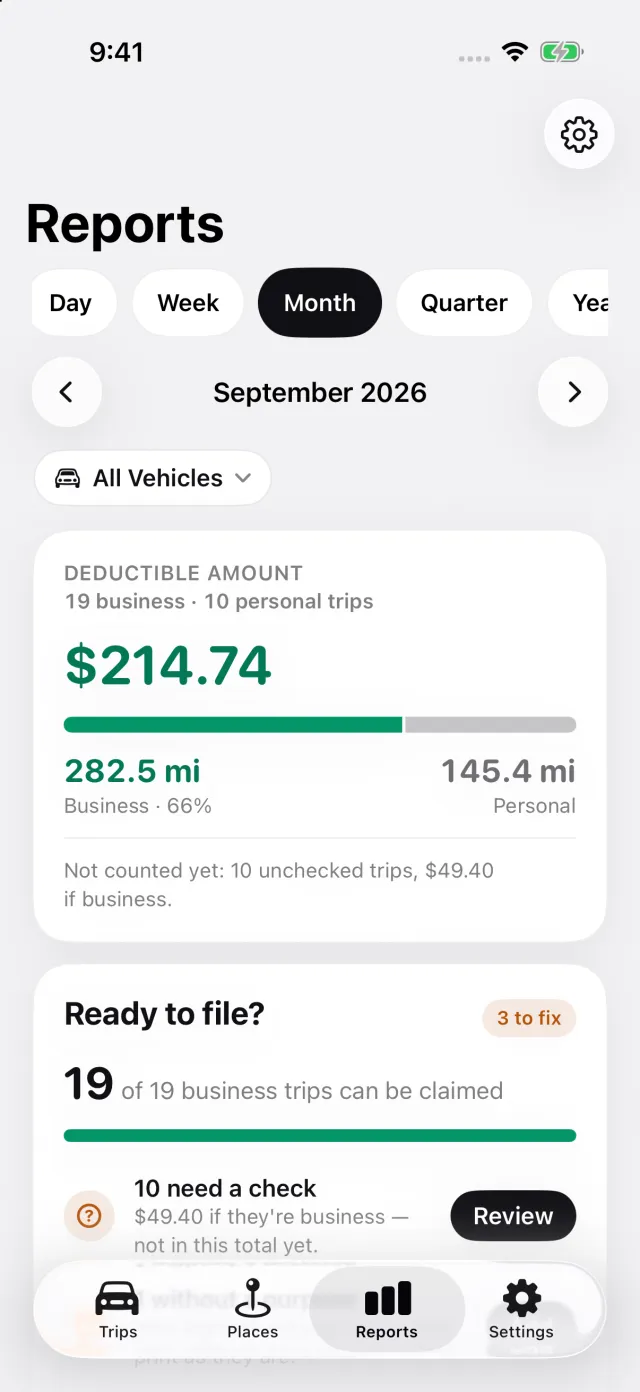
On the Reports tab you choose the period the payment covers — a month, a quarter, a single day — so each map lines up with one payment. For Portugal, the report prints each journey's places and kilometres, the amount at the rate, and the reason in your own words. Choose the car on the report, and the vehicle's owner gets a line of its own: your name, where the car is yours. Enter your name in the report details first. The objective of a visit and the time spent there are yours to add to the reason.
The last page leaves a line for your signature, one for whoever approves the map, and a date. DriveHub leaves the signing to you rather than drawing a signature that would not count. Reports export as PDF, Excel or CSV with DriveHub Pro; tracking is free.
- DriveHub on the App Store
- Portuguese mileage log requirements
- Set up automatic tracking, and know when a drive is missed
This page states what Portaria n.º 1553-D/2008, DL n.º 137/2010, Lei n.º 82/2023, the CIRS, the CIRC, the RGIT and the AT's rulings PIV 21076 and PIV 26595 say, and cites them so you can check. It is not tax advice. It can't account for your circumstances — where an allowance is in question, ask a contabilista certificado before it is paid.
Do it in DriveHub
Country, official rates, your own rate and when a change applies.
The full rule for Portugal, with the instruments it comes from: mileage log requirements in Portugal.