 DriveHub
Country guide · United States · 9 min
Real estate agent mileage: the drives between stops count, the first one depends
You are a real estate agent and drive to listings, showings and closings. An agent who is licensed, paid on sales and working under a written contract is self-employed for tax, so the mileage deduction is yours to claim on Schedule C. The IRS car-expense rules do not mention agents: the general commuting rules decide which of your drives count.

The short answer
A licensed real estate agent paid on sales under a written contract is not an employee for federal tax. The agent is self-employed, and car costs go on Schedule C. You choose the standard mileage rate or actual expenses. For 2026 the rate is 72.5 cents a mile to 30 June and 76 cents from 1 July, with business parking and tolls on top.
Which drives count? None of the IRS publications, instructions or rulings on car expenses mentions an agent's driving. Showings, open houses and the brokerage desk are not named in them. The general rules apply:
- Between business stops — listing to showing, showing to the title office — the drive is deductible.
- Home to your regular place of business is a commute, and never deductible.
- With no regular office and no qualifying home office, and every stop inside your metropolitan area, the drive to the first stop and the last drive home are commutes.
- With a home office that is your principal place of business, the drive from home to any work location is deductible.
So the drive from home to the first showing is not always business, and not always a commute. It depends on where your work is based.
Why an agent is self-employed: IRC § 3508
The rule is in the statute. IRC § 3508(a): "in the case of services performed as a qualified real estate agent or as a direct seller— (1) the individual performing such services shall not be treated as an employee, and (2) the person for whom such services are performed shall not be treated as an employer."
A "qualified real estate agent" must meet three conditions in § 3508(b)(1):
- Licensed: "such individual is a licensed real estate agent".
- Paid on output: "substantially all of the remuneration (whether or not paid in cash) for the services performed by such individual as a real estate agent is directly related to sales or other output (including the performance of services) rather than to the number of hours worked".
- Written contract: the services are performed "pursuant to a written contract" that "provides that the individual will not be treated as an employee with respect to such services for Federal tax purposes."
Publication 15-A states the result: "Direct sellers and licensed real estate agents are treated as self-employed for all federal tax purposes, including income and employment taxes". It adds that the category "includes individuals engaged in appraisal activities for real estate sales if they earn income based on sales or other output."
This is not the same as a "statutory employee". That is a different category, reported in box 13 of a W-2, and Publication 463 lists it as "full-time life insurance salespersons, certain agent or commission drivers, traveling salespersons, and certain homeworkers."
An agent paid by the hour, or working without that written contract, falls outside § 3508. Whether you are then an employee is decided by other rules, which this page does not cover. If you are an employee, see using your own car for work in the US.
Your car goes on Schedule C
Publication 334, Real estate agent or direct seller: "If you are a licensed real estate agent or a direct seller, your earnings are reported on Schedule C (Form 1040) if both the following apply." The two conditions are the pay and the written contract above. The Schedule C instructions use agents as their own example of an activity code: "531210, the code for offices of real estate agents and brokers".
From there you claim the car like any other self-employed filer:
- The standard mileage rate, business miles times the rate, plus business parking and tolls. Gas, insurance and depreciation are inside the rate.
- Actual expenses, times your business share of the year's miles.
For an owned car, the standard rate stays open only if you choose it in the car's first business year. The full comparison is in standard mileage rate or actual expenses.
Schedule C then asks about the car itself, in Part IV. Line 44 splits the year's miles into business, commuting and other. Line 47a asks "Do you have evidence to support your deduction?" and 47b "If 'Yes,' is the evidence written?"
Is driving to showings deductible?
The drive from one stop to the next is. Publication 463, chapter 4, lists among deductible transportation "Visiting clients or customers", "Going to a business meeting away from your regular workplace" and "Getting from one workplace to another in the course of your business or profession". Its rule for someone with no regular office ends: "you can deduct the costs of going from one client or customer to another."
So a drive from a listing appointment to a showing, from a showing to the title office, or from an open house back to the brokerage is a business drive. If you stop somewhere personal on the way, Publication 463 caps it: you "can't deduct more than the amount it would have cost you to go directly from the first location to the second."
The first and last drives of the day are the hard part. Whether home to the first showing is business turns on one question: where is your work based? There are three answers.
Where your day starts: three cases
You have a desk at the brokerage you use as your regular office
The drive from home to your regular place of business is a commute. Publication 463: "You can't deduct commuting expenses no matter how far your home is from your regular place of work." The drives you make from the brokerage — to a showing, a listing, a closing — are business. A drive from home straight to a showing falls under a different rule, covered in the worked day below.
Whether a brokerage desk is your regular place of business is a question no IRS text read for this page answers for agents. Publication 463's only test, written for someone with more than one job, is to "Consider the time you spend at each, the activity you have at each, and the income you earn at each." It does not say how to apply it to one job with a desk and a car.
You have no regular office and no qualifying home office
Then Publication 463's Example 3 applies, if your stops are inside the metropolitan area where you live: "the location of your first business contact inside the metropolitan area is considered your office. Transportation expenses between your home and this first contact are nondeductible commuting expenses. Transportation expenses between your last business contact and your home are also nondeductible commuting expenses."
In that case, home to the first showing is a commute, and so is the last showing to home. Everything between counts.
Your home office is your principal place of business
Revenue Ruling 99-7, holding (3): if your home is your principal place of business, you "may deduct daily transportation expenses incurred in going between the residence and another work location in the same trade or business, regardless of whether the other work location is regular or temporary and regardless of the distance." Then home to the first showing, and the last stop to home, are business drives.
Qualifying is the hard part, and the tests are in is commuting mileage deductible: exclusive and regular use, for the administration of your business. Without them, Rev. Rul. 99-7 says the business done at home "is not sufficient to overcome the inherently personal nature of the residence".
The brokerage desk and the home office
For an agent, the brokerage desk is what can stop a home office from qualifying. Publication 587 says a home office used for administration qualifies only if "You have no other fixed location where you conduct substantial administrative or management activities of your trade or business".
Publication 587 lists what does not disqualify the home office. Three items fit an agent's week:
- "You occasionally conduct minimal administrative or management activities at a fixed location outside your home."
- "You conduct substantial nonadministrative or nonmanagement business activities at a fixed location outside your home. (For example, you meet with or provide services to customers, clients, or patients at a fixed location of the business outside your home.)"
- "You have suitable space to conduct administrative or management activities outside your home, but choose to use your home office for those activities instead."
What does disqualify it is the opposite: doing substantial administrative or management work at another fixed location. A desk at the brokerage where you do your paperwork every day can be that. No IRS text says whether it is, so the answer depends on how you actually use the desk and your home office.
One day, worked through
Take an example day, with every stop inside your metropolitan area. Home to a listing appointment, 10 miles. Listing to a showing, 6 miles. Showing to the title office, 4 miles. Title office back home, 12 miles. That is 32 miles in all.
| Your situation | Home → listing, 10 mi | Listing → showing, 6 mi | Showing → title office, 4 mi | Title office → home, 12 mi | Business miles |
|---|---|---|---|---|---|
| No regular office, no qualifying home office | Commute | Business | Business | Commute | 10 |
| Home office that is your principal place of business | Business | Business | Business | Business | 32 |
In the first row the listing counts as your office for the day, so 32 − 10 − 12 = 10. At the 76-cent rate from 1 July 2026, the first row is worth 10 × $0.76 = $7.60 for the day. The second is worth 32 × $0.76 = $24.32.
If you also have a regular desk at the brokerage, the middle 10 miles are business in any case, and a drive from home to the brokerage is a commute. For the first and last legs, the general rule is Rev. Rul. 99-7, holding (2): "If a taxpayer has one or more regular work locations away from the taxpayer's residence, the taxpayer may deduct daily transportation expenses incurred in going between the taxpayer's residence and a temporary work location in the same trade or business, regardless of the distance." No IRS text read for this page says whether a listing or a showing is a "temporary work location" for an agent. That is a question for your tax preparer.
Things that don't change the answer
Publication 463 names several things that do not turn a commute into business. Two come up for agents:
- A sign or advertisement on your car. It "doesn't change the use of your car from personal use to business use."
- Parking at your office. "Fees you pay to park your car at your place of business are nondeductible commuting expenses. You can, however, deduct business-related parking fees when visiting a customer or client."
Business calls during the drive do not change it either. The commuting rules in full are in is commuting mileage deductible.
What your realtor mileage log has to show
For each business drive: the date, the destination, the business mileage and the business purpose. For the year: "the total miles for the year" (Publication 463, Table 5-1). That total is what Schedule C line 44 divides into business, commuting and other miles.
For an agent, the purpose is what carries the weight. "Showing, 14 Oak St, from listing at 3 Elm" explains why a trip is business. "Brokerage" does not say whether it was your morning commute or a drive back between appointments.
The log does not have to be written the same day. The regulation, 26 CFR § 1.274-5T(c)(1), says "A contemporaneous log is not required", and a weekly log counts. Estimates do not: "You can't deduct amounts that you approximate or estimate." The details are in what the IRS means by adequate records. If you are short of a log for a past year, see reconstructing a mileage log.
How DriveHub makes this easier
With location access set to Always, DriveHub records every drive in the background — and if it ever misses one, it tells you. The commute and personal drives are recorded too. Schedule C line 44's business, commuting and other miles come from recorded drives, and the year's total from the odometer readings you enter at each end of the tax year.
DriveHub files most trips as Business or Personal by your places, past routes and working hours, and asks you about the rest. Drives between showings, listings and closings are business in all three cases above. Write the purpose in your own words while you still remember the address.
The first and last drives of the day are the ones only you can classify, because they depend on where your work is based. When a trip waits under Need to check, you can answer Business, Personal or Commute. If your brokerage desk is your regular place of business, answer Commute for the drive from home to it. Don't put a Personal rule on the brokerage as a place. A place's rule applies to trips that start or end there. It would also file your drives from the brokerage to a showing, and from a showing back to the brokerage, as personal.
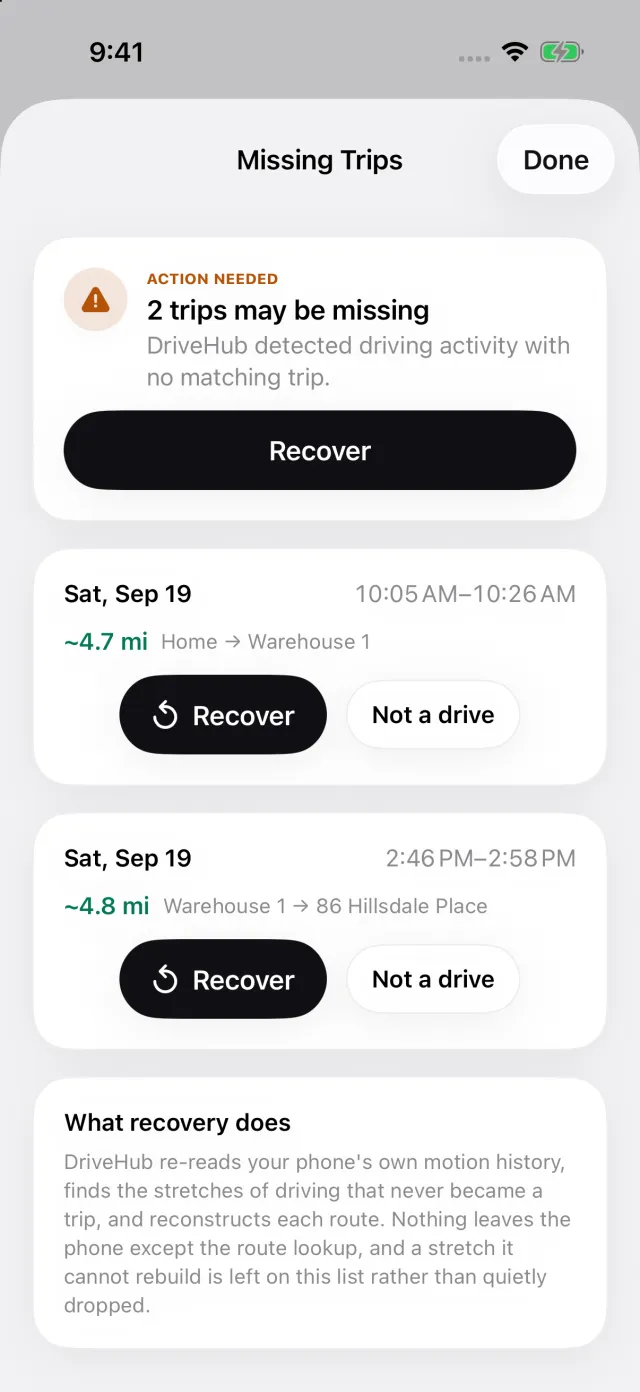
If your iPhone logged driving with no matching trip, a Missed drives story appears on the Trips tab. It opens Missing Trips, and Recover rebuilds the route, so a showing in the middle of the day does not drop out of the log.
The report prints the date, the destination, the purpose you wrote in the note, and the mileage per trip. On a report for one car, it also prints, in a block of their own, the opening and closing odometer readings you enter for the tax year. Each trip is priced at the rate in force on its own date, 72.5 or 76 cents.
Where it stops: DriveHub does not decide whether your brokerage desk is your regular place of business or whether your home office qualifies. Those are facts about your work.
- DriveHub on the App Store
- US mileage log rules
- Set up automatic tracking, and know when a drive is missed
This page states what the Internal Revenue Code, Publications 15-A, 334, 463 and 587, Revenue Ruling 99-7, Treasury Regulation § 1.274-5T and the Schedule C instructions say, and cites them so you can check. It is not tax advice. It can't account for your circumstances. Where money is involved, ask your tax preparer — and bring the log.
Do it in DriveHub
File business and personal trips →
Review suggestions, set working hours and check place rules.
The full rule for United States, with the instruments it comes from: mileage log requirements in the United States.