 DriveHub
Country guide · United States · 9 min
Reconstruct a mileage log for the IRS? A late one counts only if built from records
It is tax time, or a letter from the IRS has arrived, and there is no mileage log — or only part of one. Can you reconstruct a mileage log now? The regulation allows a record made late, but weighs it less, and keeps the word "reconstruction" for records that were lost. The Tax Court has drawn a clear line between the late logs it accepts and the ones it throws out.

The short answer
You may write a log afterwards. Whether it holds depends on what you build it from.
- The law has two routes. IRC § 274(d) accepts "adequate records" or "sufficient evidence corroborating the taxpayer's own statement". A car is on its list, so one of the two is required.
- A late record is allowed, and worth less. The regulation says a record made at or near the time "has a high degree of credibility not present with respect to a statement prepared subsequent thereto".
- "Reconstruction" is a right only for lost records. The regulation grants it where records were destroyed "by fire, flood, earthquake, or other casualty" — not where a log was never kept.
- No estimates. Publication 463: "You can't deduct amounts that you approximate or estimate." The Tax Court may not guess the miles for you either.
- What survives: in the cases, a late log was accepted when it was built from records made at the time and was detailed. Logs built from memory, or without business purposes, were not.
What a complete log contains, and why a same-day entry is not required, is in adequate records for the IRS. This page is about the log you did not keep.
Two routes in the statute, and a car is on its list
§ 274(d) allows no deduction "with respect to any listed property" unless you substantiate it "by adequate records or by sufficient evidence corroborating the taxpayer's own statement". § 280F(d)(4)(A) makes "any passenger automobile" listed property.
For a car, the elements are set out in 26 CFR § 1.274-5T(b)(6): the mileage of each business use and "the total use of the listed property for the taxable period", the date, and the business purpose.
The standard mileage rate does not change this. § 1.274-5(j)(2): "The taxpayer will not be relieved of the requirement to substantiate the amount of each business use (i.e., the business mileage), or the time and business purpose of each use." The rate replaces the receipts, not the log.
A log written late is allowed, and it is worth less
§ 1.274-5T(c)(1) ranks evidence by when it was made:
"Written evidence has considerably more probative value than oral evidence alone. In addition, the probative value of written evidence is greater the closer in time it relates to the expenditure or use."
It then says what a late statement needs:
"… the corroborative evidence required to support a statement not make at or near the time of the expenditure or use must have a high degree of probative value to elevate such statement and evidence to the level of credibility reflected by a record made at or near the time …"
("not make" here, and "corrobative" below, are the regulation's own spelling.) "At or near the time" means you had "full present knowledge of each element" when you wrote it (§ 1.274-5T(c)(2)(ii)(A)).
So a log written in March for last year is not forbidden. It simply starts with less weight, and needs strong support to make up the difference. A log written now, by anyone, is a record made afterwards.
The second route: your own statement plus corroboration
If your records are not adequate, § 1.274-5T(c)(3)(i) lets you prove each element "By his own statement, whether written or oral, containing specific information in detail", together with "other corrobative evidence sufficient to establish such element."
The regulation splits the elements by the kind of evidence each needs:
- The miles and the date need "direct evidence, such as a statement in writing or the oral testimony of … witnesses setting forth detailed information about such element, or the documentary evidence" of (c)(2).
- The business purpose "may be circumstantial evidence."
Publication 463, chapter 5, What if I Have Incomplete Records?, gives a driving example: "the nature of your work, such as making deliveries, provides circumstantial evidence of the use of your car for business purposes. Invoices of deliveries establish when you used the car for business."
Two narrower doors exist. Under (c)(2)(v), a taxpayer who "substantially complied" with the adequate-records rules may prove a missing element "by evidence which the district director shall deem adequate." Under (c)(4), exceptional circumstances apply only where, "by reason of the inherent nature of the situation", you could obtain neither adequate records nor other sufficient evidence, and you present evidence "which possesses the highest degree of probative value possible under the circumstances".
"Reconstruction" in the regulation means lost records
In the regulation, the word appears in § 1.274-5T(c)(5), Loss of records due to circumstances beyond control of the taxpayer:
"Where the taxpayer establishes that the failure to produce adequate records is due to the loss of such records through circumstances beyond the taxpayer's control, such as destruction by fire, flood, earthquake, or other casualty, the taxpayer shall have a right to substantiate a deduction by reasonable reconstruction of his expenditures or use."
Publication 463, Destroyed records, says the same: "Reasons beyond your control include fire, flood, and other casualties."
A log that was simply never kept gets no such right. It falls under the late-record and corroboration rules above.
Even a casualty is not enough on its own. In Patitz v. Commissioner, T.C. Memo. 2022-99, records were lost to Hurricane Matthew. The court: "Crucial to this reconstruction is that the secondary evidence be credible." For one claim in that case, with nothing left to rebuild from: "While the loss of the records was due to unfortunate circumstances, the Court carefully reviewed the record and does not find adequate evidence to allow the deduction." The same case went the other way on the mileage — see below.
No estimates: the Cohan rule does not reach a car
For many expenses, where a court is satisfied that an expense was incurred but not of its amount, it may estimate the amount — the Cohan rule. § 274(d) switches that off.
Sanford v. Commissioner, 50 T.C. 823 (1968), aff'd 412 F.2d 201 (2d Cir. 1969): expenses "not thus substantiated will be disallowed in full." The Second Circuit said the regulation carries out Congress's stated purpose of "insuring 'that no deduction is allowed solely on the basis of his own [the taxpayer's] unsupported self-serving testimony.'"
Sanford was about entertainment. The Tax Court applies it to cars in terms. Ottuso v. Commissioner, T.C. Memo. 2024-91: "The Court may not use the Cohan rule to estimate expenses covered by the strict substantiation requirements of section 274(d), which apply to most transportation expenses."
Ottuso quotes an earlier case, DeLima, T.C. Memo. 2012-291, which shows what that means in practice: "While we do not doubt that [the taxpayer] used one or more vehicles for business during 2005, we have no choice but to deny her any deduction for vehicle expenses in excess of the amount already allowed by respondent".
Believing you drove for business is not enough. The miles have to be shown.
What the Tax Court did with logs written afterwards
Four memorandum opinions show where the line falls.
| Case | Built from | Result |
|---|---|---|
| Aulisio, T.C. Memo. 2024-29 | A calendar and recollection | Rejected; only the miles the IRS conceded |
| Schnackel, T.C. Memo. 2024-76 | Memory, no business purposes | Rejected |
| Jadhav, T.C. Memo. 2023-140 | Nothing made at the time; no documents of time, place or purpose | Rejected |
| Patitz, T.C. Memo. 2022-99 | Handwritten notes made on client visits | Mileage allowed |
Rejected — built from a calendar and recollection. In Aulisio v. Commissioner, T.C. Memo. 2024-29, a mileage log was built from a calendar of client meetings, with addresses and Google Maps distances. The court: "While contemporaneousness is not a strict requirement under section 274(d), substantiation documents created long after the expenditure have much less probative value." Both were "based on petitioner's recollection and are not corroborated by other evidence". The taxpayer claimed 5,200 miles at trial and was allowed the 1,306 miles ($751) the IRS had already conceded — about a quarter.
Rejected — from memory, and no purposes. In Schnackel v. Commissioner, T.C. Memo. 2024-76, the log was "recalled from his memory", prepared in 2012 for the 2011 return. It had destinations and miles but no purposes. The court: "The lack of business purpose on the mileage log makes it insufficient to substantiate the claimed deduction by adequate records".
Rejected — reconstructed logs and odometer readings. In Jadhav v. Commissioner, T.C. Memo. 2023-140, the court found "reconstructions of purported travel logs and odometer readings" with no "documentary evidence or other direct or circumstantial evidence of the time, location, and business purpose". § 274(d) was not met.
Allowed — written up from handwritten logs made on client visits. In Patitz, the taxpayer made handwritten logs on client visits, then transferred them to electronic weekly logbooks with the weekly total, business and commuting miles. The court found the testimony credible and allowed the vehicle mileage.
Schnackel also describes an older case, Larson, T.C. Memo. 2008-187, where logs not prepared at the time were accepted "when … logs were prepared on the basis of contemporaneous records and were exhaustively detailed", together with "highly probative testimony".
So the line is not "written on the day or worthless." A late log survives when it is built from records made at the time, and is detailed. A log built from memory, or without business purposes, does not.
The return asks whether you have evidence
You cannot skip the question at filing time. Schedule C (Form 1040), Part IV, asks:
- "47a Do you have evidence to support your deduction?"
- "b If 'Yes,' is the evidence written?"
Form 4562 lines 24a–24b ask a depreciating filer the same. The line 47 instructions point to Publication 463. The same Part IV asks for your business, commuting and other miles for the year (line 44). Whether a self-employed driver uses the rate or actual costs is set out in standard mileage rate vs actual expenses.
If the IRS examines the return
Publication 463, If your return is examined: "you may have to provide additional information to the IRS. This information could be needed to clarify or to establish the accuracy or reliability of information contained in your records, statements, testimony, or documentary evidence before a deduction is allowed."
That is where a log written afterwards is tested against the rules above. If it fails, the business miles that cannot be shown are disallowed.
A penalty can come on top. IRC § 6662 adds "20 percent of the portion of the underpayment" for negligence or a substantial understatement. An understatement is substantial when it exceeds the greater of 10 % of the tax required to be shown or $5,000. 26 CFR § 1.6662-3(b)(1): "'Negligence' also includes any failure by the taxpayer to keep adequate books and records or to substantiate items properly."
For gig drivers the platform's own mileage figure is no substitute either. In one Uber driver's case the court allowed the miles Uber reported and nothing more — set out in the mileage log for Uber, Lyft and DoorDash drivers.
What a late log can be built from
The sources point the same way. Each item below comes from the regulation, Publication 463 or the cases above.
- Records made at the time. Patitz and Larson turned on notes or records made when the driving happened. Aulisio failed on a calendar the court found rested on recollection.
- Direct or documentary evidence for the miles and dates. The regulation requires it for those elements; Publication 463 names delivery invoices as evidence of when the car was used.
- A business purpose for each trip. Schnackel failed for its absence. The purpose is the one element that may rest on circumstantial evidence.
- The year's total miles. It is one of the elements in § 1.274-5T(b)(6), and line 44 of Schedule C starts from it.
- No estimates. A figure you approximate or estimate cannot be deducted.
How strong your own evidence is depends on your facts, and is a question for your tax preparer.
From now on the problem is easier. A log kept weekly counts as made at or near the time, and "a record of the business use of listed property, such as a computer or automobile, prepared in a computer memory device with the aid of a logging program will constitute an adequate record" (§ 1.274-5T(c)(2)(ii)(C)(2)). A blank US mileage log template (PDF) is one way to keep it.
How DriveHub makes this easier
First, what it cannot do. DriveHub cannot reconstruct a year it was not installed for. Nor does it create trips from a calendar or from memory — the kind of log the Tax Court rejected.
What it does is make sure next year's log is made at the time. With location access set to Always, DriveHub records every drive in the background — and if it ever misses one, it tells you. Business and personal drives are recorded alike, so the year's total is measured rather than added up later.
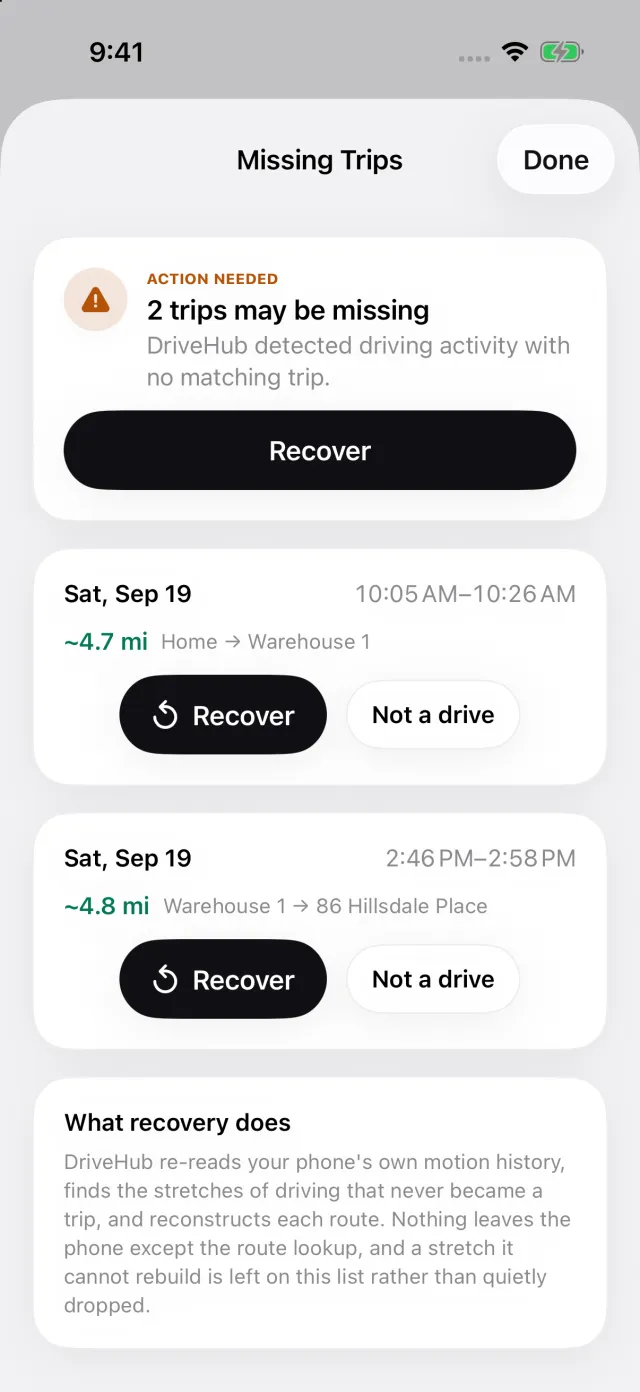
If your iPhone logged driving with no matching trip, a Missed drives story appears on the Trips tab. It opens Missing Trips. Recover rebuilds the route only from driving your iPhone itself logged. Where there is nothing to work from — the phone was off, flat or in Airplane Mode — you add the trip by hand. Turn on Show how each trip was recorded in Report settings, and the report row marks it Manual.
DriveHub files most trips as Business or Personal by your places, past routes and working hours, and asks you about the rest. Write the purpose in your own words while you still remember it. The report prints the date, the destination, the business purpose and the mileage per trip. On a report for one car, it also prints the tax year's opening and closing odometer readings you enter as their own block — the total that line 44 of Schedule C divides into business, commuting and other miles.
If you kept trips in another mileage app, Import from Another App brings them across with their original dates.
- DriveHub on the App Store
- US mileage log rules
- Set up automatic tracking, and know when a drive is missed
This page states what Publication 463, the Internal Revenue Code, its regulations and the Tax Court say, and cites them so you can check. It is not tax advice. It can't account for your circumstances. Where money is involved, ask your tax preparer — and bring the log.
Do it in DriveHub
Enter a drive that DriveHub did not record, with its time, distance, vehicle and endpoints.
The full rule for United States, with the instruments it comes from: mileage log requirements in the United States.