 DriveHub
Country guide · United States · 10 min
Personal use of a company vehicle is taxable pay. Your log decides how much
Your employer gave you a company car, and you drive it home, at weekends and to clients. Personal use of a company vehicle is taxable: its value goes on your W-2 as pay. Only the miles you can show were business stay out of it, so the log decides how much of the car is taxed.

The short answer
- Is personal use of a company car taxable? Yes. It is a fringe benefit, and fringe benefits are pay unless the law excludes them (Publication 15-B § 1).
- Is the commute personal use? Yes. Publication 15-B's own first example of a fringe benefit is letting an employee use a business vehicle "to commute to and from work."
- What stays tax-free? The business use, but only the part your records prove. Unrecorded use is taxed as personal.
- Who values it? Your employer, by fair market value or one of three special rules: cents-per-mile, the commuting rule ($1.50 per one-way commute) or the annual lease value.
- Do I need a log? Usually. You don't if the vehicle is a qualified nonpersonal-use vehicle, if your employer runs a written no-personal-use or commute-only policy, or if your employer simply taxes the whole value.
- Can I deduct the business miles myself? Not at the standard mileage rate, and for most W-2 employees not at all. The log has to reach your employer before the W-2 is made.
Why personal use of a company vehicle is taxable
The starting point is broad. Publication 15-B § 1: "Any fringe benefit you provide is taxable and must be included in the recipient's pay unless the law specifically excludes it."
Publication 463 says the same from the driver's side: "If an employer-provided vehicle was available for your use, you received a fringe benefit. Generally, your employer must include the value of the use or availability of the vehicle in your income."
The law's exception here is the working condition benefit. So the real question is how much of the car's use is business, and how that is proven.
The business share is excluded, on records only
The working condition benefit excludes what would have been deductible to you as a business expense had you paid for it. Publication 15-B § 2: "The employee must meet any substantiation requirements that apply to the deduction." Its first example is "an employee's use of a company car for business".
When one car is used both ways, the split is by miles. The regulation's own example, 26 CFR § 1.132-5(b)(1)(i): a car worth $2,000 for the year, 6,000 business miles and 2,000 other miles. The business share is $2,000 × 6,000 ÷ 8,000 = $1,500. The other $500 is pay.
The records rule is strict. Under § 1.132-5(c)(1), nothing is excluded, "by either the employer or the employee, unless the applicable substantiation requirements of either section 274(d) or section 162 … are satisfied." Records you hand over, and your employer relies on, count: they "will be sufficient to substantiate a working condition fringe exclusion" (§ 1.132-5(c)(2)).
Every unlogged mile is personal
Publication 15-B § 3 puts the burden on you: substantiate "the usage (mileage, for example), the time and place of the travel, and the business purpose of the travel. Written records made at the time of each business use are the best evidence."
Then the default: "Any use of a company-provided vehicle that isn't substantiated as business use is included in income."
On a company car the log shrinks the amount added to your wages. A business trip nobody wrote down is taxed as personal.
What counts as personal use
Personal use is wider than weekends.
- The commute. Driving between home and your regular workplace is personal, as the Publication 15-B example above shows. Which drives count as a commute, and which do not, is in commuting miles in the US.
- Your other work. Under 26 CFR § 1.274-6T(e)(5), personal use "includes use in any trade or business other than the trade or business of being the employee of the employer providing the vehicle." Delivering for a side gig in the company car is personal use.
How your employer values the personal use
Under Publication 15-B § 4, your employer values the personal use and includes it in your wages. It uses fair market value or one of three special rules: cents-per-mile, the commuting rule (for commuting only) or the lease value rule.
The choice is your employer's, car by car. 26 CFR § 1.61-21(c)(2)(ii): "An employee may use a special valuation rule only if the employer uses that rule", though "The employee may always use general valuation rules based on facts and circumstances".
Fair market value
The general rule asks what a lease would cost: "the amount the employee would have to pay a third party to lease the same or similar vehicle on the same or comparable terms in the geographic area where the employee uses the vehicle."
The cents-per-mile rule
The employer multiplies "the standard mileage rate by the total miles the employee drives the vehicle for personal purposes." This is the rule where your personal miles are the whole calculation.
It is open only to a vehicle that passes one of two tests:
- Regular business use. The employer "reasonably expect[s] the vehicle to be regularly used in your trade or business throughout the calendar year." Safe harbours: "At least 50% of the vehicle's total annual mileage is for your trade or business", or a commuting pool of "at least three employees".
- Mileage. The car is "actually driven at least 10,000 miles during the year" and "used during the year primarily by employees." If only one employee drives it 10,000 miles, it passes "even if all miles driven by the employee are personal."
Three more conditions. The car's value is capped: "the maximum FMV of automobiles (including trucks and vans) first made available to employees in calendar year 2026 is $61,700" (Notice 2026-10 § 6). The rule must apply from the first day the car is available for personal use, and in later years while it qualifies. And the rate "includes the value of maintenance and insurance"; fuel is included for miles in the US, Canada and Mexico, and "If you don't provide fuel, you can reduce the rate by no more than 5.5 cents."
Which rate applies in 2026
2026 has two business mileage rates: 72.5 cents to 30 June (Notice 2026-10 § 3) and 76 cents from 1 July (Announcement 2026-11). The announcement covers deductions and reimbursements and does not mention the value of personal use. Publication 15-B's 2026 update says "For 2026, the standard mileage rate is 72.5 cents per mile", and § 1.61-21(e)(1)(i) applies a new rate "prospectively from the first day of the taxable year following the date of publication …" That points to 72.5 cents for all of 2026, but no IRS text says so in terms. Ask payroll which rate it used.
Worked example, at the 72.5 cents Publication 15-B published. You drive 3,000 personal miles in 2026 and your employer pays for fuel.
- 3,000 × $0.725 = $2,175 added to your wages.
- If you pay for your own fuel and the employer takes the full reduction: $0.725 − $0.055 = $0.67, and 3,000 × $0.67 = $2,010.
The commuting rule: $1.50 per one-way trip
For a car you may only commute in, Publication 15-B: the value is "each one-way commute (that is, from home to work or from work to home) by $1.50. If more than one employee commutes in the vehicle, this value applies to each employee." The $1.50 "includes the value of any goods or services directly related to the vehicle (e.g., fuel)" (§ 1.61-21(f)(3)(i)).
All four conditions must hold:
- Your employer, "for bona fide noncompensatory business reasons", requires you to commute in the vehicle.
- A written policy bars personal use "other than for commuting or de minimis personal use (such as a stop for a personal errand on the way between a business delivery and the employee's home)".
- You don't in fact use it personally beyond that.
- For a car, you are not a control employee. For 2026 that is an officer paid $145,000 or more, a director, an employee paid $290,000 or more, or an owner of 1% or more of the business. If you own an S corporation and drive its car, S corp mileage reimbursement sets out the rules for an owner.
Worked example. You commute on 230 days, there and back. That is 460 one-way trips × $1.50 = $690 for the year.
The annual lease value rule
The employer takes the car's fair market value "on the first date it is available to any employee for personal use" and reads the annual lease value from Table 3-1, from $600 for a car worth up to $999 to $15,250 for one worth $58,000–59,999. Above $59,999, the value is 0.25 × the car's value + $500. Then it "Multiply[s] the annual lease value by the percentage of personal miles out of total miles driven by the employee."
Worked example. A car worth $60,000: 0.25 × $60,000 + $500 = $15,500. You drive 20,000 miles, 4,000 of them personal: 20%. Added to your wages: $15,500 × 20% = $3,100.
The table "includes the value of maintenance and insurance" but not fuel. Fuel your employer provides is valued separately, at fair market value "or at 5.5 cents per mile for all miles driven by the employee." The lease value holds until 31 December of the fourth full calendar year after that date, and a car available for part of the year is prorated by days, with a daily lease value under 30 days.
When the whole value goes on your W-2
On the lease value rule, your employer "may include in an employee's gross income the entire Annual Lease Value of the automobile" (§ 1.132-5(b)(1)(iv)). Publication 463: "Your employer must separately state the amount if 100% of the annual lease value was included in your income."
The regulation lets you then deduct the business use on your own return, but for most employees that door is shut. Form 2106 is now only for reservists, performing artists, fee-basis officials and employees with impairment-related expenses. And for a car your employer provides, "You can't use the standard mileage rate" (Publication 463 ch. 6).
So for an ordinary W-2 employee, a 100% inclusion is not recovered at tax time. The log has to reach your employer before the W-2 is made. Why the employee deduction is gone is in adequate records for the IRS.
When you don't need a log
A qualified nonpersonal-use vehicle. Publication 15-B § 2: "All of an employee's use of a qualified nonpersonal use vehicle is a working condition benefit." The list includes clearly marked police, fire and public safety vehicles, ambulances and hearses used for their purpose, cargo vehicles over 14,000 lb loaded and delivery trucks seating only the driver (plus a folding jump seat). A pickup or van of 14,000 lb or less qualifies only if "specially modified so it isn't likely to be used more than minimally for personal purposes", such as permanent markings plus a lift gate or permanent shelving. An ordinary marked car is not on the list.
A written policy kept by your employer. Under 26 CFR § 1.274-6T(a)(1), a policy of no personal use, or none except commuting, "will satisfy the employer's substantiation requirements under section 274(d). Therefore, the employee need not keep a separate set of records".
- No personal use: the car stays on the employer's premises when not in business use, nobody using it lives there, and a written policy bars all but de minimis personal use.
- No personal use except commuting: you include the commuting value in income, on the commuting rule's conditions.
Either way, there must be evidence that lets the IRS check the conditions were met.
Giving up the exclusion. Your employer may "includ[e] the value of the availability of the vehicle during the relevant period in the employee's gross income without any exclusion for a working condition fringe" (§ 1.274-6T(c)). No log is needed, and nothing is excluded either.
The choice sticks. Having filed on one method, the taxpayer "may not later use another of these methods" (§ 1.274-6T(d)). In the regulation's example, an employee who excluded 90% on records that failed the test was then limited to "other corroborative evidence".
What your log has to show
The Publication 15-B list above: mileage, time and place, business purpose. Give your total miles too: the business share is allocated by miles, and the lease value rule multiplies by personal miles out of total miles.
The log does not have to be written on the day. 26 CFR § 1.274-5T(c)(1): "A contemporaneous log is not required", and a weekly log counts as made at or near the time. The full standard is in what the IRS means by adequate records. If part of the year is already missing, reconstructing a mileage log explains what still counts.
When it reaches your W-2
Your employer "must determine the value of taxable noncash fringe benefits no later than January 31 of the next year", and may treat them as paid per pay period, quarter, half-year or year.
- November and December can move to next year. Under the special accounting rule, your employer may treat the last two months as paid in the following year. It must tell you, and you then use the same period.
- Income tax may not be withheld. Your employer may elect not to withhold it on personal use of the car. "You must, however, withhold the applicable social security and Medicare taxes", and you must be told in writing.
- Where it shows. The value goes in box 1 of Form W-2, also in boxes 3 and 5, and may be shown in box 14, where it must appear if your employer elected not to withhold income tax.
If you use your own car instead, none of this applies: see using your own car for work.
How DriveHub makes this easier
With location access set to Always, DriveHub records every drive in the background — and if it ever misses one, it tells you. Business and personal drives are recorded alike, so the total is measured rather than estimated. DriveHub files most trips as Business or Personal by your places, past routes and working hours, and asks you about the rest under Need to check. Answer Commute for a drive between home and your office. Don't put a Personal rule on the office: it would also file your client-to-office drives as Personal.
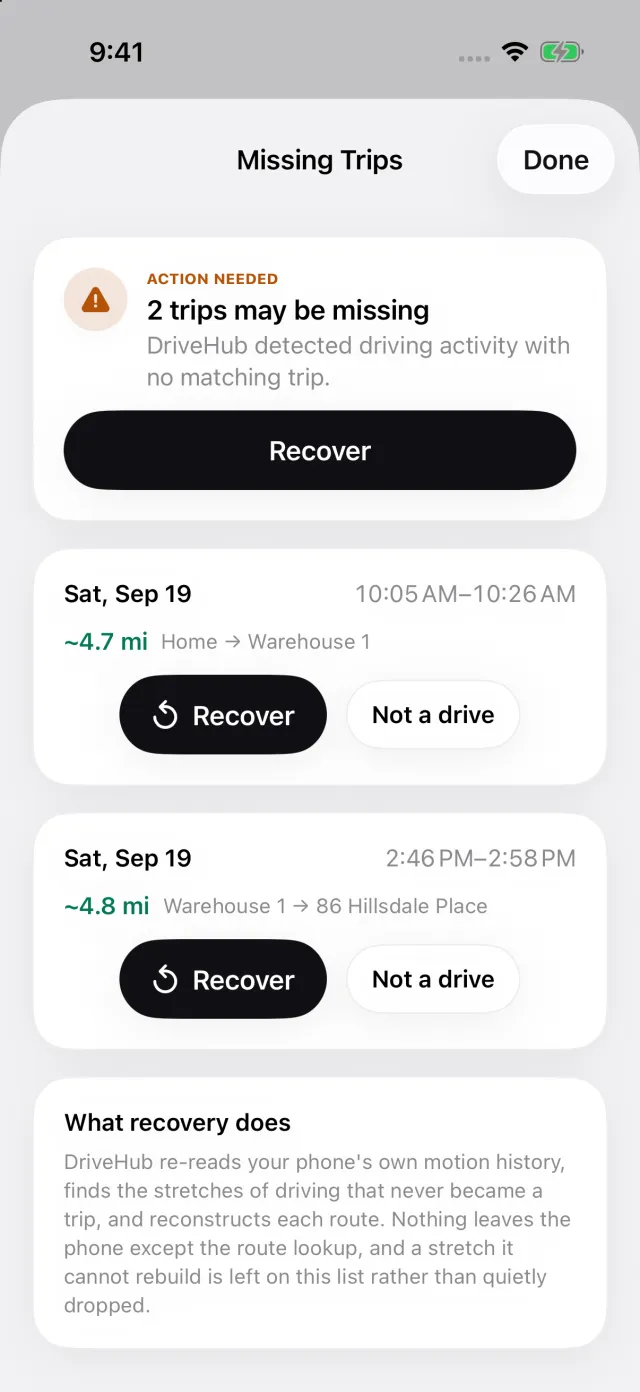
If your iPhone logged driving with no matching trip, Missed drives appears on the Trips tab and opens the Missing Trips list, where Recover rebuilds the route. A business trip that failed to record is one that would be taxed as personal.
Reports shows business and personal miles for any period or a range you choose, for one vehicle or all. On a report for one car, the PDF and Excel export add Miles by use, with the drives you answered Commute kept apart from other personal miles, and the tax year's opening and closing odometer readings you enter. With DriveHub Pro it exports as PDF, Excel or CSV, as the record for your employer.
Where DriveHub stops: it does not value your personal use, it does not know which rule your employer chose, and it sends nothing to your employer.
- DriveHub on the App Store
- US mileage log rules
- Set up automatic tracking, and know when a drive is missed
This page states what Publications 15-B and 463, Notice 2026-10, Announcement 2026-11 and the regulations say, and cites them so you can check. It is not tax advice. It can't account for your circumstances. Where money is involved, ask your employer's payroll team or your tax preparer — and bring the log.
Do it in DriveHub
File business and personal trips →
Review suggestions, set working hours and check place rules.
The full rule for United States, with the instruments it comes from: mileage log requirements in the United States.