 DriveHub
Country guide · United States · 9 min
S corp mileage reimbursement: how an owner pays themselves back for the car
You own an S corporation and drive for it. You can have it reimburse your miles tax-free, as for any employee. But you sign the check and cash it, and the IRS treats an owner differently. Above 10% it can ask you for the log; above 2% you count as a partner for fringe benefits; at 1% the flat commuting rule is closed.

The short answer
- Your own car, reimbursed per mile: an accountable plan works for you as for any employee. Report the miles, return what you didn't use, and the payments aren't wages.
- The rate: for 2026, 72.5 cents a mile to 30 June and 76 cents from 1 July. Above the rate, the excess is wages.
- The owner's catch: own more than 10% and you are "related" to your employer. You "must be able to prove your expenses to the IRS" even after accounting to the corporation.
- A written plan: good evidence, but the regulation does not require one.
- A flat car allowance you pay yourself: without accounting for it, it is pay.
- The corporation's car instead: the business miles you record stay tax-free. The personal use is wages on your W-2, and the flat $1.50 commuting rule is closed to anyone owning 1% or more.
Either way, the miles you can prove decide the money. The log is the same log.
Can an S corp owner reimburse themselves for mileage?
Yes. If you work for your S corporation, you are, in the IRS's words, a shareholder-employee. A reimbursement for your own car follows the same rules as for any employee: IRC § 62(c) and 26 CFR § 1.62-2. Publication 463, chapter 6, states the three requirements:
- "Your expenses must have a business connection."
- "You must adequately account to your employer for these expenses within a reasonable period of time."
- "You must return any excess reimbursement or allowance within a reasonable period of time."
Meet them, and the payments "are excluded from the employee's gross income, are not reported as wages or other compensation on the employee's Form W-2, and are exempt from the withholding and payment of employment taxes" (§ 1.62-2(c)(4)).
For a car, the record goes to the payor: "information sufficient to substantiate the amount, time, use, and business purpose of the expense" (§ 1.62-2(e)(2)). Under a per-mile allowance the amount is treated as proven up to the IRS rate. You still show "the elements of time, place (or use), and business purpose" (Rev. Proc. 2019-46 § 7.02).
As the owner, you are the employee who reports and the employer who checks. The deadlines, the 60 and 120 days of the fixed date method, and the rate rules are the same as for anyone. They are set out in using your own car for work in the US.
Own more than 10%? The IRS can still ask for the log
This is the rule that applies to owners and not to staff. Publication 463, chapter 6, lists as a condition for the allowance to prove the amount: "You aren't related to your employer."
Related includes this case: "Your employer is a corporation in which you own, directly or indirectly, more than 10% in value of the outstanding stock." Indirect ownership counts too: "if you have an interest in a corporation, partnership, estate, or trust that owns the stock or if a member of your family or your partner owns the stock."
The consequence: such an employee "must be able to prove your expenses to the IRS even if you have already adequately accounted to your employer and returned any excess reimbursement."
So accounting to your own corporation does not end it. The log you hand the company is the log the IRS can ask for. Rev. Proc. 2019-46, which sets the mileage-allowance rules, contains no rule that shuts a related employee out of the allowance. The duty to prove the miles is what changes.
Does the plan have to be in writing?
The regulation does not say so. 26 CFR § 1.62-2's requirements are the three above: business connection, substantiation and return of the excess. Publication 15 and Publication 463 add no writing requirement either.
A written plan is still good evidence that an arrangement exists, and of what it requires.
A flat car allowance you pay yourself is pay
A fixed monthly amount with no mileage report is not an accountable plan. IRC § 62(c): an arrangement is "in no event" a reimbursement arrangement if it "does not require the employee to substantiate the expenses" covered by the arrangement.
Then "all amounts paid under the arrangement are treated as paid under a 'nonaccountable plan'" (§ 1.62-2(c)(3)(i)). Such amounts "are included in the employee's gross income, must be reported as wages or other compensation on the employee's Form W-2, and are subject to withholding and payment of employment taxes" (§ 1.62-2(c)(5)).
For an S corporation owner this sits beside a second rule. The IRS, on its page on S corporation compensation: "S corporations must pay reasonable compensation to a shareholder-employee in return for services that the employee provides to the corporation before non-wage distributions may be made to the shareholder-employee." A car allowance paid without substantiation is not a reimbursement. It is pay, and it goes on your W-2.
Two more limits from the general rules:
- Above the IRS rate, the part over "the business standard mileage rate multiplied by the number of substantiated business miles" is wages (Rev. Proc. 2019-46 §§ 7.01(1), 7.05).
- The commute is not business. Publication 463: driving "between your home and your main or regular place of work" is a personal commuting expense. Publication 463 treats a reimbursement of a nondeductible expense as paid under a nonaccountable plan. Read the two rules together, and a per-mile payment for the commute is wages. The exceptions are in commuting miles in the US.
Worked example: your own car, paid back at the IRS rate
In 2026 you drive your own car 8,000 business miles for your S corporation: 4,000 before 1 July and 4,000 after. You report each trip to the corporation, and it pays exactly the IRS rate.
| Jan.–June (72.5 ¢) | July–Dec. (76 ¢) | |
|---|---|---|
| Business miles | 4,000 | 4,000 |
| Reimbursed | 4,000 × $0.725 = $2,900 | 4,000 × $0.76 = $3,040 |
For the year: $5,940, none of it wages, because nothing exceeds the rate. "If your allowance is less than or equal to the federal rate, the allowance won't be included in box 1 of your Form W-2" (Publication 463).
Had you taken a flat $500 a month instead, with no report, the whole $6,000 would be wages.
Should my S corp own my car?
That is the other way to do it: the corporation owns or leases the car and you drive it. The rules then change from reimbursement to fringe benefit.
The 2% shareholder rule. IRC § 1372(a): for employee fringe benefits, "the S corporation shall be treated as a partnership, and … any 2-percent shareholder of the S corporation shall be treated as a partner of such partnership." A 2-percent shareholder owns, directly or by attribution, "more than 2 percent of the outstanding stock" on any day of the year.
The business miles stay tax-free anyway. Publication 15-B's Table 2-1 marks the benefits that don't apply to 2% shareholders. Working condition benefits carry no such mark. And for that exclusion a partner counts as an employee: "A partner who performs services for a partnership." Its examples of working condition benefits include "an employee's use of a company car for business".
But only on records. Publication 15-B: "The employee must meet any substantiation requirements that apply to the deduction." And Publication 15-B: "Any use of a company-provided vehicle that isn't substantiated as business use is included in income." With no log, every mile is personal.
The personal share is wages. The Form 1120-S instructions, line 7, Compensation of officers: "Include fringe benefit expenditures made on behalf of officers and employees owning more than 2% of the corporation's stock. Also report these fringe benefits as wages in box 1 of Form W-2." The valuation rules reach you: the person taxed "need not be an employee of the provider of the fringe benefit, but may be, for example, a partner" (§ 1.61-21(a)(4)(ii)).
How the personal use is valued when you own the company
Publication 15-B gives the employer the fair market value rule and three special rules, set out in full in company car personal use in the US. As an owner, one of the three is closed to you.
No $1.50 commuting rule. A control employee includes one "who owns a 1% or more equity, capital, or profits interest in your business". For a car, the commuting rule requires that the driver "isn't a control employee". For the same reason the commuting-only written policy of § 1.274-6T(a)(3) is closed to an owner.
That leaves three:
- Cents-per-mile: the standard mileage rate times your personal miles. The car must be regularly used in the business (at least 50% of its annual miles is one safe harbor) or meet a 10,000-mile test.
- Annual lease value: a table value set by the car's value, times "the percentage of personal miles out of total miles driven". Above $59,999, it is (0.25 × the value) + $500.
- Fair market value: what it would cost you to lease a similar car on similar terms in your area.
For cents-per-mile, a car first made available in 2026 may be worth at most $61,700. For 2026 Publication 15-B published 72.5 cents for this rule; no IRS text says that July's 76 cents applies to it. Under the lease value rule, fuel the corporation provides is valued on top, at fair market value or 5.5 cents a mile.
Worked example. You drive the corporation's car 20,000 miles in 2026, 15,000 of them business, so 5,000 personal (25%).
| Car worth $45,000 — cents-per-mile | Car worth $64,000 — annual lease value | |
|---|---|---|
| Rule available? | Yes: 75% business use, value under $61,700 | Cents-per-mile closed: value over $61,700 |
| Personal-use value | 5,000 × $0.725 = $3,625 | (0.25 × $64,000) + $500 = $16,500; × 25% = $4,125 |
Either figure is wages in box 1 of your W-2. Lose the log, and the whole use is personal; whether a late log can still help is in reconstructing a mileage log. The car values here are invented for the arithmetic; the rules are Publication 15-B's.
One more difference. As the driver of a car the corporation provides, "You can't use the standard mileage rate" yourself (Publication 463). The rate becomes the corporation's yardstick for your personal use, not a figure you are paid.
Your car reimbursed, or the corporation's car
| Your car, reimbursed per mile | The S corporation's car | |
|---|---|---|
| What the log does | Proves the miles for the reimbursement | Keeps business use out of your wages |
| Business miles | Paid tax-free up to the IRS rate | Excluded as a working condition benefit |
| Personal miles | A payment for them is wages | Valued and added to your W-2 wages |
| Commute | A payment for it is wages | Personal; the $1.50 rule is closed to you |
| No log | Payments become wages | All use is personal |
| IRS can ask you | Yes, if you own more than 10% | Yes: the exclusion rests on your records |
Which costs less depends on the car, your miles and your pay. That comparison is for your tax preparer, with your figures. If you are self-employed without a corporation, the choice is a different one: see standard mileage rate or actual expenses.
What the log has to show in either case
Per trip, Publication 463 asks for the date, the destination, the business miles and the business purpose. For the corporation's car, Publication 463 also asks per year for "the total miles for the year" — the figure that splits the car into business and personal.
It doesn't have to be written the same day. 26 CFR § 1.274-5T(c)(1): "A contemporaneous log is not required", and a weekly log counts as made at or near the time. The detail is in what the IRS means by adequate records.
How DriveHub makes this easier
For an S corporation owner, everything above rests on miles you can show the corporation and the IRS alike.
With location access set to Always, DriveHub records every drive in the background — and if it ever misses one, it tells you. It keeps the date, the start and end, and the distance. DriveHub files most trips as Business or Personal by your places, past routes and working hours, and asks you about the rest under Need to check. Answer Commute for a drive between home and your office; it counts with your personal miles. Add the business purpose in your own words.
If your iPhone logged driving with no matching trip, Missed drives appears on the Trips tab, and Recover rebuilds the route.
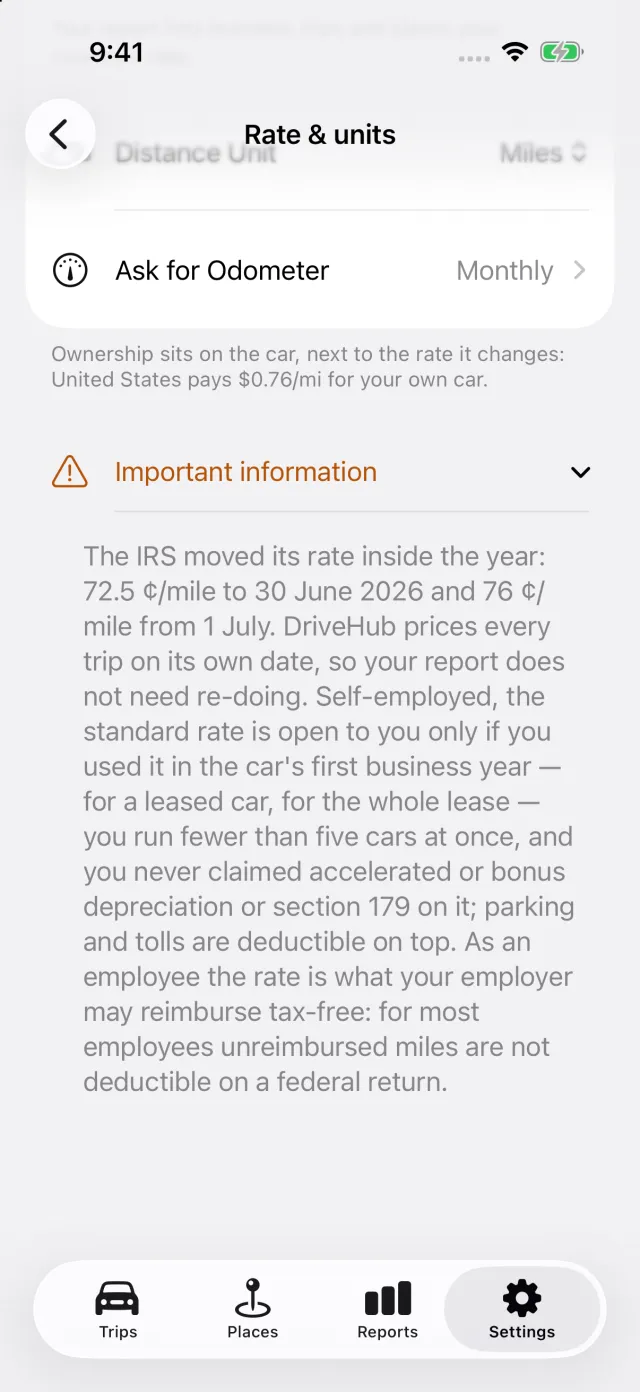
Whether the car is yours or the corporation's is set on the car, beside the rate it changes. For your own car, each trip is priced at the IRS rate in force on its date: 72.5 cents before 1 July 2026, 76 cents from then.
Reports shows business and personal miles by day, week, month, quarter or year, for one vehicle or all. For your own car, the amount it shows at the IRS rate is the reimbursement claim.
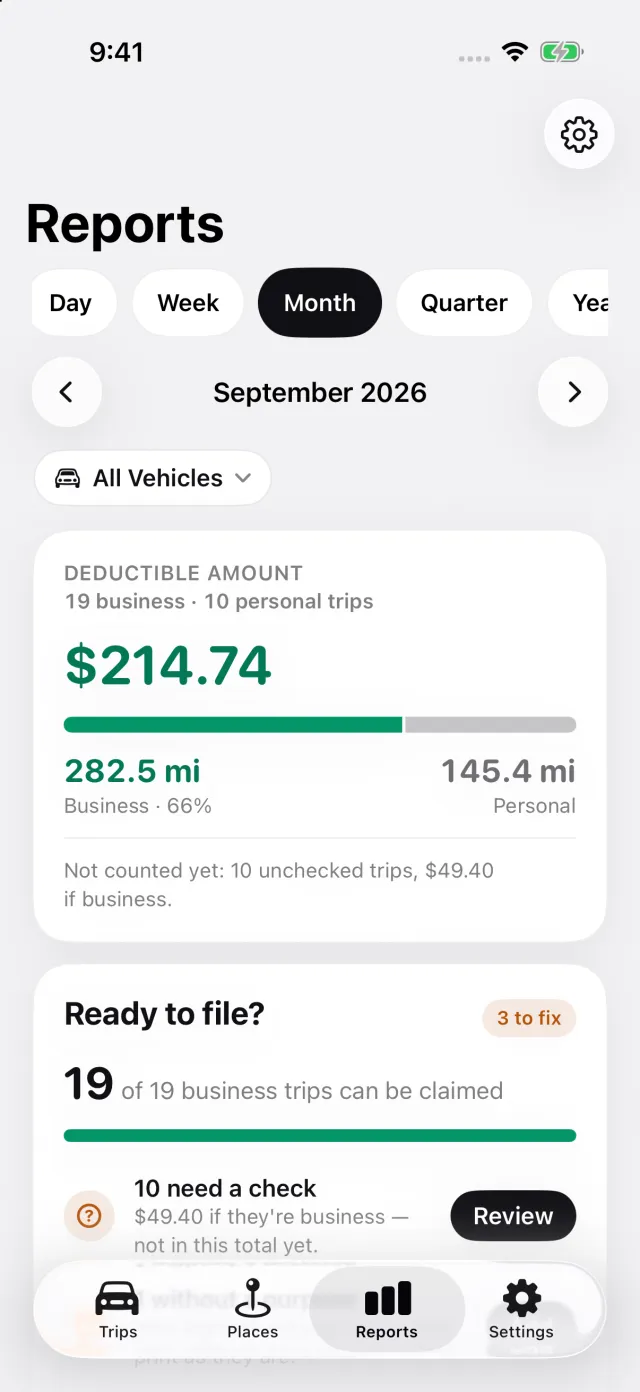
For the corporation's car, the personal miles on the same report are the share your corporation values. A report for that one car also prints the tax year's opening and closing odometer readings you enter. With DriveHub Pro the report exports as PDF, Excel or CSV.
Where DriveHub stops: it doesn't run payroll, approve your claim or fill in a W-2. It does not value the personal use of a corporation's car or choose a valuation rule.
DriveHub is on the App Store for iPhone. The United States rules are on the US page, and setting up automatic tracking takes a few minutes, once.
This page states what the Internal Revenue Code, its regulations, IRS Publications 15, 15-B and 463, Rev. Proc. 2019-46, the Form 1120-S instructions and the IRS's S corporation compensation page say, and cites them so you can check. It is not tax advice. It can't account for your circumstances. Where money is involved, ask your tax preparer — and bring the log.
Do it in DriveHub
Employment dates, different rates and trips for more than one job.
The full rule for United States, with the instruments it comes from: mileage log requirements in the United States.