 DriveHub
Country guide · United Kingdom · 9 min
Delivery driver mileage claim in the UK: 55p a mile or the £1,000 allowance
You deliver or drive for an app in your own car or van, and the miles go on your Self Assessment return. A delivery driver's mileage claim in the UK is 55p a mile for 2026-27 — or the £1,000 trading allowance instead of it. Which is worth more depends on your miles, and which miles count depends on where your working day starts.

The short answer
- The flat rate for 2026-27 is 55p a mile for the first 10,000 business miles and 25p after, in a car or van. A motorcycle is 24p. Many pages still say 45p: that was the rate up to 5 April 2026.
- Or the £1,000 trading allowance. It replaces your expenses; it is never added to them. You take one or the other.
- The mileage route wins once your business miles reach about 1,819 a year (1,819 × 55p is just over £1,000), before any other costs.
- Parking, tolls and congestion charges go on top of the flat rate. Fines never do.
- Black cabs and hackney carriages can't use the flat rate. HMRC's pages don't mention private hire cars either way.
- The drive to your first job and home from your last is decided on your facts. HMRC has given no rule for app or delivery drivers; two court cases point in opposite directions.
- Several apps, one band or several? No HMRC text answers whether driving for several apps is one trade or several.
- The log is the claim. HMRC wants "a contemporaneous record of business mileage". Keep it five years after the 31 January filing deadline.
The rate is 55p for 2026-27, not 45p
A self-employed driver can deduct a flat rate per business mile instead of the car's real costs. It is in the Income Tax (Trading and Other Income) Act 2005, Part 2, Chapter 5A. The Taxation (Energy and Vehicles) Act 2026, s. 2 raised the car and van rate from 45p to 55p. It applies "for the tax year 2026-27 and subsequent tax years."
| Vehicle | 2026-27 | Before 6 April 2026 |
|---|---|---|
| Car or van, first 10,000 business miles | 55p | 45p |
| Car or van, after 10,000 business miles | 25p | 25p |
| Motorcycle | 24p | 24p |
gov.uk and HMRC's Business Income Manual, BIM75005, print both columns. HMRC's policy paper of 17 June 2026 says the new rates "will also apply to businesses that use simplified mileage rates". The rates are under review, to be set out at the Budget on 28 October 2026.
The rate covers buying and running the vehicle: "fuel, oil, servicing, repairs, insurance, vehicle excise duty and MOT", and depreciation (BIM75005). You can't claim those on top. What you can add is "tolls, congestion charges and parking fees", where they are "incurred solely for business purposes."
How the rate and the actual-cost route compare, and why the choice sticks to a vehicle, is in self-employed mileage in the UK. This page covers what is particular to delivery and app work.
Mileage or the £1,000 trading allowance: you can't have both
Every individual has a £1,000 trading allowance. ITTOIA 2005 s. 783AD(1): "For the purposes of this Chapter, an individual's trading allowance for a tax year is £1,000." It is measured against your gross receipts from all your trades together, not each app separately (s. 783AC(1)).
It works in two ways:
- Receipts of £1,000 or less. The profits of each trade are "treated as nil" (s. 783AF(2)), unless you elect out. gov.uk: "If your annual gross trading income is £1,000 or less, from one or more trades you may not have to tell HMRC".
- Receipts above £1,000. You can elect to take your receipts minus £1,000, with no expenses deducted (s. 783AI(2)). Above £1,000 you also have to "register for Self Assessment".
gov.uk is plain on the trade-off: "You cannot deduct any other expenses or allowances if you claim the allowances." So the trading allowance replaces your mileage, your parking and everything else. And "If your expenses are more than your income it may be beneficial to claim expenses instead of the allowances."
Both elections are due "on or before the first anniversary of the normal self-assessment filing date" (ss. 783AL(2), 783AM(2)).
Worked examples (illustrative, 2026-27, car, flat rate)
A full-time courier. £9,000 of app receipts and 5,000 business miles.
- Mileage route: 5,000 × 55p = £2,750. Taxable profit: £9,000 − £2,750 = £6,250
- Trading allowance: £9,000 − £1,000 = £8,000
- The mileage route leaves £1,750 less taxable profit, before parking or any other cost.
A few evenings a month. £1,400 of receipts and 1,200 business miles.
- Mileage route: 1,200 × 55p = £660. Taxable profit: £1,400 − £660 = £740
- Trading allowance: £1,400 − £1,000 = £400
- Here the allowance leaves £340 less taxable profit, unless parking and your other costs come to more than £340.
Over 10,000 miles. 14,000 business miles in the year.
- First 10,000 × 55p = £5,500
- Remaining 4,000 × 25p = £1,000
- Mileage deduction: £6,500
The tipping point is simple arithmetic. At 55p, 1,818 miles come to £999.90 and 1,819 to £1,000.45. From 1,819 business miles, the mileage alone beats the allowance; parking and other costs bring the point lower.
Who can't use the allowance
gov.uk: "You cannot use the allowances in a tax year, if you have any trade or property income from: a company you or someone connected to you owns or controls; a partnership where you or someone connected to you are partners; your employer or the employer of your spouse or civil partner".
One more limit, from BIM86011: if you work out one trade's profit "in the normal way after the deduction of allowable expenses", full relief can't apply to a second trade. You can't deduct expenses on one and take a nil profit on the other.
Does the drive to your first job count?
This is the question most delivery drivers ask, and HMRC has not answered it for them. HMRC's business-travel pages quoted here don't mention app or delivery drivers. The test is the general one in ITTOIA 2005 s. 34: no deduction for expenses "not incurred wholly and exclusively for the purposes of the trade". HMRC's manual applies it through court cases, and two of them pull in opposite directions.
The starting point: home to work is private. BIM37605: "The cost of travelling from home to place of work is generally disallowed". "It does not matter that the taxpayer may at times work at home or keep their business records, materials, tools etc at home."
The milkman: a fixed round is a base. In Powell v Jackman, a milkman's travel from home to his round was disallowed. BIM37635: "it is quite possible to have a base of operation or place of work which is an area rather than a single place". And: "The site at which business records (financial, accounting and the like) and 'tools of the trade' (clothing, equipment and the like) are kept and maintained does not automatically become the 'base of operations'."
The itinerant trader: work wherever the next job is. BIM37620: "Where an 'itinerant' trader's base of operations is at their residence, you should allow the costs of travelling between the residence and the sites at which the trader works." It quotes Brightman J in Horton v Young: where a person "has no fixed place or places at which he carries on his trade or profession but moves continually from one place to another, … the travelling expenses of that person between his home and the places where from time to time he happens to be exercising his trade or profession will normally be … wholly and exclusively laid out". BIM37635 sums it up: "Horton v Young was a case where Mr Horton's places of work were entirely unpredictable."
Brightman J left a case open himself: "I do not wish to prejudge a case where the occupation is itinerant within a certain area but the taxpayer's home is outside that area."
So the facts decide. A depot, hub or zone you drive to before work starts looks like Powell. Work that sends you wherever the next order is looks like Horton. Picking something up on the way doesn't change a commute: "Visiting a supplier on a 'home to office' journey does not convert an otherwise non-allowable expense into an allowable deduction" (BIM37630).
Waiting and repositioning between jobs
No HMRC text deals with the miles between orders: driving to a busier area, or circling while you wait. The statute counts "any journey, or any identifiable part or proportion of a journey, that is made wholly and exclusively for the purposes of the trade" (s. 94F(5)). Whether your waiting miles meet that is the same facts question. A log that shows when and where you drove is what lets you answer it.
Several apps: one 10,000-mile band or more?
The 55p band is counted per trade. One band covers all the cars and vans that trade uses on the flat rate (s. 94F(4)). Once their business miles pass 10,000 in the period, the rest go at 25p.
Whether driving for several apps is one trade or several is not answered by any HMRC text. Don't assume a separate 10,000 miles per app. The trading allowance has no such question: it is one £1,000 against the receipts of all your trades together.
Which vehicles qualify
gov.uk lists the vehicles: "cars (except those designed for commercial use, for example, black cabs, hackney carriages or dual control driving instructors' cars); goods vehicles (for example, vans); motorcycles". BIM75005 gives black cabs and dual control driving instructor cars as its examples.
The exclusion is about the type of car, a purpose-built cab, not the work. The statute excludes a car "of a type not commonly used as a private vehicle and unsuitable to be so used" (s. 94G(2)(d)). Neither gov.uk nor BIM75005 mentions private hire vehicles.
There is no self-employed rate for a bicycle; the 20p cycle rate is for employees only. A cycle courier deducts actual costs or takes the trading allowance. A limited company can't use the flat rate at all.
What to record, and for how long
The claim is business miles times the rate, so the business miles are the record. BIM75005: "It is therefore important that a contemporaneous record of business mileage is maintained to support any claim using the flat rate." The rate "is not available for private journeys, such as travel from home to work, or for journeys that serve both a business and a private purpose."
gov.uk sets no format: "There are no rules on how you must keep records." But "HMRC can charge you a penalty if your records are not accurate, complete and readable." For a delivery driver, the first and last trip of each shift are the ones the commute question turns on, so their start point and reason matter most.
Keep the records for at least five years after the 31 January submission deadline for the tax year (TMA 1970 s. 12B(2)(a)), longer if HMRC has opened an enquiry into that return. For 2026-27 that deadline is 31 January 2028, so keep the log until at least 31 January 2033, or later if HMRC opens an enquiry into that return.
If you drive for an employer in your own car rather than for yourself, the rules are different: see own car for work in the UK. An employee's commute is tested under the 24-month rule for temporary workplaces, not the court cases above.
How DriveHub makes this easier
With location access set to Always, DriveHub records every drive in the background — and if it ever misses one, it tells you. You don't open anything before a shift. DriveHub files most trips as Business or Personal by your places, past routes and working hours, and asks you about the rest under Need to check.
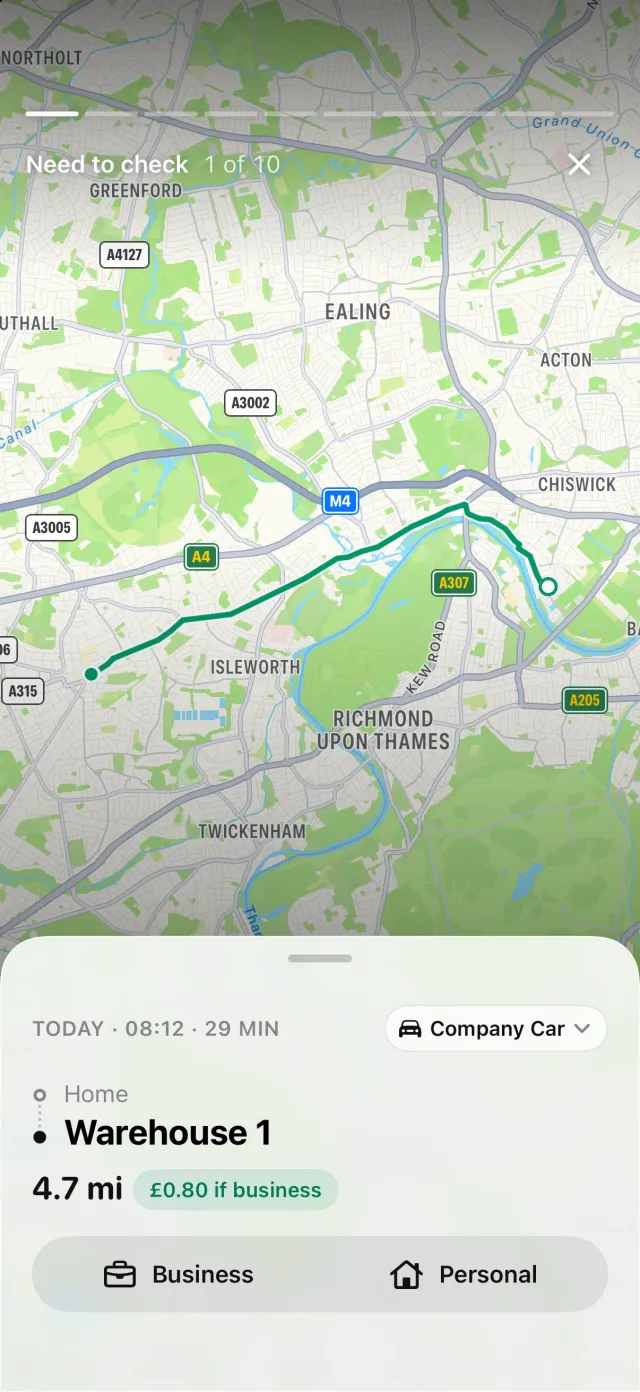
DriveHub has no rule of its own for delivery work. Whether your first trip of the day is business is your call and your accountant's. If you decide a drive from home is a commute, answer Commute under Need to check. The log keeps where each trip started and ended, and the date and time.
Reports shows business and personal miles for any period or a range you choose, such as your period of account, for one vehicle or all. Set your period of account in Settings and the 10,000-mile band counts from it. DriveHub prices each trip at the rate for its day; the business miles are the M in the flat-rate formula, and the number to weigh against the £1,000 allowance. With Pro, the report exports as PDF, Excel or CSV for your accountant.
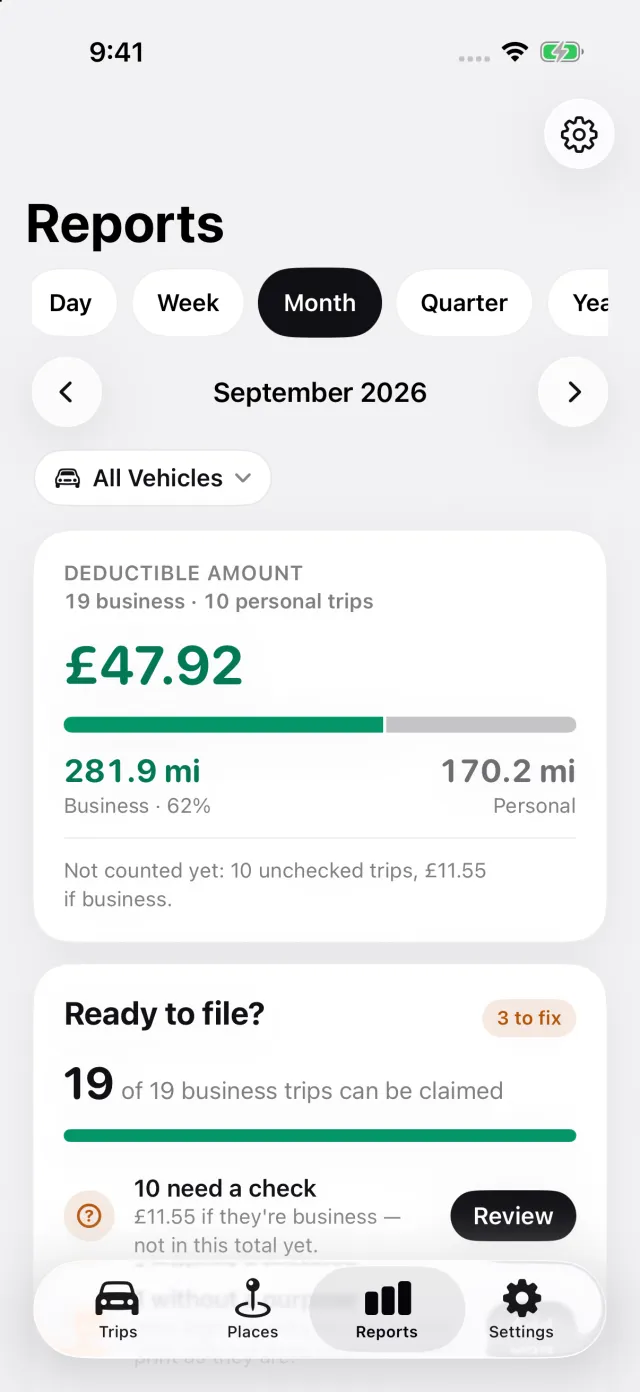
Where DriveHub stops: it isn't connected to any delivery or ride app, and it doesn't read your orders or earnings. It doesn't decide whether your apps are one trade, and it doesn't work out the trading allowance or file your return. It doesn't record parking, tolls or congestion charges. Its reports cover the trips in your log — recorded, recovered, imported or added by hand.
DriveHub is on the App Store for iPhone. The UK rules it follows are on the UK page, and setting up automatic tracking takes a few minutes, once.
This page states what HMRC and the legislation say, and cites them so you can check. It is not tax advice. It can't account for your circumstances. Where money is involved, ask your accountant — and bring the log.
Do it in DriveHub
UK: HMRC fuel rates and Making Tax Digital →
Set the fuel for a company car, read the 10,000-mile tax year and export a quarterly update.
The full rule for United Kingdom, with the instruments it comes from: mileage log requirements in the United Kingdom.