 DriveHub
Country guide · United Kingdom · 9 min
Company car, your own fuel: business miles at the Advisory Fuel Rate
You drive a company car but buy the fuel yourself. Your employer repays business miles at HMRC's Advisory Fuel Rate, and a company car business mileage claim follows different rules from your own car: no 55p, no Mileage Allowance Relief, and any tax claim uses what the fuel actually cost.

The short answer
- What rate does my employer use? HMRC's Advisory Fuel Rate (AFR), by fuel and engine size. From 1 September 2026 a 1401–2000cc petrol car is 17p a mile.
- Can I get 55p a mile? No. The 55p approved rate and Mileage Allowance Relief are for your own vehicle; the statute takes a company vehicle out of both.
- Which miles count? Business travel only. The drive between home and your permanent workplace is private, even in a company car.
- Paid less than your fuel cost, or nothing? You can claim tax relief on the difference: your actual business fuel cost minus what your employer repaid. Not the AFR or any other mileage rate. The claim goes online, on form P87 or on your Self Assessment return.
- Paid more than the AFR? The excess is taxable pay with Class 1 National Insurance, not a fuel benefit, as long as the payments cover business miles only.
- What do I keep? A log of the business journeys and the fuel receipts.
- The reverse case? If your employer pays for the fuel and you repay the private miles, see company car and private fuel.
Why a company car isn't paid 55p a mile
The 55p rate is in ITEPA 2003 s. 230(2): 55p for the first 10,000 business miles from 2026-27, 25p after that. It sets how much an employer may pay tax-free for an employee's own vehicle.
A company car is outside it twice. Section 229(4) takes a company vehicle out of the tax-free mileage payments. Section 231(3) takes it out of Mileage Allowance Relief, the claim an own-car driver makes when paid less than 55p.
gov.uk describes the 55p as covering "the cost of owning and running your vehicle". In a company car where you buy the fuel, HMRC's rate per mile is the Advisory Fuel Rate. If the car is your own, using your own car for work has the 55p rules and the claim; a director in their own car is in director, own car.
The Advisory Fuel Rate is for exactly this case
HMRC's Advisory fuel rates page (updated 21 August 2026) sets its own scope:
"These rates only apply to employees using a company car. Use the rates when you either: reimburse employees for business travel in their company cars; need employees to repay the cost of fuel used for private travel. You must not use these rates in any other circumstances."
The first use is yours: you buy the fuel, your employer reimburses the business miles. The second is the mirror case, covered in company car and private fuel. The rates are the same table either way; this page doesn't repeat it in full.
What matters for your claim:
- Your car's line. The rate depends on fuel and engine size. From 1 September 2026: petrol 1401–2000cc is 17p, diesel 1601–2000cc is 16p. The full table is on HMRC's page.
- Hybrids. "Hybrid cars are treated as either petrol or diesel cars for advisory fuel rates."
- Fully electric. The page has 7p a mile for home charging and 15p for public charging, also for business-mile reimbursement. The rest of the electric case is in electric car mileage.
- It changes every quarter. "HMRC reviews rates quarterly on: 1 March; 1 June; 1 September; 1 December". The next review after the 1 September 2026 rates is 1 December 2026.
- A month's grace. "You can use the previous rates for up to 1 month from the date any new rates apply."
Each rate applies from a date, with a month's grace for the one before, so a year of business miles isn't priced at one figure. The natural reading is that each mile takes the rate for the period it was driven in, which means splitting the business miles by period.
Which miles are business miles in a company car?
Only business travel is reimbursed at the AFR, and the law draws the line in the same place as for the fuel benefit. Section 118(2) defines "private use" of a company car as "any use other than for the employee's business travel (see section 171(1))". Section 171(1) makes business travel the travel whose cost would be deductible under ss. 337 to 342.
Section 338(2) excludes "the expenses of ordinary commuting", and s. 338(3) defines it as travel between "(a) the employee's home and a permanent workplace, or (b) a place that is not a workplace and a permanent workplace".
So in practice:
- Home to your usual office: private. Not reimbursed at the AFR.
- Office to a client, and back: business.
- Home to a temporary workplace: business. When a site stops being temporary (the 24-month and 40% tests) is in commuting or a temporary workplace.
Why the commute shouldn't be in the claim
A payment for fuel can create a fuel benefit. ITEPA s. 149(3)(d) treats fuel as provided where "any sum is paid in respect of expenses incurred in providing fuel for the car". The charge is nil under s. 151(3), Condition B, "if in the tax year in question the fuel is made available only for business travel".
A per-mile payment that covers business miles only keeps you inside Condition B. HMRC's manual draws the line where the commute comes in. EIM25690: "there will be a charge where, for example, the payments to the employee cover travel between home and the permanent workplace". Then the whole fuel benefit applies, and its size is set out in company car and private fuel.
If your employer pays more than the AFR
A rate above the AFR doesn't bring in the fuel benefit, as long as the payments are for business travel only. HMRC's AFR page: "If you pay rates that are higher than the advisory rates but cannot show that the fuel cost per mile is higher, there will be no fuel benefit charge if the mileage payments are only for business travel. Instead, you'll have to treat any excess as taxable profit and as earnings for Class 1 National Insurance purposes."
So the excess is taxed as pay, through payroll. An employer can use its own higher rate if the fuel cost per mile really is higher: "If your cars are more fuel efficient, or if the cost of business travel is higher than the guideline rates, you can use your own rates to reflect your situation." At or below the AFR, "there will be no taxable profit and no Class 1A National Insurance to pay."
A worked example
This is arithmetic, not a rule. You drive a 1.6-litre petrol company car and buy all the fuel. Between 1 September and 30 November 2026 you drive:
- 1,200 business miles (client visits, a temporary site)
- 900 miles between home and your permanent office
Your employer reimburses the business miles at that period's AFR:
- 1,200 × £0.17 = £204
- The 900 commuting miles: £0. They are private.
At 55p, the own-car rate, the same 1,200 miles would come to £660. That rate isn't available in a company car, so the £456 between the two isn't claimable. What you can claim is set out below: the fuel you actually bought for those miles, minus the £204.
From 1 December 2026 the business miles are priced at whatever rate HMRC sets then, or the previous rate for up to a month.
Paid less than the fuel cost, or nothing: claiming from HMRC
If your employer doesn't reimburse your business fuel in full, you can claim tax relief on the rest. gov.uk: "You can claim tax relief on the money you've spent on fuel and electricity, for business trips in your company car." And: "If your employer reimburses some of the money, you can claim relief on the difference."
The rule for the figure is in HMRC's P87 guidance notes, under Company vehicles:
"To work out how much to claim, you must use your actual fuel costs, not any set mileage rates published by us or any other organisation. Please attach a summary of your calculation with any claim."
That rules out two shortcuts. You can't claim 55p a mile, and you can't claim the AFR either. The AFR is an employer's reimbursement rate; your claim is built from receipts.
The claim is fuel cost minus what you were repaid
On the P87 a company-car fuel claim goes in section 7, Other expenses, not in the mileage section. The notes: "box 7.4 (Total expenses claimed) must equal box 7.2 (Amount of expense) minus box 7.3 (Amount repaid to you)." So:
claim = actual business fuel cost − what your employer paid you for it
If your employer paid more than the business fuel cost, there is nothing to claim: you can claim "unless the amount reimbursed by your employer is more than your actual business fuel cost." Other motor costs are out too: "You cannot claim for any other general motor expenses such as MOT and tyres."
Splitting the fuel bill: HMRC gives no method
Your receipts cover every mile, business and private. HMRC doesn't say how to split them. It asks for "a summary of your calculation" and the receipts, and the claim covers business trips only. The commute is out: HMRC's online service says "You cannot claim for: money you spent to get to and from your normal place of work".
One reasonable calculation, which is your arithmetic and not HMRC's: business miles ÷ all miles × the fuel you bought. The mileage log gives both mile counts.
How the claim is made
- Online. HMRC's online service for job expenses takes company-car fuel. Under "Vehicles you use for work" it asks "Do you want to claim money you spent on fuel for your company vehicle?", and whether your employer paid any of the expenses. It applies the same £2,500 and Self Assessment limits as the post route.
- By post, on form P87, if the claim is within 4 years of the end of the tax year, "your total expenses claim for each tax year is £2,500 or less" and you paid tax that year (gov.uk). "We'll reject postal claims that do not use this form."
- On your Self Assessment return, if you file one: "If you complete a Self Assessment tax return, you must claim through your tax return instead." Above £2,500 a year, the P87 route sends you to Self Assessment too.
- How far back: the current tax year and the four before it (TMA 1970 s. 43(1)). The oldest open year, 2022-23, closes on 5 April 2027.
What the relief is worth
Relief reduces your taxable pay; it isn't a refund of the cost. gov.uk: "You'll get tax relief based on what you've spent and the rate at which you pay tax." Its example: "If you claim £60 and pay tax at a rate of 20% in that year, the amount you are entitled to is £12 (20% of £60)."
This is arithmetic, not a rule. Over a tax year you buy £900 of fuel and drive 3,000 miles, 2,000 of them on business:
- Business fuel: 2,000 ÷ 3,000 × £900 = £600 (box 7.2)
- Your employer repaid 2,000 × £0.17 = £340 at the AFR, taking a single 17p for simplicity (box 7.3)
- Claim: £600 − £340 = £260 (box 7.4)
- Relief: £52 at 20%, £104 at 40%
You also need tax to set it against: the relief "cannot be more than the amount of tax you paid in that year."
What to keep
Two records do different jobs here.
The mileage log shows which journeys were business travel. HMRC's guide for employees, 490 chapter 12, lists "mileage details where they use a car (either their own or a company car) for business journeys" among the records employees make themselves. And: "Employees must be able to substantiate the statements they make." What the log should show for each journey is in what HMRC asks your mileage log to show.
The fuel receipts show the actual cost, which is what a P87 claim uses. The P87 notes: "Provide copies of your fuel receipts as evidence." Keep the summary of how you split the bill with them.
Keep both until at least the first anniversary of the 31 January after the tax year (TMA 1970 s. 12B(2)(b)). For 2026-27, that is 31 January 2029. If you are sent a Self Assessment return for the year, keep them until HMRC can no longer open an enquiry into it, or until its enquiry closes, if that is later.
Before you send the claim
- Your car's AFR line is right: fuel, engine size, and hybrids under petrol or diesel.
- Each business mile is priced at the rate for its period (a reading of the page's one-month grace, not an HMRC rule).
- No home-to-office miles are in the claim.
- Sites you treat as temporary still pass the 24-month test.
- For a claim to HMRC: the receipts, the actual business fuel cost, not a rate per mile, and what your employer repaid taken off it.
- A short summary of how you split the fuel bill between business and private miles.
How DriveHub makes this easier
Both the AFR reimbursement and a P87 claim start from a count of business miles, per rate period, with the commute left out. That count is only as good as the log behind it.
With location access set to Always, DriveHub records every drive in the background — and if it ever misses one, it tells you. It files most trips as Business or Personal by your places, past routes and working hours, and asks you about the rest under Need to check. When DriveHub asks about a drive between home and your office under Need to check, answer Commute. A commute counts as personal, so it stays out of the business total.
In Reports, choose the company car and a range that matches an AFR period, such as 1 September to 30 November; it shows the business and personal miles for that range. Tell DriveHub the company car's fuel and engine size, and it values each business trip at the Advisory Fuel Rate in force on the day it was driven, quarter by quarter, so a range that crosses 1 December is priced at both rates. Until the fuel is set, the car's rate reads Not set. If your employer pays nothing towards the fuel, DriveHub shows no AFR figure: that claim uses the actual cost. For a claim to HMRC, a range covering the tax year gives the business and total miles for splitting the fuel bill.
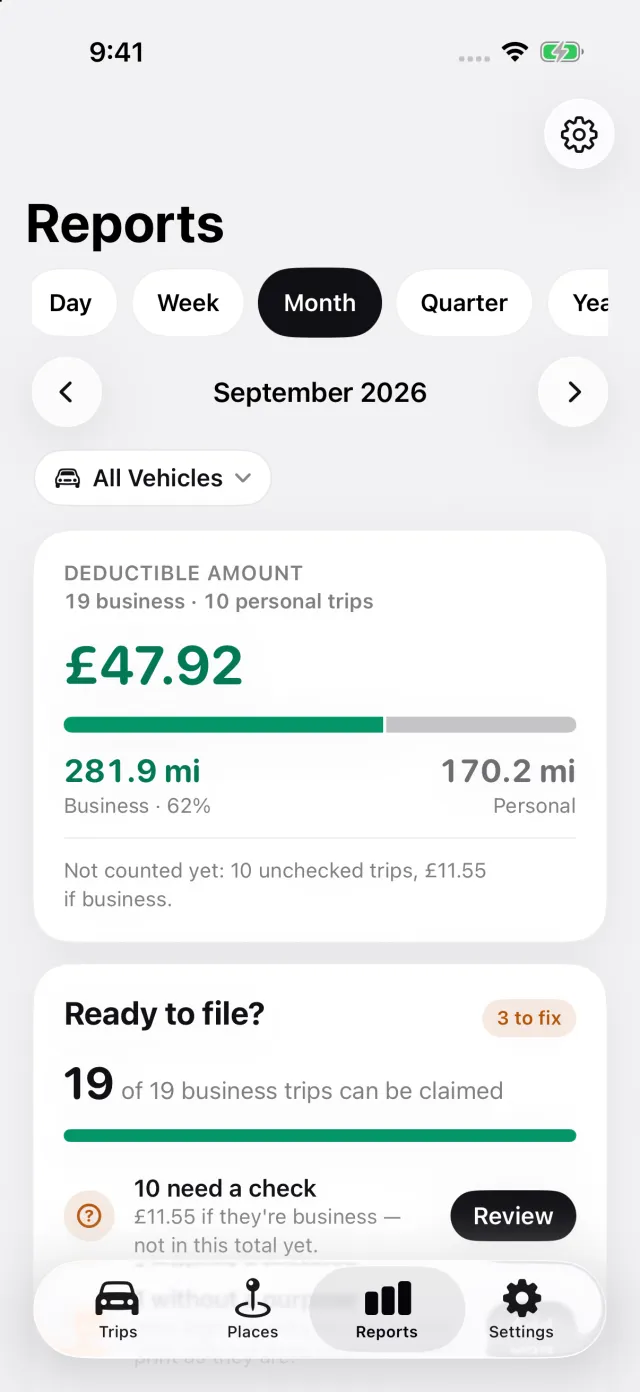
Where DriveHub stops: it doesn't hold your fuel receipts, doesn't split the fuel bill, and files nothing with HMRC. Its AFR figure is what your employer would repay, not what you claim on a P87, which uses the actual fuel cost. It prices each trip at the quarter it falls in and doesn't use the one-month grace. It doesn't decide whether a site is a permanent workplace.
DriveHub is on the App Store for iPhone. The UK rules and rates are on the UK page. Setting up automatic tracking takes a few minutes, once.
This page states what HMRC and the legislation say, and cites them so you can check. It is not tax advice. It can't account for your circumstances. Where money is involved, ask your employer's payroll team or your accountant — and bring the log.
Do it in DriveHub
UK: HMRC fuel rates and Making Tax Digital →
Set the fuel for a company car, read the 10,000-mile tax year and export a quarterly update.
The full rule for United Kingdom, with the instruments it comes from: mileage log requirements in the United Kingdom.