 DriveHub
Country guide · United Kingdom · 9 min
Director mileage allowance: your own car, your own limited company
You run your own limited company and drive your own car for it. A director mileage allowance works like an employee's, because for these rules you are one: the company pays, HMRC's approved amount is the tax-free ceiling, and the company keeps the log.

The short answer
- Can my limited company pay me mileage? Yes. A director is an office-holder, and the employment rules apply to offices. The company is your employer for this.
- How much tax-free? For 2026-27, 55p a mile for the first 10,000 business miles and 25p after. Before 6 April 2026 it was 45p and 25p.
- What is reported? Nothing, as long as the year's payments stay within the approved amount. Anything above it goes on a P11D or through payroll and is taxed.
- National Insurance? A separate test, with no 25p band: the payment is compared with 55p for every business mile, per earnings period.
- Paid less than the approved amount? You can claim Mileage Allowance Relief on the gap, like any employee.
- Simplified expenses? No. A limited company can't use them.
- The commute? Home to your permanent workplace is not business travel, even when you own the company.
- How long does the company keep the records? Six years from the end of the company's financial year, not three.
Why a director counts as an employee here
The 55p rules are written for an "employee". A director is one for these purposes, because a directorship is an office.
ITEPA 2003 s. 5(1): "The provisions of the employment income Parts that are expressed to apply to employments apply equally to offices, unless otherwise indicated." Section 5(2) then reads "employee" as "the office-holder" and "employer" as "the person under whom the office-holder holds office."
HMRC confirms a director holds an office. ESM2503: "For example, a director of a company is an office holder because the Companies Act requires a company to have a board of directors". And ESM2502: "It is not necessary to show, as for an employee, that an office holder works under a contract of service."
So no contract of service with your own company needs to be shown. The mileage sections, ss. 229 to 232, sit in Part 4 of ITEPA, one of the employment income Parts, and nothing in them says otherwise.
Not the sole trader's flat rate
Simplified expenses look similar, at the same 55p, but they belong to the self-employed. HMRC's BIM75001: "Limited companies and partnerships with one or more corporate partners cannot use the rules." If you trade on your own account instead, self-employed mileage covers that route.
If the company provides the car rather than you, none of this applies: see company car and private fuel and company car, your own fuel.
What the company can pay you tax-free
The company sets the rate. HMRC's approved amount is the ceiling on what it pays without tax, not a sum it owes you.
The approved amount is in s. 230: "M×R", your business miles in the tax year times the rate. For a car or van the s. 230(2) table reads "55p for the first 10,000 miles 25p after that". The Taxation (Energy and Vehicles) Act 2026, s. 2 raised 45p to 55p "for the tax year 2026-27 and subsequent tax years". HMRC's policy paper: "The increase is retrospective taking effect from 6 April 2026."
Within that amount, s. 229(1): "No liability to income tax arises in respect of approved mileage allowance payments". The test is the year's total, per kind of vehicle. Section 229(3) approves payments "if, or to the extent that, for a tax year, the total amount of all such payments … does not exceed the approved amount".
Two companies, one band
The 10,000 miles count across "any associated employment" (s. 230(3)). An employment is associated with another where the employer is the same, where one person controls both, or where the employers are associated companies (s. 230(4)). A director of two companies they control has one 10,000-mile band between them, not two.
What gets reported, and what doesn't
Up to the approved amount, nothing. gov.uk's employer guidance, Expenses and benefits: business travel mileage for employees' own vehicles: "You're allowed to pay your employee a certain amount of MAPs each year without having to report them to HMRC. This is called an 'approved amount'."
Above it, the same page: "You must: report on form P11D; add anything above the 'approved amount' to the employee's pay, and deduct and pay tax as normal".
HMRC 480, 16.7 puts both sides in two sentences: "If you pay more than the approved amount, the excess should be returned on form P11D, or payrolled if you've registered to payroll. If you pay the exact amount, do not tell HMRC at all, whether on forms P11D, or otherwise."
Not through salary sacrifice
HMRC 480, 16.16: "From 6 April 2017 where mileage payments are given as part of optional remuneration arrangements, the payments are not exempt from tax and the employee is taxable on the amount of salary or cash paid." Mileage paid in exchange for giving up salary loses the exemption.
National Insurance has its own figure
Class 1 National Insurance doesn't use the 25p band. gov.uk's employer page on mileage for employees' own vehicles sets a "qualifying amount": business miles "in the earning period" times the rate. For cars and vans the table reads "55p from 6 April 2026 (45p before 6 April 2026)", for "Every business mile".
- Paid more than the qualifying amount: "add the excess to their other earnings for that earnings period when calculating Class 1 National Insurance (but not Pay As You Earn (PAYE) tax) through payroll".
- Paid less: "nothing to report; no National Insurance to pay".
- No catching up later: "There's no Mileage Allowance Relief for National Insurance, and you cannot carry forward the difference between RME and the qualifying amount to a later earnings period."
HMRC's EIM31205 warns against mixing the two: "You should not assume that something that is true for one scheme is also true for the other."
Worked examples for 2026-27
This is arithmetic from the statute, not HMRC's own example.
12,000 business miles, the company pays 55p for every mile.
- Paid: 12,000 × 55p = £6,600
- Approved amount: 10,000 × 55p + 2,000 × 25p = £5,500 + £500 = £6,000
- Income tax: £600 is above the approved amount. It goes on a P11D or through payroll, and is taxed.
- National Insurance: the qualifying amount is 12,000 × 55p = £6,600. Nothing is above it, so no Class 1 on the payment, if the miles and the payment fall in the same earnings period.
12,000 business miles, the company pays 55p, then 25p after 10,000.
- Paid: £5,500 + £500 = £6,000, exactly the approved amount.
- Nothing to report for income tax, and nothing for National Insurance: £6,000 is below the £6,600 qualifying amount, again if both fall in the same earnings period.
8,000 business miles, the company pays 45p.
- Paid: 8,000 × 45p = £3,600
- Approved amount: 8,000 × 55p = £4,400
- Mileage Allowance Relief: £4,400 − £3,600 = £800
Paid less than 55p: Mileage Allowance Relief
If the company pays less than the approved amount, or nothing, you are entitled to relief on the difference under s. 231. It is a deduction from your income (s. 232), so it is worth the tax on the gap, not the gap. gov.uk: "If you claim £60 and pay tax at a rate of 20% in that year, the amount you are entitled to is £12 (20% of £60)."
So the £800 above is worth £160 to a 20% taxpayer and £320 to a 40% one. If you file a Self Assessment return, gov.uk says you "must claim through your tax return instead" of the online form or P87. How the claim works, and the four-year limit, are in using your own car for work.
Which miles count
Only business travel. Owning the company doesn't change where the line is drawn. Section 338(2) excludes "the expenses of ordinary commuting", which s. 338(3) defines as travel between "(a) the employee's home and a permanent workplace, or (b) a place that is not a workplace and a permanent workplace."
So the drive from home to the company's office is private. A drive to a client's site can be business; whether a long engagement turns that site into a permanent workplace is in commuting or a temporary workplace.
The company's side: the deduction and the records
The company's deduction for the payments rests on the general rule for trading expenses, not on the mileage sections. CTA 2009 s. 54(1): "In calculating the profits of a trade, no deduction is allowed for— (a) expenses not incurred wholly and exclusively for the purposes of the trade". Section 54(2) allows "any identifiable part or identifiable proportion of the expense" that is.
The record that supports the payment is the mileage log. HMRC 480, 16.15: "employers should make sure that adequate records are kept to demonstrate that payments satisfy the conditions for exemption." And: "Records should relate to miles travelled and not to actual expenses incurred." What each journey's line should show, down to the postcodes, is in postcodes and the 10,000-mile band.
Six years, not three
The Companies Act sets three years for a private company's accounting records (s. 388(4)(a)). The tax rule is longer, and it governs. FA 1998 Sch. 18 para. 21 requires records to be kept until "the sixth anniversary of the end of the period for which the company may be required to deliver a company tax return". They include "all receipts and expenses in the course of the company's activities". That is the company's clock. If you claim Mileage Allowance Relief yourself, your own records follow the employee rule in postcodes and the 10,000-mile band.
gov.uk, Running a limited company: "You must keep records for 6 years from the end of the last company financial year they relate to, or longer if: … you sent your Company Tax Return late; HMRC has started a compliance check into your Company Tax Return". And: "You can be fined £3,000 by HMRC or disqualified as a company director if you do not keep accounting records."
Before the company pays you
- The miles are business travel: no home-to-office drives.
- The year's payments are compared with 55p for the first 10,000 miles and 25p after, across all associated companies.
- Anything above the approved amount goes on a P11D or through payroll.
- For National Insurance, each earnings period's payment is compared with 55p for every business mile in it.
- The log is kept with the company's records for six years from the end of the financial year.
How DriveHub makes this easier
The payment is only as good as the log behind it, and in a one-person company you are the one who has to keep it.
With location access set to Always, DriveHub records every drive in the background — and if it ever misses one, it tells you. Each trip keeps its date, both ends and the distance. DriveHub files most trips as Business or Personal by your places, past routes and working hours, and asks you about the rest. When a drive between home and the company's office waits under Need to check, answer Commute, and it stays out of the business total.
Reports shows business and personal miles for any month, quarter or year, or a range you choose, such as the company's accounting period. You can pick one vehicle or all. For the 10,000-mile band and Mileage Allowance Relief, use the tax year, 6 April to 5 April.
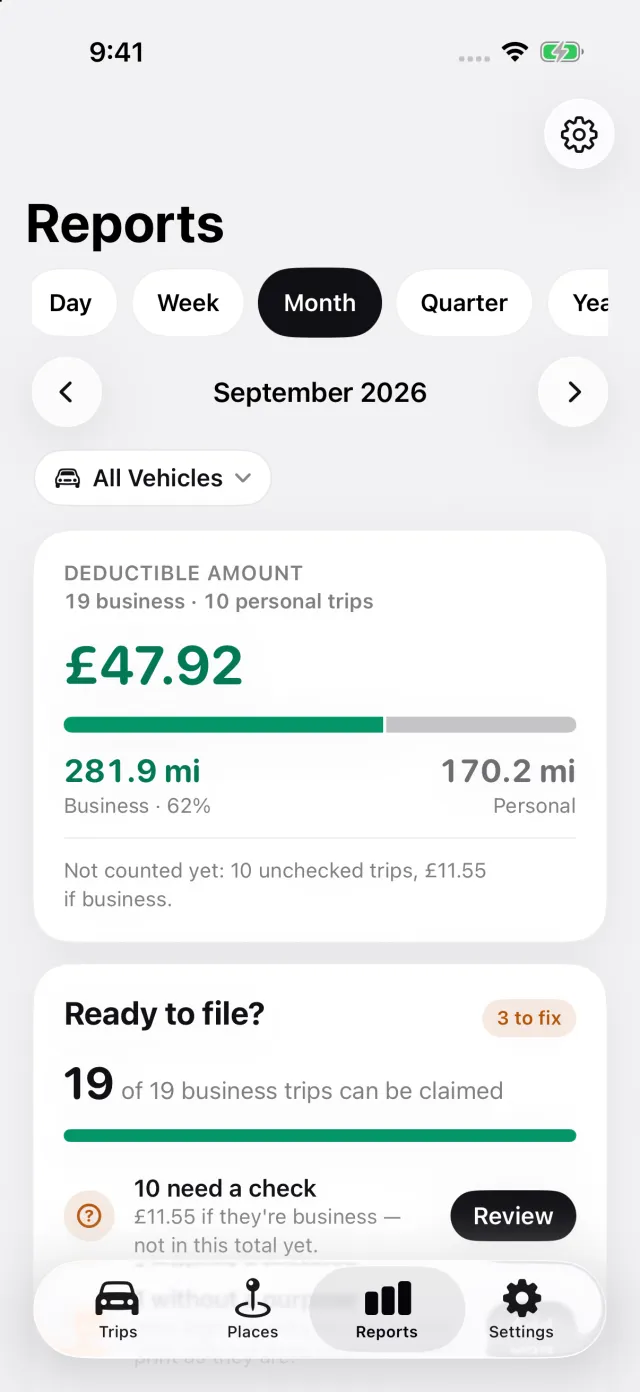
The report prints the date, both addresses, the distance and your reason for each journey. In Settings, choose Employed, reimbursed for my own car, then add your company as the employer, with what it pays per mile. The report counts the 10,000-mile band per employment, and where the company pays less than HMRC's banded approved amount, it prints the Mileage Allowance Relief. With Pro, it exports as PDF, Excel or CSV for your accountant.
Where DriveHub stops: it files nothing with HMRC and runs no payroll, P11D or National Insurance figures. A drive it didn't record and can't recover, because the phone was off, flat or in Airplane Mode, stays out of the report until you add it by hand. It doesn't know whether two of your companies are associated; if they are, add them as one employer, so they share one 10,000-mile band. It doesn't decide whether a site is a permanent workplace.
DriveHub is on the App Store for iPhone. The UK rules it follows are on the UK page, and setting up automatic tracking takes a few minutes, once.
This page states what HMRC and the legislation say, and cites them so you can check. It is not tax advice. It can't account for your circumstances. Where money is involved, ask your accountant — and bring the log.
Do it in DriveHub
UK: HMRC fuel rates and Making Tax Digital →
Set the fuel for a company car, read the 10,000-mile tax year and export a quarterly update.
The full rule for United Kingdom, with the instruments it comes from: mileage log requirements in the United Kingdom.