 DriveHub
Country guide · United Kingdom · 9 min
Electric car mileage: 55p in your own, 7p or 15p in a company car
You drive an electric car for work. The electric car mileage rate in the UK isn't one figure: in your own EV it's the same 55p a mile as any car, and in a company EV it's HMRC's Advisory Electricity Rate, 7p a mile for home charging or 15p for public charging. Who owns the car decides which.

The short answer
- Your own electric car? The approved rate is 55p a mile for the first 10,000 business miles in 2026-27, and 25p after. The same rate as a petrol or diesel car.
- Can I claim the electricity on top? No. The 55p already covers it.
- A company electric car? HMRC's Advisory Electricity Rate: from 1 September 2026, 7p a mile for home charging and 15p for public charging.
- What is the 15p built from? The average price at public chargers slower than 50 kilowatts. HMRC says nothing more about rapid chargers, but allows a higher rate where you can show a higher cost per mile.
- Charged at both? The miles can be split by how much charging happened at each place. The split has to be "fair and reasonable".
- Plug-in hybrid? In your own car, 55p like any car. In a company car it takes the petrol or diesel advisory rate, not 7p or 15p.
- Charging at work? Tax-free under ITEPA s. 237A, own car or company car, if the chargers are open to all staff at that workplace. Charging at home isn't covered by that exemption.
- Private miles in a company EV? No fuel benefit, so nothing to repay for tax.
- When do the rates change? The electricity rates are reviewed every quarter; the next review is 1 December 2026. The 55p is under review at the 28 October 2026 Budget.
The fuel doesn't pick the rate, the owner does
For mileage, an electric car isn't a category of its own. What decides the rate is whether the car is yours or your employer's:
| Your car | The rate | Where it comes from |
|---|---|---|
| Your own electric car | 55p a mile to 10,000 miles, then 25p | ITEPA 2003 s. 230(2), Approved Mileage Allowance Payments |
| Company electric car, charged at home | 7p a mile | HMRC's Advisory Electricity Rate |
| Company electric car, charged in public | 15p a mile | HMRC's Advisory Electricity Rate |
| Company plug-in hybrid | the petrol or diesel line | HMRC's Advisory Fuel Rates |
The two schemes don't mix. The 55p is for your own vehicle only; the advisory rates are for company cars only.
Your own electric car: 55p a mile, like any car
HMRC's guide for employers, 480 chapter 16, names electric cars outright. At 16.2: "Employees using their own cars, vans (including electric cars and vans), motorcycles or cycles for business travel can get a tax-free amount". At 16.5 the rate applies to "cars or vans (including hybrid and electric cars or vans)".
The statute has no fuel test: ITEPA 2003 s. 235(2) defines a car as "a mechanically propelled road vehicle" that isn't a goods vehicle, a motorcycle or a type not commonly used privately. So the approved rate in s. 230(2) applies: 55p for the first 10,000 business miles and 25p after, from 6 April 2026. Until 5 April 2026 it was 45p and 25p.
The 55p already includes the electricity
gov.uk, on vehicles you use for work: the approved rate "covers the cost of owning and running your vehicle. You cannot claim separately for things like: fuel; electricity; vehicle tax; MOTs; repairs".
So there is no second claim for what you spent charging, whether you charged at home or at a rapid charger: the 55p is the whole of it.
If your employer pays you for the charging
Some employers pay for the charging rather than 55p. HMRC's manual, EIM23900: "If by reference to mileage, AMAP rules apply for business miles travelled. Any amounts in excess of AMAP rates would be taxable. If less than AMAPs rates, employee may claim appropriate amount of tax relief under MAR for business miles. If a flat-rate amount is paid it is taxed as earnings".
A worked example: paid 7p a mile in your own EV
This is arithmetic, not a rule. Your employer pays you 7p a mile for business trips in your own electric car, because that's what the charging cost. In 2026-27 you drive 4,000 business miles.
- Approved amount: 4,000 × 55p = £2,200
- Paid: 4,000 × 7p = £280
- Mileage Allowance Relief: £2,200 − £280 = £1,920
The relief is a deduction from your taxable pay, so it's worth the tax on £1,920: £384 at 20% and £768 at 40%. The 7p belongs to company cars; in your own car, HMRC compares what you were paid with 55p. How to claim it, and the four-year window, is in using your own car for work.
A company electric car: the Advisory Electricity Rate
If your employer provides the car and you charge it, your employer can reimburse your business miles per mile. HMRC's pages call this the Advisory Electricity Rate or the advisory electric rates (AER); they're the same figures. HMRC's Advisory fuel rates page (updated 21 August 2026):
"From 1 September 2026 the advisory electric rates for fully electric cars will be: 7 pence per mile for home charging; 15 pence per mile for public charging".
The same page lists the electric rates before that:
| From | Home charging | Public charging |
|---|---|---|
| 1 September 2026 | 7p | 15p |
| 1 June 2026 | 7p | 15p |
| 1 March 2026 | 7p | 15p |
| 1 December 2025 | 7p | 14p |
| 1 September 2025 | 8p | 14p |
1 September 2025 was the first quarter with a separate public rate.
These rates are for company cars only. The page: "These rates only apply to employees using a company car." The 55p isn't available in a company car either, so there's no gap to claim between 15p and 55p. Why, and how the same page works for petrol and diesel, is in company car, your own fuel.
What "public charging" means
The page defines the public figure by charging speed. It "is updated to reflect the average price of public charging using slow or fast chargers (charging speed less than 50 kilowatts)".
So rapid chargers, 50 kW and over, aren't in the price the 15p is built from, and the page says nothing more about them. It does allow a higher rate where the cost is higher: "if the public charger used is higher in cost per mile than the new advisory rate introduced for public charging, a higher rate can be used as long as you can show the cost per mile is higher."
"Home charging" isn't defined beyond "residential locations" and the domestic electricity price.
Charged at home and in public: splitting the miles
For a company EV charged in both places, the page says:
"For journeys where a company car is charged at both public and residential locations, you can apportion the mileage based on how much charging happens at each place. The apportionment calculation should be fair and reasonable."
HMRC prescribes no formula beyond that. Worked example, one reading and not HMRC's method: between 1 September and 30 November 2026 you drive 1,600 business miles in a company EV. About three quarters of the charging was at home and a quarter at public chargers under 50 kW.
- Home share: 1,200 × 7p = £84
- Public share: 400 × 15p = £60
- Reimbursement for the quarter: £144
Plug-in hybrids aren't electric here
The same page: "Hybrid cars are treated as either petrol or diesel cars for advisory fuel rates." A company plug-in hybrid takes the petrol or diesel line for its engine size, not 7p or 15p. The petrol and diesel table is in company car and private fuel.
In your own car, a hybrid is simply a car: 55p, as above.
The rate moves every quarter
The page: "HMRC reviews rates quarterly on: 1 March; 1 June; 1 September; 1 December". And "You can use the previous rates for up to 1 month from the date any new rates apply."
So the next review is 1 December 2026. One reading, not HMRC's words: since the page lets you use the previous rates for a month after a change, each business mile is priced at the rate for the period it was driven in, or the previous rate during that month. A year of company-EV miles may then need splitting by quarter, not one annual total.
When your employer pays the electricity instead
Your employer reimburses what the charging cost. "The exemption under s.239(2) ITEPA 2003 means there is no separate charge to tax under the benefits code when an employer reimburses an employee for the cost of electricity to charge their company car at home or at a public charging point." The condition: "Employers will need to ensure that the reimbursement made towards the cost of the electricity is solely for the company car".
A home charge point paid for by your employer, for a company car: "No taxable benefit because of section 239(4) ITEPA 2003". Solar panels or a home battery are different: "Taxable benefit based on the cost to the employer".
Your employer pays nothing for charging. "If business use only or mixed use, employee is entitled to section 337/338 ITEPA 2003 deduction for electricity cost of business miles travelled". That claim uses what the electricity actually cost, not 7p or 15p. HMRC's P87 notes for company vehicles: "you must use your actual fuel costs, not any set mileage rates published by us or any other organisation." How that claim is made, and what it's worth, is in company car, your own fuel.
Private miles in a company EV: no fuel benefit
A fully electric company car brings no fuel benefit charge. ITEPA 2003 s. 149(4): "References in this section to fuel do not include any facility or means for supplying electrical energy or any energy for a car which cannot in any circumstances emit CO2 by being driven."
So there's no private-mile repayment to make for tax. Your employer may still ask for one, and EIM23900 names the rate: "If an employer decides that an employee should repay the cost of electricity for their private mileage, they may wish to use the Advisory Electric Rates (AER's)".
Charging at work is tax-free, charging at home isn't covered
ITEPA 2003 s. 237A(1): "No liability to income tax arises in respect of the provision, at or near an employee's workplace, of facilities for charging a battery of a vehicle used by the employee". Under s. 237A(2), the exemption applies "only if the facilities are made available generally to the employer's employees at that workplace".
It covers a vehicle "used by the employee", so your own EV as well as a company one. HMRC's manual, EIM01035, draws the line at home: "The exemption does not apply where the charging facilities are at the employee's home."
For a company car, EIM23900 finds no benefit in workplace charging at all: "electricity does not sit within the meaning of fuel so the Fuel Benefit Charge does not apply".
Which miles count, in either car
Business miles only. The drive between home and your permanent workplace is ordinary commuting under s. 338(3), whichever car you drive. In your own EV those miles never enter the 55p claim; in a company EV they aren't reimbursed at 7p or 15p. Travel to a temporary workplace is business travel; when a site stops being temporary is in commuting or a temporary workplace.
If you run your own limited company and drive your own EV, the company is your employer for these rules. The 55p applies the same way; see paying yourself mileage from your own company.
Keep the log
For both cars, HMRC's guide 490 asks employees to keep "mileage details where they use a car (either their own or a company car) for business journeys". What each journey needs, and how long to keep it, is in postcodes and the 10,000-mile band.
Before you claim or reimburse
- Whose car is it? Your own EV: 55p and 25p. A company EV: 7p or 15p.
- Your own EV paid less than 55p, even at an electricity rate? The gap is Mileage Allowance Relief.
- A company plug-in hybrid: the petrol or diesel line, not the electric one.
- Home and public split "fair and reasonable"; the 15p is priced on chargers under 50 kW.
- Each company-EV mile at the rate for its quarter (a reading of the page's one-month grace, not an HMRC rule).
- No home-to-office miles in either claim.
How DriveHub makes this easier
Every figure on this page is business miles times a rate, and the miles come from the log.
With location access set to Always, DriveHub records every drive in the background — and if it ever misses one, it tells you. DriveHub files most trips as Business or Personal by your places, past routes and working hours, and asks you about the rest under Need to check. For a drive between home and your office, answer Commute: it stays out of the business total.
Reports shows business and personal miles for any period or a range you choose, for one vehicle or all. For your own EV in the UK, the report prices business miles at HMRC's approved rate. Where you enter what your employer pays per mile, it prints the Mileage Allowance Relief.
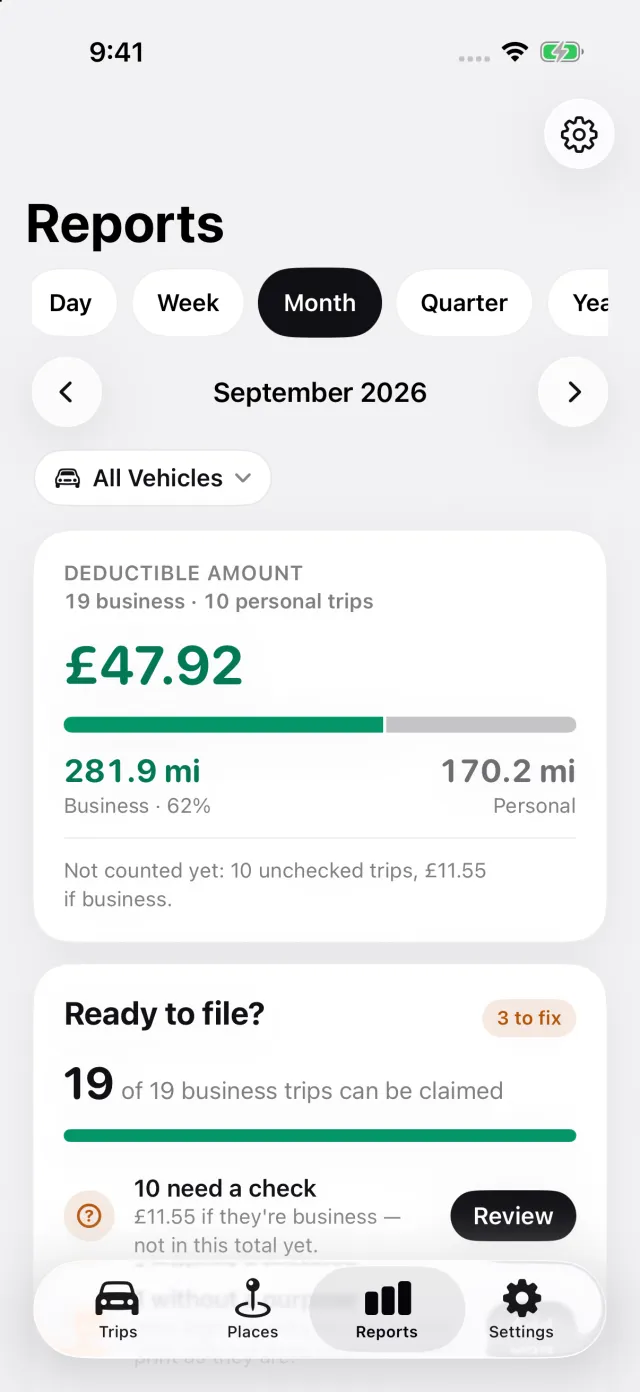
For a company EV, set on the car whether it's charged at home or in public, and DriveHub prices each trip at HMRC's advisory electric rate for the quarter it was driven in. Where DriveHub stops: it takes that one answer per car, home or public charging, and applies it to every trip. So the home and public split is yours to make. It doesn't use the one-month grace for previous rates. It files nothing with HMRC, and it doesn't decide whether a site is a permanent workplace.
DriveHub is on the App Store for iPhone. The UK rules and rates are on the UK page. Setting up automatic tracking takes a few minutes, once.
This page states what HMRC and the legislation say, and cites them so you can check. It is not tax advice. It can't account for your circumstances. Where money is involved, ask your employer's payroll team or your accountant — and bring the log.
Do it in DriveHub
UK: HMRC fuel rates and Making Tax Digital →
Set the fuel for a company car, read the 10,000-mile tax year and export a quarterly update.
The full rule for United Kingdom, with the instruments it comes from: mileage log requirements in the United Kingdom.