 DriveHub
Country guide · Germany · 7 min
Fahrtenbuch im Außendienst: thirty customers a day, and what you may leave out
You drive a company car from customer to customer, and a full Fahrtenbuch line for every stop would take longer than the visit. For the Fahrtenbuch im Außendienst, the tax administration has Erleichterungen made for exactly this job. They drop the route and the distances between stops, unless a detour is large. They do not drop the customers, and they do not drop the odometer.

The short answer
Yes, there are Erleichterungen for the Fahrtenbuch im Außendienst, and they are narrower than people hope. They sit in the BMF letter of 3 March 2022, Rz. 30, not in the Lohnsteuer-Richtlinien. For drivers with "täglich wechselnden Auswärtstätigkeiten" the letter names five jobs: Automatenlieferanten, Kurierdienstfahrer, Handelsvertreter, Kundendienstmonteure and Pflegedienstmitarbeiter.
- What you may leave out: the route, and the distances between the stops of a round. Both are needed only where the direct distance and the distance actually driven differ by a larger amount.
- What is enough instead: stating which customers you visit, at which place.
- What stays: the odometer reading at the start and end of each Auswärtstätigkeit, and a logbook kept continuously and promptly as one closed chain, private trips included. The customers must be in the logbook itself, not in a calendar beside it.
The self-employed have similar reliefs in their own letter, BMF 18 November 2009, Rz. 24–28, plus one more: a numbered customer register for regular delivery rounds, which the employee letter does not have. If an employee's logbook fails anyway, private use falls back to the 1% rule for the whole year.
What the full logbook asks for
The starting point is R 8.1 Abs. 9 Nr. 2 Satz 3 LStR. For business trips it asks, "i. d. R." — as a rule — for: "Datum und Kilometerstand zu Beginn und am Ende jeder einzelnen Auswärtstätigkeit, Reiseziel und bei Umwegen auch die Reiseroute, Reisezweck und aufgesuchte Geschäftspartner."
For a sales rep with eight appointments, that is manageable. For a service technician, a courier or a care worker with twenty or thirty stops, it is not. The BMF letter says which of these details may be left out, and when. Note the unit of the odometer rule: the reading is taken "zu Beginn und am Ende jeder einzelnen Auswärtstätigkeit". The full field list, private trips and the commute are covered in Fahrtenbuch or the 1% rule. Driving your own car on business rather than a company car is a separate question: see a Dienstreise in your own car.
The Erleichterungen in BMF Rz. 30, word for word
The reliefs are not in the guideline or in its official hints: H 8.1 (9-10) LStH has no list of Erleichterungen and points to the BMF letter. BMF, 3 March 2022 – IV C 5 - S 2334/21/10004 :001, Rz. 30, opens with what a logbook is for:
"Ein Fahrtenbuch soll die Zuordnung von Fahrten zur betrieblichen und beruflichen Sphäre darstellen und ermöglichen. Es muss laufend geführt werden und die berufliche Veranlassung plausibel erscheinen lassen und ggf. eine stichprobenartige Nachprüfung ermöglichen."
Then the general rule:
"Auf einzelne in R 8.1 Absatz 9 Nummer 2 LStR geforderte Angaben kann verzichtet werden, soweit wegen der besonderen Umstände im Einzelfall die erforderliche Aussagekraft und Überprüfungsmöglichkeit nicht beeinträchtigt wird."
Then the field-service case:
"Bei Automatenlieferanten, Kurierdienstfahrern, Handelsvertretern, Kundendienstmonteuren und Pflegedienstmitarbeitern mit täglich wechselnden Auswärtstätigkeiten reicht es z. B. aus, wenn sie angeben, welche Kunden sie an welchem Ort aufsuchen. Angaben über die Reiseroute und zu den Entfernungen zwischen den Stationen einer Auswärtstätigkeit sind nur bei größerer Differenz zwischen direkter Entfernung und tatsächlicher Fahrtstrecke erforderlich."
The paragraph goes on with separate reliefs for taxi drivers in their Pflichtfahrgebiet, for driving instructors' "Lehrfahrten" and "Fahrschulfahrten", and for persons under a security threat.
Reading Rz. 30 closely
The list of jobs is not the only door. The named jobs are the letter's worked case. The sentence before them is general: single details may be left out "soweit wegen der besonderen Umstände im Einzelfall die erforderliche Aussagekraft und Überprüfungsmöglichkeit nicht beeinträchtigt wird". For the named jobs, the condition is "täglich wechselnden Auswärtstätigkeiten". A job outside the list would have to meet the general sentence, case by case.
The test is whether the Finanzamt can still check you. The letter wants the business purpose to look plausible and a spot check to be possible. A line such as "Heizungswartung, Schmidt, Kassel-Wilhelmshöhe" lets someone ring Schmidt. "Kunden Nordhessen" does not.
What it drops is the route, not the stops and not the readings. The letter speaks of "den Stationen einer Auswärtstätigkeit": a round of visits with several stations. Who you saw and where stays in, and so do the odometer readings. How you drove between them may go, unless the actual distance is well above the direct one. The letter sets no figure for a "größere Differenz". A detour that adds noticeably to the day is safer written down.
The seven days are a different rule. For a logbook that captures trips automatically, Rz. 29 accepts the purpose and the business partner as prompt if they are entered within up to seven calendar days. Rz. 30 changes what you write, not when. What a late entry can and cannot fix is in a Fahrtenbuch written afterwards.
What the reliefs do not change
One closed chain, private trips included. R 8.1 Abs. 9 Nr. 2 Satz 2 LStR still wants business and private kilometres recorded "gesondert und laufend". H 8.1 (9-10) LStH, citing BFH 9 November 2005 – VI R 27/05, still wants the logbook "zeitnah und in geschlossener Form", with every trip and the total odometer at its end. Nothing in Rz. 30 lifts that.
A private stop in the middle of a round. H 8.1 (9-10): "Der Übergang von der beruflichen zur privaten Nutzung des Fahrzeugs ist im Fahrtenbuch durch Angabe des bei Abschluss der beruflichen Fahrt erreichten Gesamtkilometerstands zu dokumentieren." Collecting your children on the way back is a new line with an odometer reading.
No representative period. Satz 5: the logbook "kann nicht auf einen repräsentativen Zeitraum beschränkt werden, selbst wenn die Nutzungsverhältnisse keinen größeren Schwankungen unterliegen". Field staff whose weeks look alike still keep the whole year.
The odometer readings. Rz. 30 lets the customer and the place stand in for destination, purpose and business partner, and relieves only the route and the distances between the stations. It says nothing about the readings, so R 8.1 still wants them at the start and end of each Auswärtstätigkeit.
The customers belong in the logbook, not in the calendar
The Federal Fiscal Court decided a field-service case on exactly this point. In BFH, 13 November 2012 – VI R 3/12, a handwritten logbook marked business trips only "Außendienst", with "siehe Anlage". The customers were in a printout of the employer's electronic calendar. The Finanzgericht had accepted the logbook; the BFH reversed it. The Leitsatz:
"Die Ausgangs- und Endpunkte der jeweiligen Fahrten und die jeweils aufgesuchten Kunden und Geschäftspartner gehören zu den unverzichtbaren Angaben, die im Fahrtenbuch selbst zu machen sind. Die erforderlichen Mindestangaben können nicht durch anderweitige nicht im Fahrtenbuch selbst enthaltene Auflistungen ersetzt werden."
The reasons add: "Entsprechendes gilt für vom Arbeitgeber erstellte Listen und Ausdrucke des Terminkalenders." Put that beside Rz. 30, and the line is plain. The relief lets you write less about the drive. It never lets the customers move out of the logbook into the route planner, the dispatch system or the CRM.
A worked day
Illustrative figures, not taken from any rule. A Kundendienstmonteur leaves on Monday 5 October 2026 and visits customers in four places. On the way home he stops privately. He takes an odometer reading at every stop, so each line has its own start and end.
| Date | Odometer start | Odometer end | Business / private | Purpose, customer and place |
|---|---|---|---|---|
| 05.10.2026 | 48,210 | 48,238 | Business | Heizungswartung, Schmidt, Kassel-Wilhelmshöhe |
| 05.10.2026 | 48,238 | 48,259 | Business | Störung Ofen, Bäckerei Krause, Baunatal |
| 05.10.2026 | 48,259 | 48,263 | Business | Wartung Klimagerät, Praxis Dr. Yilmaz, Baunatal |
| 05.10.2026 | 48,263 | 48,291 | Business | Ersatzteil eingebaut, Autohaus Weber, Vellmar |
| 05.10.2026 | 48,291 | 48,309 | Business | Rückfahrt |
| 05.10.2026 | 48,309 | 48,324 | Private | — |
The business part is 28 + 21 + 4 + 28 + 18 = 48,309 − 48,210 = 99 km; the private leg is 48,324 − 48,309 = 15 km. The reading of 48,309 at the end of the business part is the transition H 8.1 asks for. What Rz. 30 saves him is the route: no streets between Kassel, Baunatal and Vellmar, because the round had no larger detour. If it had — say a part fetched from a depot far off the direct line — that leg would get its route.
Why not one pair of readings for the whole round? The texts expressly allow one pair for many stops in only two cases. Taxi drivers in their Pflichtfahrgebiet may give the reading "täglich zu Beginn und Ende der Gesamtheit dieser Fahrten". And BMF 18 November 2009 Rz. 28 lets regular delivery rounds to the same customers record date and odometer "jeweils zu Beginn und Ende der Lieferfahrten", plus the customers' numbers. The condition: each customer is kept with name and (delivery) address under a number in a Kundenverzeichnis, and that register is attached to the logbook. The register relief is in the letter for business-owned cars only; the employee letter's Rz. 30 has no such sentence.
For an ordinary service or sales round, no rule expressly allows one pair for the whole day, and no BFH decision on the point was found either way. What the employee texts do say is readings at the start and end of each Auswärtstätigkeit, its stations listed, only their distances relieved. A reading at each stop, as above, leaves nothing to argue about. A private stop always needs its own reading.
If you are self-employed
The employee letter has a counterpart for business owners. BMF, 18 November 2009 (as amended in 2012) sets the minimum content and the reliefs in Rz. 24–28. Its minimum content is counted per trip: "Datum und Kilometerstand zu Beginn und Ende jeder einzelnen betrieblich/beruflich veranlassten Fahrt". Rz. 25 gives the same relief as Rz. 30 to Handelsvertreter, Kurierdienstfahrer, Automatenlieferanten and others who regularly cover long distances with several destinations. They state "welche Kunden an welchem Ort besucht wurden", and the distances only where the difference is larger.
Rz. 26 and 27 cover taxi drivers and driving instructors. Rz. 28 is the numbered customer register for regular delivery rounds described above — with the taxi relief, one of only two that also relieve the odometer, and only for those rounds. For private trips, "genügen jeweils Kilometerangaben" (Rz. 29). If the logbook is not accepted and business use is over 50%, private use is valued by the 1% rule (Rz. 30 of that letter).
What it costs if the logbook fails
The Finanzamt does not strike out the doubtful days. It reverts to the 1% / 0.03% method, and a break in the chain invalidates the logbook for the entire year. Other records cannot rescue it — H 8.1 (9-10) LStH, in line with BFH 16 November 2005 – VI R 64/04: "Eine Schätzung des Privatanteils anhand anderer Aufzeichnungen kommt nicht in Betracht." The arithmetic of that fallback is in the article on the 1% rule linked above.
The relief from the other direction: "Kleinere Mängel führen nicht zur Verwerfung des Fahrtenbuchs, wenn die Angaben insgesamt plausibel sind" (H 8.1 (9-10), citing BFH 10 April 2008 – VI R 38/06). Whatever form you keep, keep it for ten years.
How DriveHub fits a day of thirty stops
The reliefs shorten what you write. They do not shorten what you drive, and a day with thirty stops has thirty chances for one to go missing.
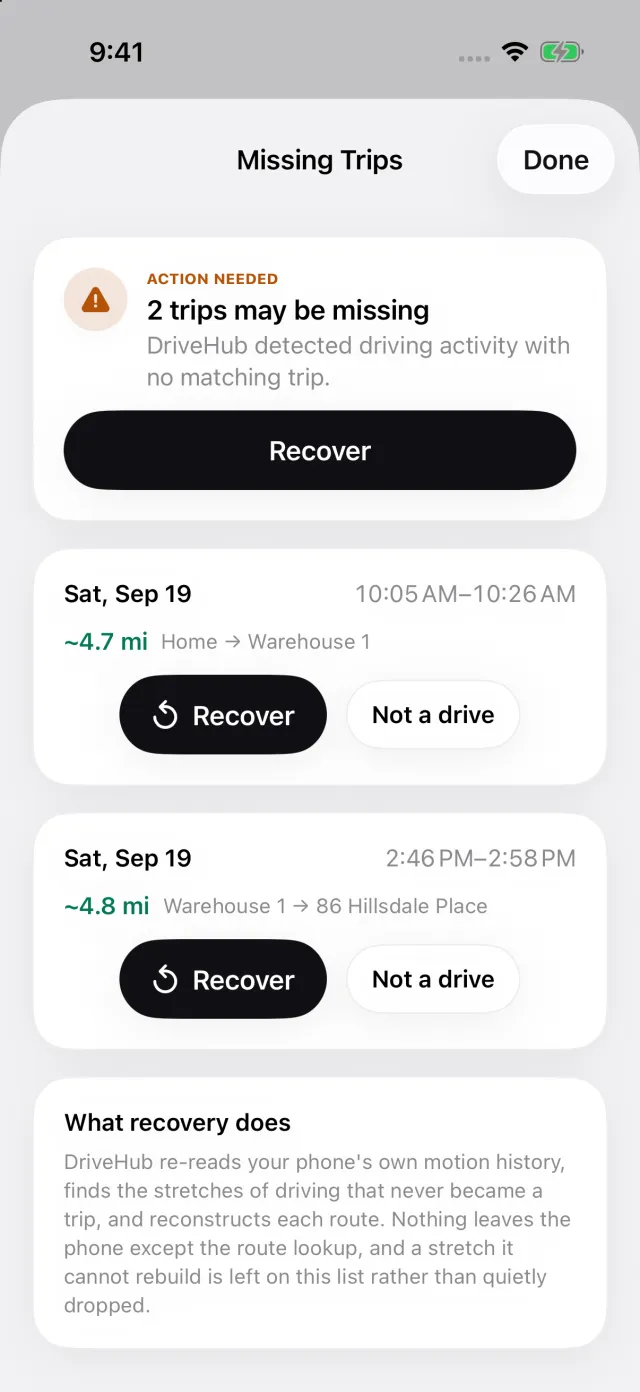
With location access set to Always, DriveHub records every drive in the background — and if it ever misses one, it tells you. Business and private drives are recorded alike, so the private leg home is in the chain too. DriveHub files most trips as Business or Personal by your places, past routes and working hours, and asks you about the rest. If your iPhone logged driving with no matching trip, Missing Trips lists it, and Recover rebuilds the route.
Each drive is its own trip, so every stop gets its own line on the report. It prints the odometer at the start and end of each trip — figures from your own readings, with carried-forward ones marked ≈ — and the business partner you visited. Give a regular customer's place its client once, and later visits print that name. Every later change to a trip is printed on the report itself. DriveHub can ask you for the car's real odometer reading on a schedule you set, and the report compares those readings with the recorded distance.
What stays yours. Write the purpose as a reason — "Heizungswartung, Schmidt" — not just "business", and within the seven days. Whether your logbook is ordnungsgemäß is the Finanzamt's decision, for your logbook. No app is approved in advance; see which Fahrtenbuch app the Finanzamt accepts.
DriveHub is on the App Store for iPhone. Germany's other Fahrtenbuch rules are on the Germany page. Setting up automatic tracking takes a few minutes, once.
Sources
- R 8.1 Abs. 9 Nr. 2 Sätze 2–5 LStR; H 8.1 (9-10) LStH — Amtliches Lohnsteuer-Handbuch 2026.
- BMF-Schreiben vom 3. März 2022 – IV C 5 - S 2334/21/10004 :001, Rz. 29 and 30 (LStH 2026 Anhang 24 IV.1).
- BMF-Schreiben vom 18. November 2009 – IV C 6 – S 2177/07/10004, Rz. 24–30.
- BFH, 13 November 2012 – VI R 3/12; BFH, 10 April 2008 – VI R 38/06; BFH, 9 November 2005 – VI R 27/05; BFH, 16 November 2005 – VI R 64/04.
This page states what the Lohnsteuer-Richtlinien, the BMF letters and the Bundesfinanzhof say, and cites them so you can check. It is not tax advice. It can't account for your circumstances. Where the money matters, ask your Steuerberater — and bring the logbook.
Do it in DriveHub
Add your document identity and review which fields appear in the PDF.
The full rule for Germany, with the instruments it comes from: mileage log requirements in Germany.